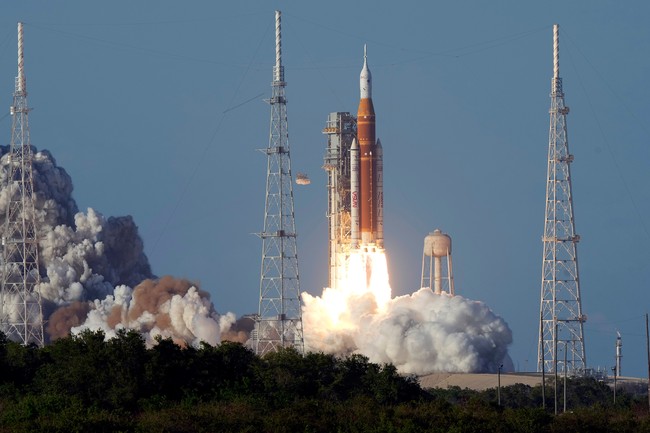

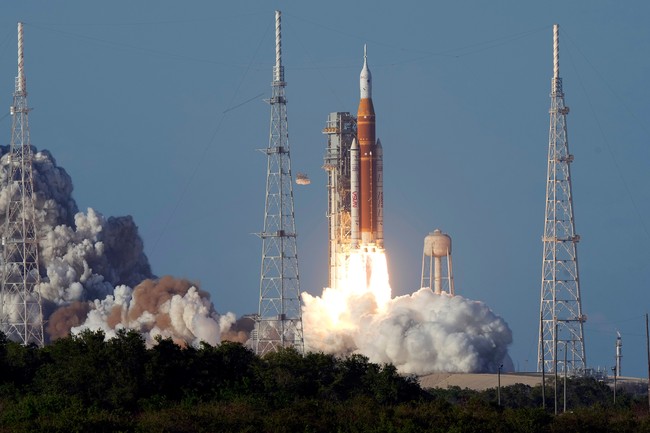
After the successful liftoff yesterday, the plan was for the crew to spend the day circling the earth twice and testing out the spacecraft to make certain everything was working properly for the moon mission. If there had been a serious problem, the mission to the moon could have been aborted. But as of now it looks like everything is go for what NASA calls the translunar injection burn. That’s the firing of the spacecraft’s engine to direct it out of earth orbit toward the moon.
NASA’s Artemis II mission management team polled “Go” for the translunar injection burn to send the crew in the Orion spacecraft toward the Moon and send humans around Earth’s closest celestial neighbor for the first time since Apollo 17 in 1972.
The spacecraft will ignite its main engine on the service module for five minutes and 49 seconds beginning at 7:49 p.m. EDT.
Orion’s main engine provides up to 6,000 pounds of thrust, enough to accelerate a car from 0 to 60 mph in about 2.7 seconds.
That burn should be complete by the time this post goes up. Earlier, the ship carried out another burn called the perigee raise burn.
After a brief rest period, the crew was awakened to monitor the Orion spacecraft’s systems through the burn. The ground team woke them at 7:06 a.m. EDT with the song “Sleepyhead” by Young and Sick.
The spacecraft ignited its service module’s main engine for 43 seconds, raising the lowest point of its orbit and refining the trajectory as it continues to circle Earth. This critical burn placed Orion, named Integrity by the Artemis II crew, into a stable high Earth orbit that aligns with its path to the Moon. The crew members will now move back into their rest period for another four and a half hours before they are again awakened to start their first full day in space.
So what else have the astronauts been up to today? A surprising number of things. First there was a problem with the toilet which needed some repair.
The Artemis II crew, working closely with mission control in Houston, were able to restore the Orion spacecraft’s toilet to normal operations following the proximity operations demonstration.
Ahead of the apogee raise burn on April 1, the Artemis II crew reported a blinking fault light and mission control teams successfully assessed the data and worked with the crew to troubleshoot and resolve the issue.
NASA sent $30 million on this toilet making space the only place where installing a toilet is more expensive than in San Francisco. Naturally, the toilet repairs led to some funny memes.
— Line Doggie (@DoggieLine) April 2, 2026
And jokes.
BREAKING: THE TOILET IS FIXED.
Artemis II’s crew WILL boldly Go where nobody has Gone before https://t.co/KPg2xRzgQm
— Ryan Caton (@dpoddolphinpro) April 2, 2026
There is a space toilet on the International Space Station but this will be the first time anyone near the moon has used one.
I’ve been listening to the live feed from NASA in the background and there were a bunch of other activities taking place. For instance, the astronauts have a couple of GoPro cameras on board but one of them seems to have a problem that causes settings to be lost when it reboots. Ground control told the astronauts to store the camera giving them trouble and try using the backup.
Also, the astronauts spent some time assembling some kind of exercise bike that they will use to stay in shape during the next 10 days as they go to the moon and back. One of the astronauts gave it a try and said it gave him a good workout.
The ship just made an adjustment to its orientation in preparation for the translunar injection burn. Again, that should be over by the time this story goes up but you can probably scroll back a bit in this video to see it. If that doesn’t work, someone will clip it and I’ll post it below.
Translunar injection (TLI): ESA’s service module will provide the last push needed to send Orion on a trip of about four days to and around the Moon.
It will last about 6 minutes. Watch the live coverage, followed by a mission status briefing from NASA: https://t.co/s6DDBeMqor
— Canadian Space Agency (@csa_asc) April 2, 2026
Update: Orion is on its way to the moon after a successful burn. If you want to track Orion in real time, NASA has a website where you can do that. It’s running a bit slow at the moment, likely because so many people are using it. As I write this the spacecraft is already over 2,500 miles from earth and moving fast at over 19,000 mph.
Editor’s Note: Do you enjoy Hot Air’s conservative reporting that takes on the radical left and woke media? Support our work so that we can continue to bring you the truth.
Join Hot Air VIP and use promo code FIGHT to receive 60% off your membership.