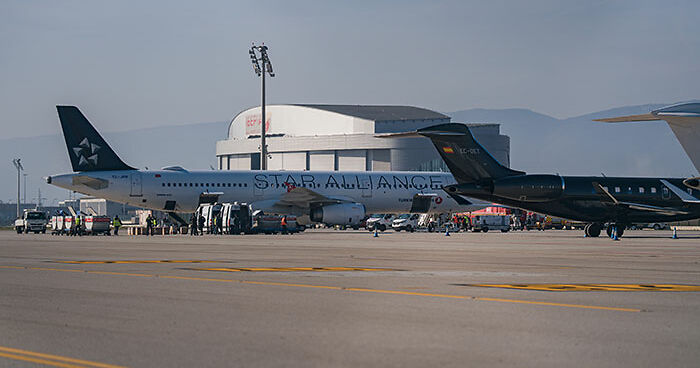

Panic ensued aboard a Turkish Airlines flight after officials suspected the presence of explosives on the aircraft.
A passenger onboard managed to use the WiFi hotspot and convince authorities that there was a serious threat on the plane, triggering an emergency alert.b
NATO fighter jets scrambled to escort the flight to its destination.
Panic ensued aboard a Turkish Airlines flight after officials believed there were explosives on the aircraft
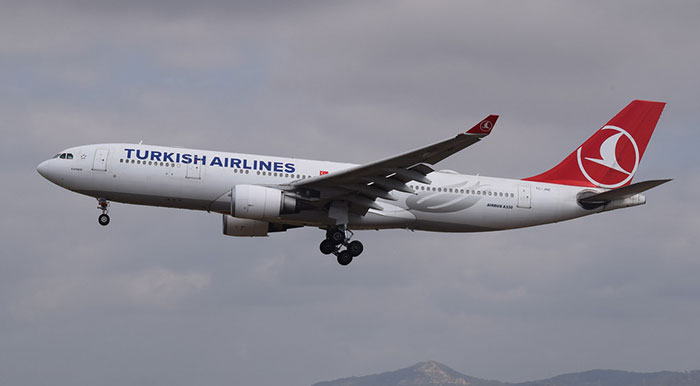
Image credits: d.king03/Flickr (Not the actual photo)
Turkish Airlines’ TK1853 flight took off from Istanbul without any issues early on Thursday morning, January 15.
The flight was en route to Barcelona when chaos erupted approximately three hours into the flight.

Image credits: Brett Jordan/Unsplash (Not the actual photo)
Pilots and authorities suspected that explosives had been placed on the flight due to a hotspot network name.
It is believed a passenger created an in-flight wireless network with a name that contained a b*mb threat.
“I have a b*mb, everyone will d*e,” read the network’s name, according to Turkish Airlines Communication Director Yahya Üstün and Catalan authorities.
A passenger allegedly created an in-flight wireless network with a name that contained a b*mb threat
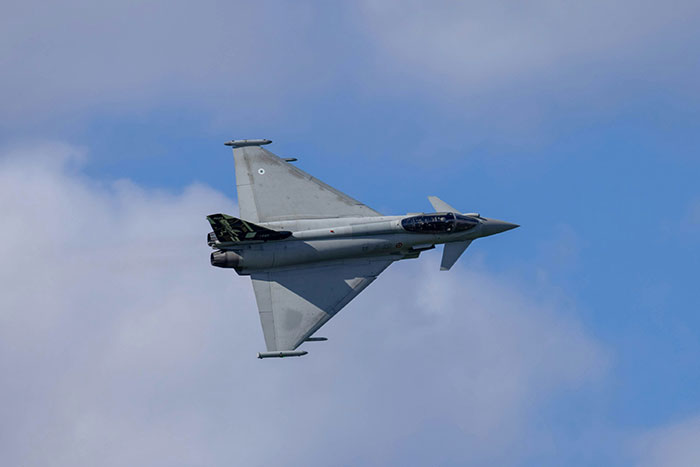
Image credits: Edoardo Bortoli/Unsplash (Not the actual photo)

The flight, with all its 148 passengers and crew members onboard, reportedly began circling mid-air for about 20 minutes.
An emergency alert was triggered, and fighter jets from France scrambled under a Quick Reaction Alert (QRA) to escort the commercial plane.
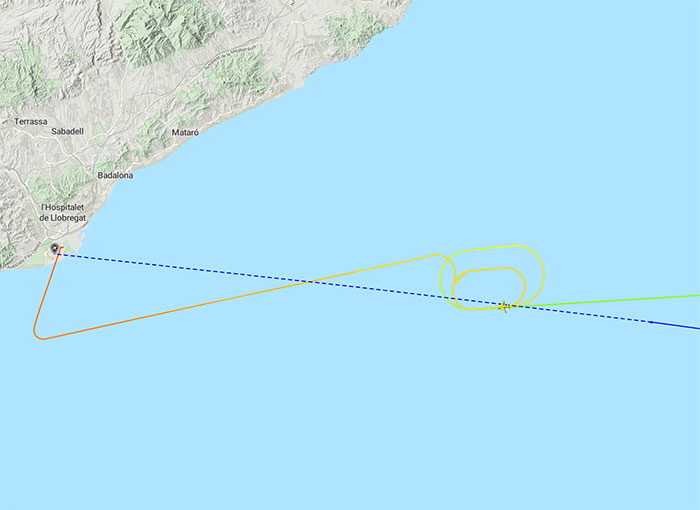
Image credits: AirNavRadar

After entering Spain’s airspace, Spanish military jets took over from the NATO jets and continued escorting the flight to its destination.
After the skwark 7700 code (issued for a general emergency) was declared, the flight was diverted to an isolated part of the Barcelona-El Prat Airport to minimize risk to other flights.
Military aircraft scrambled to escort the flight towards Barcelona
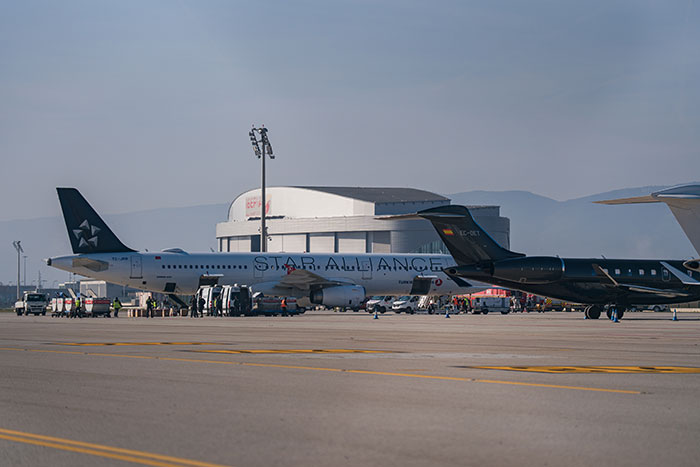
Image credits: Marc Asensio/Getty Images
The Airbus 321 made an emergency landing, following which Spain’s Civil Guard police force investigated and found no explosives inside the aircraft.
“It was detected that a passenger had set up an in-flight internet access point and configured its network name to include a bomb threat,” Yahya Üstün said in a statement.
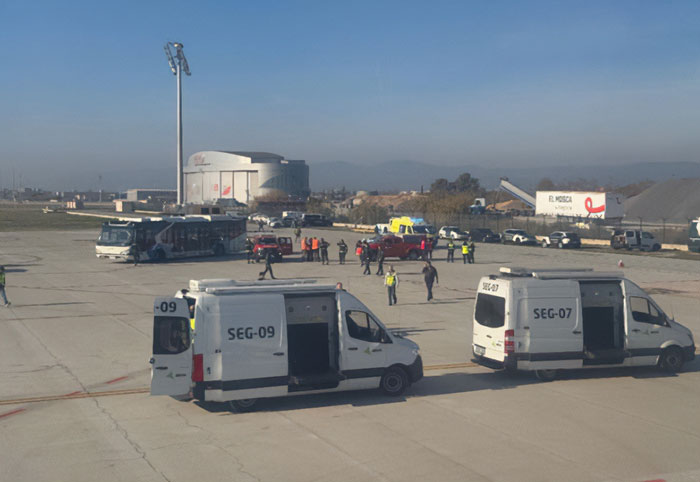
Image credits: shihyu_fang
The threat prompted crew members to initiate “necessary procedures” as per the Turkish Airlines’ “flight safety protocols,” Yahya said.
He noted that authorities conducted a thorough search of the Airbus 321 “within the framework of international aviation security rules.”
Authorities are working to identify the passenger who broadcast the false threat
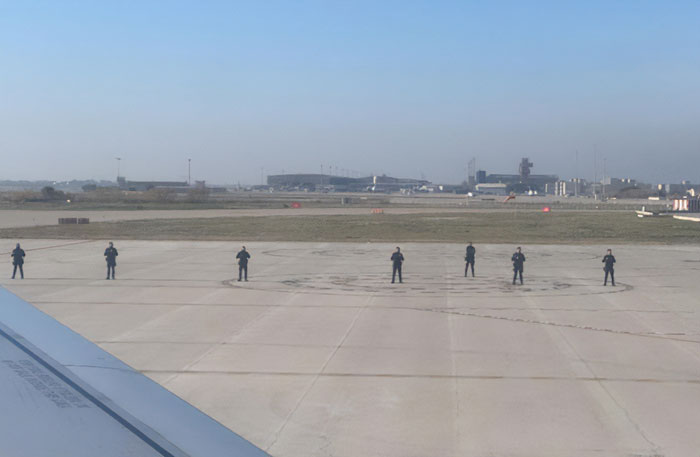
Image credits: shihyu_fang

Yahya later shared an update and said authorities did not find any “irregularities” while searching the aircraft, and investigators are working to nab the perpetrator who sparked the panic by broadcasting a false threat.
“Efforts have been initiated to identify the passenger in question and to carry out the legal process,” he said.
“Our aircraft’s return flight will be carried out after the completion of passenger boarding,” he added.
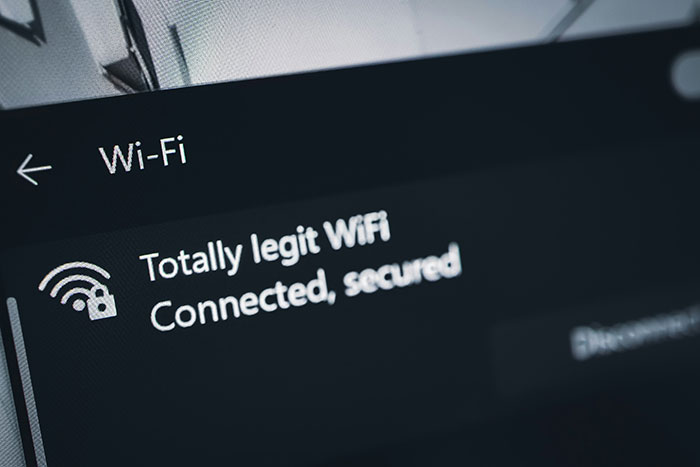
Image credits: Mika Baumeister/Unsplash (Not the actual photo)

Recently, a United Airlines flight on its way to Chicago was forced to divert to St. Louis after receiving a b*mb threat.
The flight had taken off from Dallas on November 16 at 6:57 a.m. and landed at the Lambert St. Louis International Airport around 8:40 a.m.
The emergency landing was executed after a passenger said there was an explosive device in his wife’s luggage.
A United Airlines flight recently made an emergency landing after a man said there were explosives in his wife’s luggage
Image credits: Marc Asensio/Getty Images
Upon landing, passengers were evacuated from the aircraft, and a thorough search was conducted.
Investigators determined that there was no threat and arrested the man for making the false claim.
A similar B*mb threat was received last month in connection with an IndiGo Airlines flight, traveling from Kuwait to the Indian city of Hyderabad.
A full-scale emergency response was launched after the airline’s grievance portal received an email about a b*mb threat on the December flight.
Officials in the Indian capital said other cities in India were also mentioned in the email.
“The email was received on IndiGo’s grievance portal. It mentioned several other airports, including Delhi, Chennai, and Goa,” Delhi Police said in a statement. “Following the information, precautionary checks have been conducted at all locations.”
“After investigating the scene, it was ruled a hoax,” a fire department official confirmed.