
Rows of students plonk themselves down wearily, resigned to their latest essay. While tracksuits and hoodies – not academic gowns – are the uniform of choice, the grandeur of the medieval library gives them away. These are Oxford University students, heads buried in laptops and even, surprise surprise, the odd printed book.
But one teenager in particular stands out. With a tripod for her camera and a ring light to hand, she sits in the corner (with the best lighting, naturally) and sets about filming herself reading and writing… or at least pretending to.
No, she won’t have an essay to hand in later, but she will have an Instagram post, and frankly that might serve her better.
Welcome to the rarefied world of the Oxfluencer – the Oxbridge students whose hefty social media followings are built on ‘content’ displaying the kind of academic prestige money can’t buy. And who are making small fortunes out of it.
The saying goes that you’ll know if someone went to Oxford or Cambridge because they’ll tell you within five minutes of meeting – and far be it from me to negate this stereotype. Towards the end of my time as an undergraduate at Cambridge between 2018 and 2022, influencers like Holly Gabrielle (78,200 followers), Eve Bennett (95,300 followers) and Ruby Granger (256,000 followers) were beginning to take off, sharing aesthetically pleasing videos of everything from formal dinners and library study sessions to admissions advice.
While many were educational, giving a glimpse behind the glossy veneer to share the stress of yet another essay crisis at 2am, there was, and still is, a healthy dose of envy-inducing too – videos showing picnics on college lawns and study sessions in ancient college bedrooms, complete with ‘scouts’ (cleaners to you and me).
Of course, many of us laughed at them back then. Far from being treated like celebrities, they often cut lonely figures (filming and editing does take up valuable extra-curricular time, after all). Plus, the assumption that our lives were interesting enough to merit hours of online content was toe-curling.
But while my friends and I rested on our laurels, smug in the assumption that an Oxbridge education would open unlimited doors in law, banking or government, it’s the student influencers, whipping microphones out in tutorials and setting up cameras mid-service in King’s College Chapel, who are laughing at us now.

Oxbridge students who post on social media about life at their prestigious universities – ‘Oxfluencers’ – are making a small fortune from the content
According to figures released last week, a record 1,000 taxpayers under the age of 30 earned at least £1million last year – an 11 per cent rise on the year before – with experts explaining that the increase comes at least in part from young people eschewing traditional careers and turning to online influencing instead.
Among the Oxfluencers, the most successful are raking it in not only from views on YouTube and endorsement deals, but from private tuition on the art of acing tricky admissions interviews.
Public accounts show Ruby Granger, who posted study videos of herself reading and drinking tea in rarefied libraries at Oxford, has more than £300,000 in the bank from her influencing activities – not bad aged just 25.
Meanwhile, the rest of us are struggling with the realisation that we aren’t as uniquely clever as we thought we were. While employment rates remain high, hovering around the 90 per cent mark for recent graduates, studies suggest that lots have to apply for as many as 100 jobs before getting an interview. Consultancy firm PwC, where Oxbridge graduates were once a shoo-in, cut 200 entry-level roles last year, with graduate job openings predicted to drop by 9 per cent in 2026.
The world has always been fascinated by Britain’s most prestigious educational institutions. Early reports suggest a record number of applicants have thrown their hat into the ring this year, with the most popular courses being English Literature, History and Philosophy, Politics and Economics (PPE).
Many of these teens will be looking for the highest academic challenge, but large numbers also recognise that social capital is the true benefit of an Oxbridge education.
And what better way to alert people to your new status than to make your entire Instagram presence revolve around your education?

25-year-old Ruby Granger, who posts study videos of herself reading and drinking tea in rarefied libraries at Oxford, has more than £300,000 in the bank from influencing

Eve Bennett, who has 95,300 followers, took off online by sharing aesthetically pleasing videos of her life at Oxford, from dinners and library study sessions to admissions advice
According to the Sutton Trust, the most powerful and influential people in the UK are 21 times more likely to have been Oxbridge educated than the general population. Who can blame Oxfluencers for flexing their academic credentials on the most relevant forum of the 21st century?
While their motivation for sharing may be clear, the appetite for such content is rather more baffling, given how irritating most people find Oxbridge braggers to be.
‘These universities represent a world that still feels elite, mysterious and slightly untouchable to many, which makes content related to it extremely marketable,’ brand and PR expert Nick Ede explains.
To be fair, some also gain huge followings by demystifying the entrance process. Certainly for Oxford PhD student and influencer Eleonora Svanberg, 26, who has half a million followers across Instagram and TikTok, the primary audience is young girls who want to follow in her footsteps. A self-described campaigner for ‘equality, mathematical physics and everything in between’, she tells me girls feel more confident taking their place among the male-dominated science applicants as a result of watching her videos.
Her content includes footage of her studying, attending conferences and yes, enjoying those classic, Harry Potter-style formal dinners. Crucially, she explains, if you want to reach young people, you have to be where they are – which is social media.
But it’s not all sunshine and punting on the Cherwell.
Svanberg never brings up her online presence in the real life MCR (or Middle Common Room, where the post-grads hang out), unless anyone asks her about it directly.

Oxford PhD student and influencer Eleonora Svanberg, 26, explains that if you want to reach young people, you have to be where they are – which is social media

Eleonora explains that her peers do not understand her desire to post content online as ‘academia isn’t the most supportive of this kind of public-facing work’
‘I worry that people might assume it makes me less serious as a researcher,’ she admits. ‘I can still feel a bit self-conscious about it. Academia isn’t the most supportive environment for this kind of public-facing work.’
Despite her colleagues ‘just not understanding’ what she does, Svanberg’s posting – which she is keen to emphasise fits around her research and teaching – has brought her opportunities she wouldn’t otherwise have had. She’s been invited to run workshops, speak about her research and even consulted with the Swedish parliament on inclusive education (Svanberg hails from Linköping in Sweden). She’s even signed a deal to write popular science books in English and Swedish – no doubt helped by her online presence.
Thanks to her regular social media posts, event organisers already know she’s comfortable with public speaking – and are grateful for her platform if she shares even a snippet of their event.
But would she have had the same success if she was posting from another university? She’s aware that Oxford adds a certain cachet to her content.
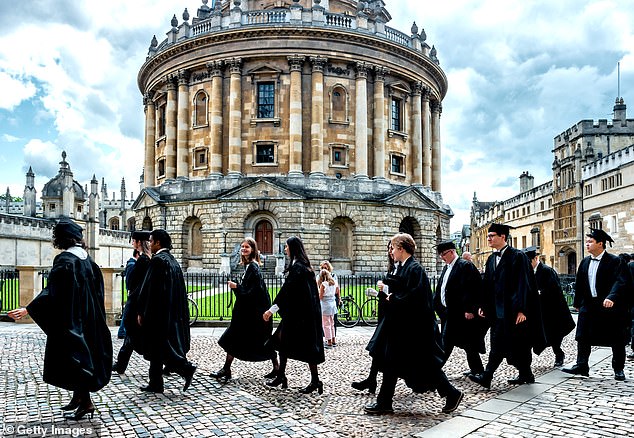
‘Being at Oxford does add credibility, and I think that matters when you’re an “influencer” wanting to achieve change,’ she says. The Oxford scenery, with its spires, students on rickety bikes and dons in gowns is unmistakably front and centre on her Instagram page.
‘Honestly, Oxford content is more likely to go viral,’ she admits. ‘The setting draws people in, then I can use that attention to show what studying here actually looks like.’

Svanberg, pictured dressed up for a formal dinner, says that content in Oxford is more likely to go viral as the city is so visually compelling
The quintessential British-ness makes it particularly marketable to audiences overseas. ‘Oxford is so visually compelling, and for a lot of people internationally, it represents a dream – it certainly did for me.
‘When I show the historic architecture, the traditions like formal [dinners] and the day-to-day reality of being a student here, I think people can imagine themselves being here too. They can picture themselves walking those streets, sitting in the libraries, going to dinner, doing the work. Living their dream.’
Ede agrees. ‘Fairly or unfairly, an Oxbridge education signals discipline and status. When that’s combined with a strong online presence, it creates a strong personal brand. Employers increasingly value communication and visibility, and these types of influencers demonstrate both.’
Indeed recruiting platform TotalJobs told the Mail that 58 per cent of recruiters say social media skills, including digital marketing, social media management and content creation (that’s making Instagram videos, to you and me) are likely to command higher salaries. Ironically 15 per cent said these skills are the most vital in determining salary or career progression – so perhaps the Oxfluencers’ social media abilities are in fact more important than the Oxbridge education.
It’s worth noting that very few make a fortune through influencing alone. Ilya Carey – a contemporary of mine who posted YouTube videos on his channel Ilya’s Cambridge Advice – did both an undergraduate and masters degree in biology at Cambridge and is now studying for a PhD at the University of Zurich. He admits his motivation for posting online was mainly financial, but ‘considering the effort, you don’t make that much’.

The quintessential British-ness of Oxford makes it hugely appealing to overseas audiences – the university’s historical architecture and formal dinners are particular highlights

Ilya Carey, who posted YouTube videos about his time at Cambridge University, admits his motivation for sharing content online was mainly financial

After graduating in her masters in English, Ruby Granger launched a business selling journals and planners
He explains it can take a while before your content becomes monetised; you need 1,000 subscribers and at least 4,000 hours of views in the last year. Once you’ve achieved that, you get around £2 per 1,000 views.
Since the inception of his channel in 2020, he’s made around £2,000 from YouTube – a pittance if you consider the hours of editing and promotion he put in.
Yet the cachet of a Cambridge education eventually came good. Thanks to his online presence, private tutoring requests came rolling in, leading to him setting up his own lucrative business matching students with tutors.
Clearly, however, Oxfluencers have a short shelf life. How can you possibly stay relevant once you’ve left the university that was your selling point? The smartest ‘studytubers’ launch businesses capitalising on the academic qualities their followers seem to value.
Ruby Granger, who did a masters in English at Oxford, has launched a business called Pumpkin Productivity, for example, selling journals and planners to followers who want to live the #GrangerLifestyle.
Holly Gabrielle, who posted Cambridge study videos, co-founded Narna, a sustainable clothing brand, and diversified into fitness content – likely to net her a tidy profit through endorsement deals and sponsorships.
‘The pressure to constantly put on a performance of intelligence, productivity and success can be intense,’ says Ede. ‘Very few people make it big, and sustaining relevance takes enormous effort.’

Holly Gabrielle, who posted Cambridge study videos, co-founded Narna, a sustainable clothing brand – like many other influencers who go on to found businesses
Then there are the inevitable legions of online trolls, who love nothing more than a bit of smug Oxbridge nerd to get their teeth into.
There are threads as long as your arm about the most successful on the online gossip forum Tattle Life, where Ruby Granger is relentlessly accused of privilege and inauthenticity, for example.
Elsewhere, the Oxfluencers attract predictable misogyny.
Svanberg tells me she found the nastier trolling difficult at the start, but now – depressingly – sees it as the price you pay for having a profile online. Even more shocking, it’s her posts about equality and inclusivity in education that get the most trolling rather than pictures of her looking stunning at a scholars’ dinner. Nobody minds a woman at Cambridge, it seems, as long as she looks pretty doing it.
Still, she says, she’s grateful she started posting her Oxford life online, even taking into account the mud-slinging from academics and internet trolls alike.
In today’s digital world, it’s Eleonora and her contemporaries who speak louder than any doctoral thesis ever could.