
In an era where flexible work is meant to be the norm, one employee has been left stunned after being formally pulled up for clocking off just three minutes early.
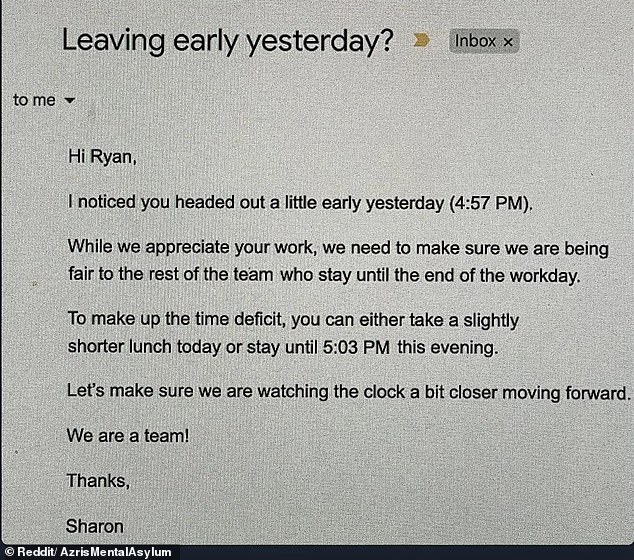
Ryan, whose experience was shared online on Reddit, said he received an email from his manager Sharon after leaving work at 4:57pm instead of 5pm – a difference of just 180 seconds.
The subject line alone raised eyebrows: ‘Leaving early yesterday?’
In the email, his manager acknowledged his work but warned that fairness across the team required closer attention to finishing times.
‘I noticed you headed out a little early yesterday (4.57pm),’ the email read.
‘While we appreciate your work, we need to make sure we are being fair to the rest of the team who stay until the end of the workday.’
To compensate for the three-minute ‘time deficit’, Ryan was told he could either take a slightly shorter lunch the following day or stay until 5.03pm that evening.
‘Let’s make sure we are watching the clock a bit closer moving forward. We are a team!’ the message concluded.

Ryan received a reprimanding email from his manager after leaving work ‘early’ at 4:57pm
The interaction has struck a nerve with workers who say it highlights everything wrong with modern corporate culture, particularly at a time when burnout and cost-of-living pressures are already running high.
‘Three minutes? Is corporate really that bad?’ one asked.
‘Next time something urgent comes up. Drop it at 5pm. If pulled in about it on Monday, remind them of this email. Burn the bridge and call in this petty behaviour. Lol three minutes, what a s*** manager. If your not outcome driven but by micro managing time. You have no position in being a manager.
Others shared eerily similar experiences, suggesting Ryan’s situation was far from unique.
One worker recalled being reprimanded for leaving 10 minutes early during severe flooding, despite staying back 40 minutes the day before to help a client.
Another described a workplace so obsessed with timekeeping it bordered on absurd.
‘You were required to work exactly seven hours and 21 minutes a day,’ they said.
‘If you worked under, you got in trouble. If you worked over, you also got in trouble. If you worked exactly that time, you were accused of watching the clock.’
They said the manager would even stand near the sign-in book and scold staff for rounding their start times up or down.

With many Australians juggling longer commutes, rising living costs, and shrinking work-life boundaries, critics argue that policing minutes sends the wrong message
‘One morning the digital clock said 7:59:50 and I wrote 8am. I got in trouble. That mentality took me 15 years to shake.’
Several workers said hyper-fixation on minutes often backfires, leading to rigid behaviour and lower morale.
‘I worked somewhere that cracked down hard on timeliness. Suddenly sick leave went up, no one answered emails after 5pm, no one came in early, and everyone took every single break down to the second. The crackdown didn’t last long.’
Others pointed out the double standard often at play.
‘There’s no way this person hasn’t arrived early by three minutes before. Unless it’s repeated and deliberate, this is a total overreaction,’ another wrote.
In contrast, some workers shared what happens when employers focus on outcomes rather than minutes.
‘My boss says if the work is done, go home. If you’re unproductive, go home and reset. As a result, he gets more work out of us and no one ever leaves.’
The debate taps into a broader conversation about Australian work culture, particularly as hybrid work, flexible hours and productivity-based performance clash with outdated ideas of clock-watching.
With many Australians juggling longer commutes, rising living costs, and shrinking work-life boundaries, critics argue that policing minutes sends the wrong message.
For Ryan, the email was less about three minutes and more about what it represented – a reminder that in some workplaces, time is still measured not in output or trust, but in seconds.