
For years, we’ve been a nation of supermarket snobs, choosing our weekly shop based on big brands and labels rather than what’s better for our wallets.
And, with their distinctive branded packaging and bargain-basement prices, we’ve looked down our noses at value products. As a cookery writer, I confess I’m drawn to high-end products bearing lavish descriptions and posh packaging and hide any bargain buys at the bottom of the basket.
But all that is changing thanks to a quiet revolution that’s driving middle-class shoppers towards budget ranges, many of which now boast impressively good products. Sales of value lines at Marks & Spencer rose by 20 per cent in the third quarter of last year, recently launching more than 30 new items in its range.
Meanwhile Tesco – which phased out its Value range in 2012 as customers were ‘embarrassed’ to buy from it – is now bringing those iconic blue and white stripes back.
Among the TikTok generation, own-brand items bear a certain retro cool, with penny-pinching influencers using budget food and drink products in their viral recipes.

As a cookery writer, I confess I’m drawn to high-end products bearing lavish descriptions and posh packaging and hide any bargain buys at the bottom of the basket
And they may just be onto something, says leading nutritionist GQ Jordan. ‘Value supermarket ranges often get written off, but some contain nutritional hidden gems,’ she explains. ‘When the ingredient list is simple and the nutrition panel stacks up, a value product can be just as good as a branded one.’
So which own-brand items should you be adding to your weekly shop – and which ones are better left languishing on the shelf?
Penne pasta


Supermarket own-brand pastas vary enormously in price and quality – even when you stick to basic penne
Supermarket own-brand pastas vary enormously in price and quality – even when you stick to basic penne.
Best: Sainsbury’s Stamford Street Co Penne Pasta (500g, 41p)
A generously-sized bag for just 41p, this budget pasta looks indistinguishable from a more expensive brand. It cooks well, giving lovely al dente pieces in just nine minutes. Unlike some of the budget ranges, the tubes aren’t too small; they soak up a decent amount of tomato sauce and taste delicious.
What the nutritionist says: It’s ‘a clear example of where value works well’, says GQ Jordan, with ‘very low salt [0.01g per serving)’. One portion is 326 calories, with just 1.4g fat and 1.6g sugar.
Worst: Tesco Hearty Food Co Penne Pasta (500g, 41p)
While the pieces of penne look intact and well-sized in the packet, cooking them is a different story.
The tubes break down after 5-6 minutes in boiling water, turning mushy and losing their shape. The result is a pan of starchy water, and gloopy, jelly-like pasta strands I don’t want to eat. A portion contains just 296 calories, but it also has 1.8g sugar and 0.03g salt.
What the nutritionist says: ‘The nutrition is similar, but fibre [2g per serving] and protein [9.4g] are slightly lower, and the texture tends to be softer,’ says GQ. ‘It’s not harmful, just weaker-quality pasta.’
Minced meat


I was surprised to find several supermarkets offering top-quality, ethically sourced (and always British) minced pork as part of their own-brand ranges
Clearer on provenance, animal welfare and usually lower in fat, premium mince is my go-to. So I was surprised to find several supermarkets offering top-quality, ethically sourced (and always British) minced pork as part of their own-brand ranges.
Best: M&S Remarksable Value British Outdoor Bred Pork Mince 5 per cent Fat (500g, £3.60)
Though more expensive than other budget products, this pork mince from M&S’s Remarksable Value range is worth the extra £1. Made from outdoor-bred British pork, which is RSPCA-assured, it contains just 5 per cent fat, making it a lean, healthy addition to your fridge.
When cooked, it colours evenly in the pan and there’s little water or fat run-off. The taste is hearty and flavoursome.
What the nutritionist says: ‘You’re paying for a better protein-to-calorie ratio (30.5g to 158 calories per 100g) and clearer sourcing. It’s lean, high-protein mince with significantly lower fat [just 3.4g] per 100g.’
Worst: Morrisons Savers 20 per cent Pork Mince (454g, £2.27)
The cheapest of the lot, this looks promising – it’s pink, plump and smells fresh. However, as it cooks it releases a lot of fat. It tastes oily and bland and, at just 454g, there’s 50g less meat to go around.
What the nutritionist says: This has ‘much higher fat [20g per 100g] and saturated fat [7.3g], meaning fewer nutrients per calorie. It’s fine occasionally, but less supportive if used regularly if protein intake is the goal.’ There’s just 19.1g protein per 100g and 257 calories.
Sliced bread


Supermarket bread has a poor reputation for containing additives, preservatives and flavour-enhancers, not to mention added salt and sugar
Supermarket bread has a poor reputation for containing additives, preservatives and flavour-enhancers, not to mention added salt and sugar. But this applies equally to branded options (such as Hovis and Warburtons) as it does to own-brand budget loaves.
Best: Waitrose Essentials Wholemeal Medium Sliced Bread (800g, 75p)
Low in saturated fat (0.2g) and sugar (0.9g) per slice, this wholemeal bread is a healthy option that’s almost half the price of branded equivalents. Per slice, there are 82 calories, 2.4g fibre and 3.7g protein. It contains wholemeal wheat flour, yeast and a few – but not many – preservatives.
The flavour is nutty, slightly salty, and it makes a wholesome, filling sandwich.
What the nutritionist says: This is ‘closer to what wholemeal bread should look like nutritionally, with higher fibre, fewer added sugars, and a more balanced nutritional profile’.
Worst: M&S Remarksable Value Thick Wholemeal Loaf (800g, 75p)
An unexpectedly low price for an M&S product, this wholemeal loaf sounds – and tastes – delicious. It’s enriched with vitamin D and contains 234 calories per 100g.
However it also contains not one but two different types of sweetener (sugar is the fifth item on the ingredients list, and it’s also made with caramelised sugar).
What the nutritionist says: ‘Despite the name, this is more heavily processed, with added sugars, palm oil, and multiple emulsifiers. The fibre is lower [just 6.2g per 100g] and salt higher [0.8g] than expected for wholemeal bread.’
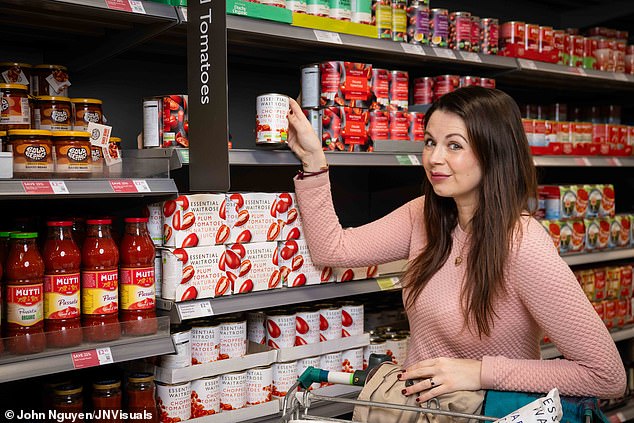
Tinned tomatoes


Italians might baulk at the prospect of supermarket tinned tomatoes, but there aresome reasonable options out there
Italians might baulk at the prospect of supermarket tinned tomatoes, but there are some reasonable options out there.
Look for the tomato content – at least 60 per cent – otherwise they’ll taste watery and insipid. And check for other seasoning that might be used to disguise a bad batch.
Best: Sainsbury’s Stamford Street Co Chopped Tomatoes (400g, 43p)
Price-matching the other supermarkets’ cheap tinned tomatoes, this has now become a cupboard staple in my house. There’s a good ratio of tomatoes to liquid (the tin is 60 per cent tomatoes), with no ingredients other than tomato juice and citric acid, used to regulate the acidity.
They cook down well in a pasta sauce, are low in fat (less than 0.5g per portion), sugar (5.2g) and salt (0.2g), and have a sweet, authentically- Italian flavour. Per half tin, they contain 38 calories.
What the nutritionist says: ‘A strong base product and a real value-range win,’ says GQ.
Worst: Tesco Grower’s Harvest Chopped Tomatoes (400g, 43p)
The price is the same, as is the percentage of tomatoes in the tin, but this Tesco product – under the wholesome-sounding ‘Grower’s Harvest’ branding – isn’t good quality.
The pieces inside look like odds and ends, rather than quality chunks, and the flavour is overwhelmingly acidic.
What the nutritionist says: ‘This includes concentrated tomato juice and higher natural sugars per serving,’ says GQ. ‘At 0.14g per serving, the salt is also slightly higher.’ Each half-tin comprises 44 calories and 7.6g sugar.
Cheddar cheese


As a household of cheese-lovers, we spend a fortune each week on Cathedral City – reputedly the nation’s favourite cheddar – which costs £3 for 350g
As a household of cheese-lovers, we spend a fortune each week on Cathedral City – reputedly the nation’s favourite cheddar – which costs £3 for 350g. But the supermarket shelves abound with all sorts of own-brand alternatives.
Best: Tesco Creamfields Mature White Cheddar (400g, £2.79)
Made from British and Irish cows’ milk, this Creamfields cheddar comes in a slimmer packet than most cheeses, making it easy to slot into the door of my fridge.
It’s velvety-smooth, medium in strength rather than extra-mature, and well-priced at £2.79. A portion comprises 125 calories, 10.5g fat and 0.54g salt.
The texture is firm and creamy, and it has a lovely ooze when melted on toast.
What the nutritionist says: ‘This has high protein [7.6g per 30g serving], proper maturation, and a simple ingredient list,’ says GQ. ‘The fat and saturates are high, as expected, but you get good protein and flavour per portion.’
Worst: Asda Just Essentials Mature White Cheddar (400g, £2.79)
Rubbery, mild and cheap-tasting, this Asda cheese is disappointing. It crumbles when cut, and takes ages to melt in my toastie, dribbling fat all over the bread.
Not one I’ll be trying again, when you can get far better for the same price. There are 125 calories per 30g serving, which also contains 6.5g saturated fat and 0.54g salt.
What the nutritionist says: ‘It’s very similar nutritionally, but with slightly lower protein, and milder in flavour, which can lead to larger portions for satisfaction.’
Chicken breast


Not all supermarkets do fresh chicken breast as part of their budget ranges. Of those that do, all contain British chicken
Not all supermarkets do fresh chicken breast as part of their budget ranges. Of those that do, all contain British chicken.
Best: Waitrose Essentials Slower Reared Chicken Breast Fillets (600g, £5.25)
Waitrose chickens are ‘slower-reared’, meaning a higher welfare environment, and this is reflected in the quality.
It’s succulent, flavoursome and there’s very little fat or gristle to cut off.
What the nutritionist says: ‘This chicken is very lean and high in protein [22.9g per 100g], with minimal fat [1.6g].’
Worst: Morrisons Savers Chicken Breast Pieces (750g, £5.05)
The chicken was tough and sinewy, rather than lean, and strangely flavourless.
What the nutritionist says: ‘They’re nutritionally-similar on paper, but with a slightly lower protein density and higher fat.’
Laundry liquid


Though not something you’ll have to buy every week, laundry liquid is an expensive addition to a supermarket trip
Though not something you’ll have to buy every week, laundry liquid is an expensive addition to a supermarket trip.
Best: M&S Remarksable Value Bio Colours Laundry Liquid (1.5l, £5.50)
There has been a lot of hype around this product which fans say smells just like a £75 Le Labo perfume. Made with plant-based biodegradable ingredients and essential oils, there are no hidden nasties and the bottle is meant to last 50 washes.
What the nutritionist says: ‘It’s more concentrated, meaning fewer washes are needed per bottle, and the more balanced formulation tends to be better tolerated by people with sensitive skin.’
Worst: Morrisons Savers Biological Laundry Liquid (1l, £2)
There’s nothing eco-friendly about this cheap product. It fails to remove, or even fade, a splodge of sauce on my husband’s work shirt.
What the nutritionist says: ‘This has a higher reliance on harsher chemicals, optical brighteners, and multiple preservatives.’
Porridge oats


As porridge fans know, there’s a huge difference between quality, jumbo, nutritious oats – and the ones that taste like sawdust
As porridge fans know, there’s a huge difference between quality, jumbo, nutritious oats – and the ones that taste like sawdust. Usually, this is reflected in what you spend: a 1kg box by market leader Quaker, for example, is £2.95, and promises 100 per cent wholegrain rolled oats that are sustainably grown in the UK. But I found some surprisingly good offerings among the supermarket value ranges.
Best: M&S Remarksable Value Traditional Scottish Porridge Oats (1kg, £1.15)
Stone-ground for a creamy texture, these breakfast oats are chunky and robust – for less than half the price of a branded box. They’re hearty and filling, and blend deliciously with milk and honey to make a moreish bowl, comprising just 149 calories.
What the nutritionist says: GQ praises their high fibre (3.3g per 40g serving), low sugar (0.4g) and lack of salt (0.01g). ‘It’s a dependable, nourishing staple,’ she adds.
Worst: Asda Just Essentials Porridge Oats (1kg, 85p)
By far the cheapest around, these porridge oats promise very little on their day-glo yellow packaging – and are something of a let-down. Small, flaky and dotted with chewy husks (the fibrous layer that surrounds the grain), they get stuck in my teeth and make for a lumpy, gruel-like porridge.
What the nutritionist says: ‘The fibre is slightly lower [4.9g per 50g portion] and texture is more broken. It’s still a decent product, just marginally less satisfying.’
A single serving contains 186 calories, 2.9g fat and 0.04g salt.
Baked beans


I’ve been a Heinz faithful for more than three decades, so it’s going to take some seriously tasty supermarket beans to convince me own-brand tins are just as good
I’ve been a Heinz faithful for more than three decades, so it’s going to take some seriously tasty supermarket beans to convince me own-brand tins are just as good. Some of the budget ranges are not only high in sugar but watery and tasteless – so it’s worth checking the nutritional tables.
One thing that could convince me is the price, with most own-brand beans just 28p per tin.
Best: Waitrose Essential Baked Beans (420g, 55p)
In a rich tomato sauce, with just the right balance of sweetness and savouriness, these baked beans truly are a cut above. Each half-tin contains 179 calories, with 52 per cent haricot beans, more than any other supermarket value tin, as well as paprika, cloves, cinnamon, chilli and garlic.
What the nutritionist says: ‘There’s a higher bean content, good fibre [10.9g per serving] and protein [16.4g], and lower sugar [just 8.7g] than many value options,’ explains GQ. ‘Salt is still present [0.92g per serving] but it’s reasonable for baked beans.’
Worst: Asda Just Essentials Baked Beans (410g, 28p)
They may be cheap, but that’s no excuse for the watery, insipid contents of this tin. With just 44 per cent beans, plus sugar, glucose-fructose syrup and added salt, these are sloppy, don’t hold together when cooked and taste artificial. The only added flavour is paprika.
The lurid yellow tin is off-putting too; I’m no snob, but this just doesn’t look like a product I want in my cupboard.
What the nutritionist says: They’re ‘more sauce than substance,’ says GQ, making them ‘less filling and less supportive nutritionally’. Each half can contains 158 calories, 0.88g salt and just 8.4g fibre and 8g protein.
Sandwich spread


Depending on where you shop, a branded plant-based sandwich spread costs between £1.75 and £2.80 – a lot for something you use daily without a second thought
Depending on where you shop, a branded plant-based sandwich spread costs between £1.75 and £2.80 – a lot for something you use daily without a second thought.
Best: Sainsbury’s Stamford Street Co Soft Spread (500g, 95p)
Shoppers claim this vegan spread tastes just as good – if not better – than Flora and Lurpak, and I can’t help but agree. It has a pleasant, creamy taste and the colour (aided by the addition of carotene) is buttery yellow.
Though reasonably high in fat (4.2g), it’s low in calories (just 38 per serving) and sugar (less than 0.5g), and contains vitamins D and A.
What the nutritionist says: ‘It’s lower in saturated fat than many spreads, with modest salt [0.11g per portion], and a relatively simple formulation for a soft spread.’
Worst: Morrisons Savers Soft Spread (1kg, £1.90)
I could only find this spread in a huge tub at my local supermarket, which would have been ideal if it tasted good – but sadly that’s not the case. Bland and flavourless, it leaves an unappetising oily residue on my bread.
On the plus side, it’s low in calories (38 per serving) and contains just a trace of sugar. But I’ve got 99 more portions to get through.
What the nutritionist says: ‘It has a very similar ingredient structure, but is higher in saturated fat [11g] and salt [1.1g] per 100g. This is where cheaper fat blends and higher saturates start to show, which matters if it’s used daily.’