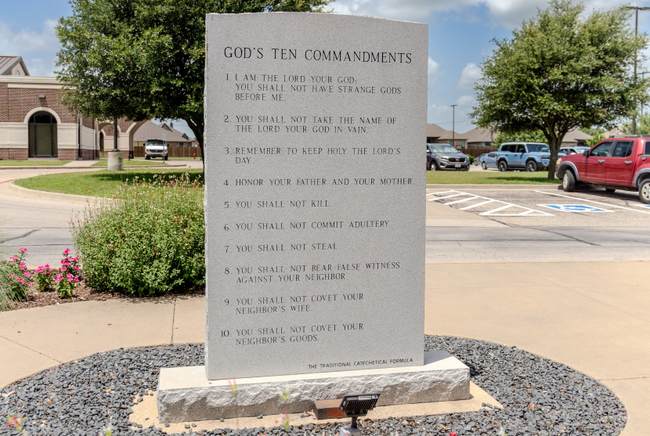
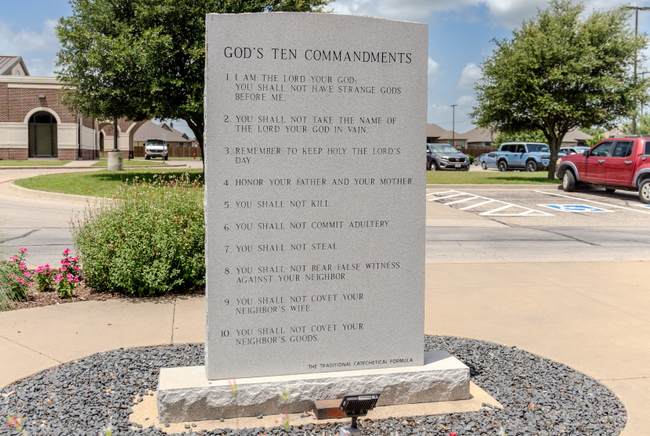
Color me surprised. When Texas and Louisiana passed laws that required public schools to display the Decalogue, most expected courts to fall back to the Warren Court era and slap a few wrists. Instead, an en banc ruling from the Fifth Circuit injected some common sense into the question of messaging and formation in public schools.
The ruling yesterday cuts Louisiana loose for the moment over questions of ripeness in that legal challenge to a similar law. For now, however, Texas can enforce its requirement for public schools to display the Ten Commandments, and that precedent will apply to all states within the Fifth Circuit’s jurisdiction – unless and until the Supreme Court rules otherwise:
A U.S. appeals court has ruled that Texas can require schools to display a copy of the Ten Commandments, finding the legislation that mandates the Decalogue in classrooms does not require students to believe in the religious teachings.
The Tuesday ruling from the Fifth Circuit Court of Appeals is a victory for Texas conservatives and Christians who have fought to further include religion in public spaces. The decision is expected to be appealed to the Supreme Court.
“This is a major victory for Texas and our moral values,” the state’s Republican attorney general, Ken Paxton, said in a statement.
“The Ten Commandments have had a profound impact on our nation, and it’s important that students learn from them every single day.”
The jurisprudence of the last six decades would have normally argued against this statute. Any display of religious material would have violated both the Establishment and Free Exercise clauses of the US Constitution merely by their presence in government-run environments. The plaintiffs bringing this case made those same arguments that had succeeded in that period.
This time, however, the Fifth Circuit didn’t buy it. And if the plaintiffs think that they may get a more sympathetic hearing in the inevitable appeal to the Supreme Court, they may be in for a rude surprise. Four years ago, the top court dismissed the notorious “Lemon test,” a precedent that put the Establishment Clause at a higher priority than free speech and free religious expression. The ruling in this case notes that, and then goes on to dismantle the ahistorical reading of the Establishment Clause at some length:
First, the Establishment Clause. Plaintiffs primarily claim we are bound by Stone v. Graham, 449 U.S. 39 (1980) (per curiam), which invalidated a similar Kentucky law decades ago. We disagree. Stone applied an analysis—the “Lemon test”—which confounded courts for decades. See Lemon v. Kurtzman, 403 U.S. 602 (1971). Mercifully, the Supreme Court jettisoned Lemon and its offspring some years ago. See Kennedy v. Bremerton Sch. Dist., 597 U.S. 507, 534 (2022) (recognizing the Court has “abandoned Lemon”). With Lemon extracted, there is nothing left of Stone.
In place of Lemon, courts now ask a question rooted in the past: does the law at issue resemble a founding-era religious establishment? Answering that question requires delving into historical sources and scholarship.
At the time of the founding and the ratification of the Constitution, “establishment” meant forced compliance under penalty of law with a particular sect, not just the display or publication of tenets of generalized religion, the court points out. States enforced laws that required church attendance and controlled doctrine, punished heretics, and more. It excluded or forbade competing religions from the public square or from operating at all. It took many years for the states to comply with the Establishment Clause and dismantle these state churches, in part because the states didn’t believe that the Bill of Rights applied to anything other than the federal government.
Displaying the Ten Commandments does none of that, the court ruled, especially since it doesn’t require anyone to believe in them:
Plaintiffs counter that, like historical establishments, S.B. 10 is “coercive” because it pressures children to honor the Ten Commandments. Not so. S.B. 10 requires no religious exercise or observance. Students are neither catechized on the Commandments nor taught to adopt them. Nor are teachers commanded to proselytize students who ask about the displays or contradict students who disagree with them.
Most importantly, the “coercion” characteristic of religious establishments was government pressure to engage in religious worship. That’s why establishments prescribed liturgies and punished those who skipped them. S.B. 10 is far from that. It puts a poster on a classroom wall. Yes, Plaintiffs have sincere religious disagreements with its content. But that does not transform the poster into a summons to prayer.
This argument also applies to the second argument against the statute as a violation of the Free Exercise clause. Without coercion, there is no violation. The plaintiffs try to use the recent Mahmoud v Taylor ruling in which the Supreme Court ended mandatory sex-education lessons in Maryland schools without opt-outs for religious objections, but coercion mattered there too;
In Mahmoud, a school district designed a compulsory curriculum to “disrupt” students’ beliefs about sexuality and gender. Id. at 528–29. Teachers were to inform students that their religious views on these topics were “hurtful, perhaps even hateful” and that their parents’ views were wrong. Id. at 553. No opt outs were permitted. Id. at 543. The Supreme Court ruled the school violated the parents’ right to direct their children’s religious upbringing. See id. at 529–30.
S.B. 10 bears no resemblance to the oppressive curriculum in Mahmoud. As noted, S.B. 10 authorizes no religious instruction and gives teachers no license to contradict children’s religious beliefs (or their parents’). No child is made to recite the Commandments, believe them, or affirm their divine origin. …
To Plaintiffs, merely exposing children to religious language is enough to make the displays engines of coercive indoctrination. We disagree. The curriculum in Mahmoud went far beyond books sitting silently on classroom shelves. Those materials were deployed by teachers with lesson plans designed to subvert children’s religiously grounded views on marriage and gender. S.B. 10 authorizes nothing of the sort.
Common sense in a judicial ruling. What won’t they think of next?
The plaintiffs will undoubtedly appeal this ruling to the Supreme Court, and whether the justices grant cert will be a question worth watching. The 6-3 ruling in 2002’s Kennedy v Bremerton that ended the Lemon test related to private prayer within the public-school setting, not action by the school to publish religious material. That context may make a difference to one of the justices who went with the majority. It takes four justices to grant cert, and the liberal justices will absolutely want to have a debate over this statute and revisit the balancing test in these circumstances. For now, though, Texas schools will have to display the Ten Commandments, and hopefully Texas students will learn something from them.
Editor’s Note: Every single day, here at HotAir, we will stand up and FIGHT, FIGHT, FIGHT against the radical Left and deliver the conservative reporting our readers deserve.
Help us continue to tell the truth about the Trump administration and its successes. Join HotAir VIP and use promo code FIGHT to receive 60% off your membership.