
In the 19th century, it was said that the length of a man’s boat, in feet, should match his age, in years.
The Victorians, therefore, would have had some questions at the 40th annual Palm Beach International Boat Show, which convened in March 2022 on Florida’s Gold Coast.
A typical offering: a 203ft superyacht named Sea Owl, selling second-hand for $90 million (£67 million).
The owner, hedge fund tycoon Robert Mercer, was throwing in furniture and accessories including a Steinway piano, a variety of frescoes and a security system that requires fingerprint recognition.
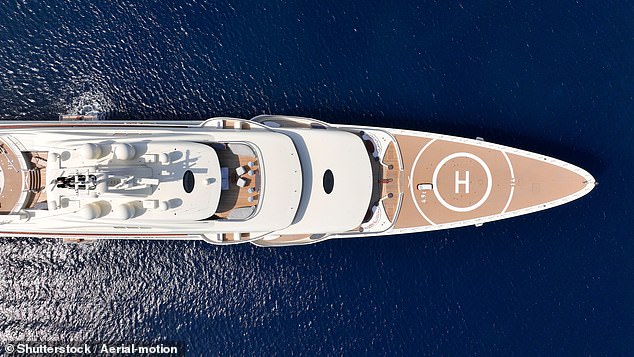
Nevertheless, Mercer’s package was a modest one: the largest superyachts are more than 500ft nowadays – on a scale with naval destroyers – and cost six or seven times what he was asking.
For the moment, a ‘gigayacht’, as a vessel of this size is classed, has overtaken housing as the most expensive item that our species has figured out how to own.
One boating guest told me about a conversation with a famous friend who keeps one of the world’s largest yachts.
‘He said, “The boat is the last vestige of what real wealth can do – you have a chef and I have a chef. You have a driver and I have a driver. You can fly privately and I fly privately. So, the one place where I can make clear to the world that I am in a different f***ing category than you, is the boat”.’

A typical offering: a 203ft superyacht named Sea Owl, selling second-hand for $90 million (£67 million)

deck-adent: A gigayacht is the ultimate status symbol for super-rich
Another advantage of a boat over property is that they can ‘absorb the most excess capital’ while also affording the owner a degree of flexibility.
Another owner explained: ‘If you’re on your boat and you don’t like your neighbour, you tell the captain, “Let’s go to a different place”. On land, escaping a bad neighbour requires more work: you’ve got to try to buy him out or make it uncomfortable or something.’
But who can afford these costly solutions to neighbourly discord?
At the Palm Beach Boat Show, highly trained greeters are employed to determine just that: to pick out ‘super-rich clients’ from ‘ineligible visitors’. They scan the dockside crowd for promising clues (the right shoes, jewellery, pets) as well as for red flags (cameras, ornate business cards, clothes with pop culture references).
One resorted to binoculars to spot a passerby with a $100,000 watch. Those deemed to have insufficient buying power are quietly marked for ‘dissuasion’.
If you hail from the latter category, you may not be aware that we are currently living through the ‘greatest boom in the yacht business that’s ever existed’.
In 2021, the industry sold a record 887 superyachts worldwide, nearly twice the previous year’s total.
One reason for the increased demand was the pandemic, which created a need for social distancing coupled with a kind of existential awakening. Another, deeper, reason, is the undeniable widening imbalance of wealth throughout the world.

Jeff Bezos And Lauren Sanchez throw a foam party on their yacht ahead of their Italian wedding
Since 1990, the United States’ supply of billionaires has increased from 66 to more than 800: the biggest among them being Elon Musk, Mark Zuckerberg and Jeff Bezos (Musk doesn’t actually own a yacht but has been a guest on plenty). In that time, the number of truly giant yachts – those longer than 250ft – has climbed from less than ten to more than 170.
As Raphael Sauleau, CEO of the International Yacht Company, told me bluntly: ‘Covid and wealth – a perfect storm for us.’
Nobody pretends that a superyacht is a productive place to stash your wealth. As an article in The Financial Times observed: ‘Owning a superyacht is like owning a stack of ten Van Goghs – only, you are holding them over your head as you tread water, trying to keep them dry.’
In the 1950s, the height of aspirational style was fine French furniture. But before long, more and more money was going airborne.
Playboy founder Hugh Hefner, a pioneer in the 1960s private jet era, decked out a plane he called Big Bunny, where he entertained Elvis Presley, Raquel Welch and James Caan. But once it seemed that every plutocrat had a plane, the thrill was gone. In any case, an aeroplane is just transportation.
As sea-based investments have grown, so have the proportions of taste. Back in 1954, Greek shipping baron Aristotle Onassis bought a Canadian navy frigate and spent more than $4 million turning it in to the Christina O.
Its flourishes included a Renoir in the master suite, a swimming pool with a mosaic bottom that rose to become a dance floor and, in the bar, a collection of whale teeth carved into pornographic scenes from The Odyssey and stools upholstered in whale foreskins.
In the yachting world today, tales of ‘conspicuous consumption’, like that of Onassis, still abound, including exotic deliveries by helicopter or seaplane of bagels from Zabar’s bakery in New York, sex workers or a rare melon from the Japanese island of Hokkaido. When you flip through the yachting Press, it’s easy to wonder how you’ve gone this long without a personal submarine or a cryosauna that ‘blasts you with cold’ down to minus 110 degrees Celsius, or the full menagerie of ‘exclusive leathers,’ such as eel and stingray.
Yet for many, often these material things aren’t enough. Andrew Grant Super, a co-founder of the ‘experiential yachting’ firm Berkeley Rand, explained how he serves and entertains a uniquely overstimulated clientele he calls the ‘bored billionaires’.
Some of the company’s ‘experience products’ use state of the art ‘immersive technology’, to reenact historical sea battles onboard, complete with the smell of cordite and cannon fire.
And if that doesn’t satisfy, there’s a dining experience like no other. ‘We fly a 3D-printed, architecturally freestanding restaurant into the middle of the Maldives, on a sand shelf that can only last another eight hours before it disappears,’ he says.
Of course, there is more going on, onboard, than entertainment and showboating.
For owners and their guests, a superyacht provides a discreet marketplace for the exchange of trust, patronage and validation.
I talked to Brendan O’Shannassy, a veteran captain who has skippered some of the world’s biggest yachts, including that of Paul Allen, the late co-founder of Microsoft, and a few other billionaires he declines to name.
He has come to see big boats as a space where powerful ‘solar systems converge and combine’ for mutual benefit.
‘It’s all gracious and everyone’s kiss-kiss but there’s a lot going on in the background,’ he said.
He recalled an incident of one yacht owner who deliberately limited the number of newspapers on board, as a ‘mind game among billionaires’ organised for his personal amusement. ‘There were six couples and three newspapers… they were ranking themselves constantly,’ he remembers.
Everyone would have come away with something from the experience, however. ‘It is implicit in every interaction that their sharing of information will benefit both parties; it is an obsession with billionaires to do favours for each other. A referral, an introduction, an insight – it all matters,’ O’Shannassy, wrote in his memoir, Superyacht Captain.
The secret machinations of the superyacht elite are always bound to attract attention – and not all of it good.
Since Russian president Vladimir Putin launched his assault on Ukraine, the superyacht world has come under increasing scrutiny, bringing with it what many suspect is a marked animus towards the very rich. Putin is said to have amassed a storehouse of outrageous luxuries, including four yachts, 20 homes and dozens of private aircraft – all on an official annual salary of about $140,000 (£105,000).
Since the invasion, boats suspected of having links to Putin and the Russian elite have been frozen, seized and, on at least one occasion, nearly scuttled in dock.
Yet, for all its profits from Russian clients, the yachting industry was unsentimental about their banishment. Brokers stripped photos of Russian yachts from their websites, questionnaires were sent to anonymous clients asking who, exactly, they were. Business was roaring and if some Russians were cast out of the ‘have-yachts’, other buyers would replace them.
Even before Russia’s invasion, the yachting community was straining to manage its reputation as a gusher of carbon emissions (one well-stocked diesel yacht is estimated to produce as much greenhouse gas as 1,500 cars).
Few need to be reminded of film producer David Geffen’s misstep during the early weeks of the pandemic when he Instagrammed a photo of his 545ft yacht, The Rising Sun – with its double-height cinema, spa, salon and a staff of 57 – in the Grenadines.
He posted that he was ‘avoiding the virus’ and ‘hoping everybody is staying safe’.
It drew thousands of responses, many marked #EatTheRich, others summoning a range of nautical menaces: ‘At least the pirates have his location now.’
More bad PR for superyacht owners came in 2022 when it was reported in the Netherlands that Jeff Bezos was building a sailing yacht so tall the city of Rotterdam might have to temporarily dismantle a bridge that had survived the Nazis to let the boat pass out to the open sea.
Rotterdammers were not pleased. On Facebook, a local man urged people to ‘take a box of rotten eggs with you and let’s throw them en masse at Jeff’s superyacht when it sails through’. At least 13,000 people expressed interest.
Amid the uproar, the dismantling was abandoned and instead the yacht was towed without its masts, to be installed later.
The superyacht industry is huge and not just in the planning, building and selling of the boats. There is also the staff who must adhere to a culture of secrecy, often enforced by Non-Disclosure Agreements or NDAs. On one yacht, seasoned captain O’Shannassy learned to communicate in code with the helicopter pilot who regularly flew the owner from Switzerland to the Mediterranean.
Before take-off, the pilot would call with a cryptic report on whether the party included the presence of a pomeranian dog.
Were any guest to overhear, their cover story was that a customs declaration required details about pets. In fact, the lapdog was a constant companion of the owner’s wife; if the pomeranian was in the helicopter, so was she. ‘If no dog was in the helicopter,’ O’Shannassy recalled, the owner was bringing ‘somebody else’.
It was the captain’s duty to rebroadcast the news across the yacht’s internal radio: ‘Helicopter launched, no dog, I repeat no dog today’ – the signal for the crew to ready the main cabin for the mistress, instead of the wife.
They swapped out dresses, family photos, bathroom supplies, favoured drinks in the fridge.
On one occasion, the code got garbled and the helicopter landed with an unanticipated pomeranian. Afterwards, the owner summoned O’Shannassy and said: ‘Brendan, I hope you never have such a situation, but if you do I recommend making sure the correct dresses are hanging when your wife comes into your room.’
In the hierarchy on board a yacht, the most delicate duties tend to trickle down to the least powerful. Yacht crew – ‘yachties’, as they’re known – trade manual labour and obedience for cash and adventure.
On a well-staffed boat, the ‘interior team’ operates at a forensic level of detail: they’ll use Q-tips to polish the rim of your toilet, tweezers to lift your fried chicken crumbs from the teak, a toothbrush to clean the treads of your staircase.
Many are English-speaking 20-somethings, who find work by doing the ‘dock walk,’ passing out resumes at marinas. The deals can be alluring: $3,500 (£2,600) a month for deckhands; $50,000 (£37,000) in tips for a decent summer in the Med.
For captains, the size of the boat matters – they tend to earn about a thousand dollars per foot per year. There are sizeable downsides and risks, too. The job comes with perilously little protection. A big yacht is effectively a corporation with a rigid hierarchy and no HR department.
In recent years, the industry has fielded increasingly outspoken complaints about sexual abuse, toxic impunity and a disregard for mental health.
Crew have reported a range of scenarios beyond the boundaries of ordinary employment: guests who did so much cocaine that they had no appetite for a chef’s meals; armed men who raided a boat offshore and threatened to take crew members to another country; owners who vowed that if a young stewardess told anyone about abuse she suffered on board they’d call in the Mafia and ‘skin her alive’.
Bound by NDAs, crew at sea have little recourse and many were paranoid that their emails were reviewed or that they were being bugged. Of course, there is no hint of this dark underbelly among the opulence at the five-day Palm Beach Boat Show.
Once it’s over, the summer season in the Mediterranean cranks up when the really big hardware heads east from Florida and the Caribbean to escape the coming hurricanes, and reconvenes along the coasts of France, Italy and Spain.
At the centre is the Principality of Monaco, one of the richest countries on Earth, where superyachts bob in the marina like bath toys.
When I visited, the nearest available hotel room, at a price that would not get me fired, was an Airbnb over the border with France. Through an acquaintance, I managed to secure a room – called a ‘cabin’ – at the members only Yacht Club de Monaco overlooking the marina.
Inside my cabin, I quickly came to understand that I would never be fully satisfied anywhere else again. The space was silent and aromatically upscale, bathed in soft sunlight that swept through a wall of glass overlooking the water.
I thought, intrusively, of a line from Santiago, Hemingway’s old man of the sea. ‘Do not think about sin,’ he told himself. ‘It is much too late for that and there are people who are paid to do it.’
One morning, I was on my terrace, enjoying my latest meal delivery – an airy French omelette and a glass of preternaturally fresh orange juice – when I was distracted by the sight of a man on a yacht in the marina below. He was staring up at me. I went back to my brunch but, when I looked again, there he was – a middle-aged man, on a mid-tier yacht, juiceless, on a greige banquette, staring up at my perfect terrace.
A surprising sensation started in my chest and moved outward like a warm glow: the unmistakable pang of superiority.
I finally knew how it was to feel, however briefly, the world tilting to my advantage.
n Adapted from The Haves And Have-Yachts by Evan Osnos (Simon & Schuster, £22). © Evan Osnos 2025. To order a copy for £19.80 (Offer valid to 04/01/26; UK P&P free on orders over £25) go to mailshop.co.uk/books or call 020 3176 2937.