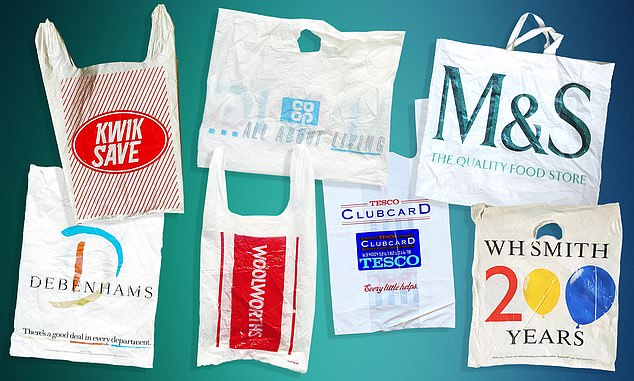

Years before Brits reached for a trendy tote or a Bag For Life, supermarket plastic bags were a staple household item that changed with each decade.
Much to the nation’s dismay, in 2015 single-use bags virtually faded into non-existence following a government-enforced plastic bag charge – which saw shoppers instead embrace the use of a reusable bag.
Yet while they are scarcely seen across UK supermarkets now, viewers of hit television star Rivals were recently given a fresh reminder of nostalgic carrier bags during the latest series release.
In keeping with the 80s’ time period of the show – character Taggie O’Hara, played by Bella MacLean, was seen carrying two bags of shopping in retro Waitrose carrier bags that led to several viewers relishing in the ‘nostalgic’ memories it generated.
And the appetite for nostalgic supermarket bags is certainly not wavering – with shoppers taking to retail sites such as Ebay to get their hands on second-hand retro carrier bags to relive the past.
Hull-based artist Aaron Thompson has also amassed more than 14,000 Instagram followers by sharing his impressive collection of vintage carrier bags with delighted social media users.
From discontinued shops such as Woolworths to British signature stores such as Tesco and Sainsbury’s, the British carrier bag has experienced a notable shift over the last 50 years.
Read on to see whether you can remember these nostalgic supermarket carrier bags, and which discontinued shops you may have forgotten about entirely…

Long before Brits reached for a trendy tote or Bag For Life, supermarket plastic bags were a staple household item reminiscent of different eras

While they are scarcely seen across UK supermarkets now, viewers of hit television series Rivals were recently given a fresh reminder of nostalgic carrier bags during the latest series release (pictured)
Waitrose

Supermarket giant Waitrose continues to dominate the high street, but the carrier bags have experienced a significant rebrand since the brand first opened its doors in 1904
Supermarket giant Waitrose continues to dominate the high street, but the carrier bags have experienced a significant rebrand since the brand first opened its doors in 1904.
While the bags are now a light green shade, the early plastic bags featured red stripes and a tagline which read: ‘Each week we price check hundreds of everyday items’.
Another variation of the Waitrose bag featured red stripes at a different angle and text which read: ‘Waitrose, food shops of the John Lewis Partnership’.
According to the Waitrose & Partners Memory Stre, the brand ‘did not advertise until the 1990s’ meaning that it was ‘important before that to try to catch the eye of customers’.
‘Orange was the predominant colour used until the current green colour scheme was adopted,’ it added.
‘In 1987 a new logo hit the high street and the typeface was used on the buildings as well as the carrier bags, other packaging and letterheading.’
Woolworths

Known for its pick ‘n’ mix sweets and bargain prices, Woolworths sold everything ranging from clothes, to records and household goods
Known for its pick ‘n’ mix sweets and bargain prices, Woolworths sold everything ranging from clothes, to records and household goods.
Affectionately referred to as ‘Woolies’, the department store chain closed its doors for good in 2009, much to the dismay of customers around the country.
Yet while the supermarket store may be no more – its retro bags live on in its memory, with several online users delighting in the nostalgia they bring.
Taking to Instagram to share an image of a late 90s Woolworths bag, Aaron wrote: ‘Woolworths… Up there for me personally with one of the best high street shops for multiple buys, could never leave this place empty handed.
‘Still dreaming for a resurgence, we can only hope?’
One commenter shared their joy at the vintage photograph, and wrote: ‘Ahh woolies you have my heart. Many memories there from buying my first cd with my own money and the pick and mix.’
Meanwhile, another added: ‘Woolies was a treat at the end of a never ending morning, and we never seemed to spend much time in there – or it was simply so good it went so quick. Still missed.’
Tesco’s

Founded in 1919 by Sir Jack Cohen, Tesco’s carrier bags have evolved over the decades to durable Bags for Life. Pictured: a retro Tesco carrier bag

Shoppers are taking to retail sites such as Ebay to get their hands on second-hand retro carrier bags to relieve the past
Founded in 1919 by Sir Jack Cohen, Tesco’s carrier bags have evolved over the decades to durable Bags for Life.
However, their once-loved plastic carrier bags proved immensely popular – and some shoppers may remember the retro 1980s blue stripes with Tesco written in bold text in the middle.
Another Tesco plastic bag was specifically made to commemorate the chain’s 50th birthday in 1981, and featured the old logo with a 50 sign filled with a tick.
Between 1981 and 1987, the Tesco logo was changed slightly to feature ‘Today’s Tesco’ and a tick, also known as a ‘checkmark image’.
According to Tesco, this logo was the most ‘noticeable change’ the brand had experienced thus far, with ‘today’s’ added to highlight ‘the network’s relevance’.
Sainsbury’s

In fact, older versions by the brand featured paler bags with blue text and a different font – while others were printed with the phrase ‘Sainsburys – Fresh Food Fresh Ideas’
While Sainsbury’s are commonly associated with bright orange plastic bags, this bright and bold visual has not always been the case.
In fact, older versions by the brand featured paler bags with blue text and a different font – while others were printed with the phrase ‘Sainsburys – Fresh Food Fresh Ideas’.
In the 1950s, Sainsburys began selling stronger paper bags with handles which featured the phrase: ‘Good food costs less at Sainsbury’s’, while customers were later given the choice between paper or plastic bags by 1978.
Taking to Facebook to place a retro Sainsbury’s shopping bag on sale, one thrifty user wrote: ‘I helped my neighbour clear this garage and I was ecstatic to find this mint condition, perfectly preserved mid 1990s Sainsburys carrier bag, just as I remembered them as a child.
‘Against all odds, the bag hasn’t degraded in any way and is still as good as the day it was made. I can’t wait to whip this out at the check out to load my shopping into, I hope to get complimented on my choice of retro and very rare bag.’
M&S

Throughout its 142-year history, the brand’s logo has shifted from a ‘St Michael’ image to a sleek and monochrome mark – and now features the simple ‘M&S’ initials with ‘EST 1884’ written underneath

As times have changed, so have the supermarket carrier’s shopping bags – with a green and white bag imprinted with ‘Marks and Spencer’ used in the 1970s, while an older variation featured ‘M&S The Quality Food Store’
Retail giant M&S has changed drastically over the years – but still remains one of the nation’s most popular stores for its high-quality options and reliable service.
Throughout its 142-year history, the brand’s logo has shifted from a ‘St Michael’ image to a sleek and monochrome mark – and now features the simple ‘M&S’ initials with ‘EST 1884’ written underneath.
As times have changed, so have the supermarket carrier’s shopping bags – with a green and white bag imprinted with ‘Marks and Spencer’ used in the 1970s, while an older variation featured ‘M&S The Quality Food Store’.
Yet while the retro bags may have been hugely popular, in 2008 M&S became one of the UK’s first major retailers to voluntarily introduce a 5p charge for plastic bags in a bid to slowly phase in an emphasis on reusable bags.
Debenhams

A historic British brad that later shifted into an online department store, Debenhams offers fashion, beauty and homeware and is firmly popular among British shoppers
A historic British brad that later shifted into an online department store, Debenhams offers fashion, beauty and homeware and is firmly popular among British shoppers.
However, since its onset in 1778, its bags have shifted drastically – with older variants featuring a blue, red and yellow symbol and the text: ‘Debenhams- There’s a good deal in every department’.
Taking to Instagram to share an image of the vintage bag, Aaron’s followers praised the ‘delightful’ retro item as ‘the best’.
‘I miss this arcade,’ commented one user. ‘Spent many hours as a teenager sitting in the garden bit eating sweets’.
‘Bring Debenhams back!!!,’ commented another.
Co-op

In 2016, Co-op launched a bid to win its shoppers over by returning to its 60s clover logo that was much-loved by customers across the nation

Vintage Co-op bags ranged from designs that featured light and dark blue swirls with the text ‘Your Caring Sharing Co-op’, alongside bags printed with the tagline ‘Co-Op Quality Foods’
In 2016, Co-op launched a bid to win its shoppers over by returning to its 60s clover logo that was much-loved by customers across the nation.
Vintage Co-op bags ranged from designs that featured light and dark blue swirls with the text ‘Your Caring Sharing Co-op’, alongside bags printed with the tagline ‘Co-Op Quality Foods’.
Yet while the retro bags may have been popular with many, the supermarket giant made the decision to opt for certified compostable carrier bags, while they have also removed Bags for Life from sale.
WH Smith

WH Smith has already undergone several changes in its logo and design – and now trades under its more recent blue and white logo
WH Smith has already undergone several changes in its logo and design – and now trades under its more recent blue and white logo.
WH Smith started as a news vendor, with its first store opened by Henry Walton Smith and his wife Anna in London’s Little Grosvenor Street, near Bond Street.
The company’s first travel store opened in London’s Euston station in 1848 and saw its glory days in the seventies and eighties.
Some vintage WH Smith bags from the 60s and 70s are almost unrecognisable from what we know the brand to look like today – with red and black designs, alongside bags from the retail’s record department.
Kwik Save

Launched in 1965, Kwik Save was a pioneering British discount supermarket chain that went into administration in 2007

While mostly defunct, the brand still draws large bouts of nostalgia for British shoppers – who delight in the rare sight of the vintage bags
Launched in 1965, Kwik Save was a pioneering British discount supermarket chain that went into administration in 2007.
While mostly defunct, the brand still draws large bouts of nostalgia for British shoppers – who delight in the rare sight of the vintage bags.
Indeed, one vintage Kwik Save carrier bag is being sold on Ebay for £30, while other variants of the retro carrier bags are retailing in the £12 to £18 region.
‘You don’t know what you’ve got until it’s gone!,’ commented one nostalgic Instagram user on a picture shared of a retro Kwik Save bag.
‘We didn’t deserve Kwik Save!,’ they added.