
Think acne is only a problem for teenagers? Think again.
A global study of more than 50,000 people published in a US journal last year suggests that almost one in ten of us aged between 40 and 64 suffer from acne. So what’s going on?
‘It can often be related to hormones,’ says Dr Emma Craythorne, a consultant dermatologist and founder of prescription-by-post skincare brand, Klira.
‘Women in their 30s may come off the oral contraceptive pill because they want to conceive and find that the pill was controlling their androgens (the name given to “male” hormones, such as testosterone, which can increase levels of oil in the skin) so they start to develop acne.’
She adds: ‘Others in their late 30s and early 40s may be perimenopausal, so also suffering from the hormone fluctuations that can lead to androgens becoming dominant, and causing a flare-up.’
Dr Ophelia Veraitch, a consultant dermatologist based on London’s Harley Street, flags that hormones used in fertility treatment – which is increasingly common among women in their 40s – and HRT may also cause acne.
But lifestyle factors can be to blame, too. ‘Stress and lack of sleep, which we see a lot of in women juggling a career and family, can have an impact, and living in busy cities where pollution is higher is also correlated with a higher incidence of acne,’ says Dr Craythorne.
But what if you have no issues with hormones, stress or city life, but still have unsightly outbreaks? Your skincare regime could be the culprit – and not for the reasons you might expect.

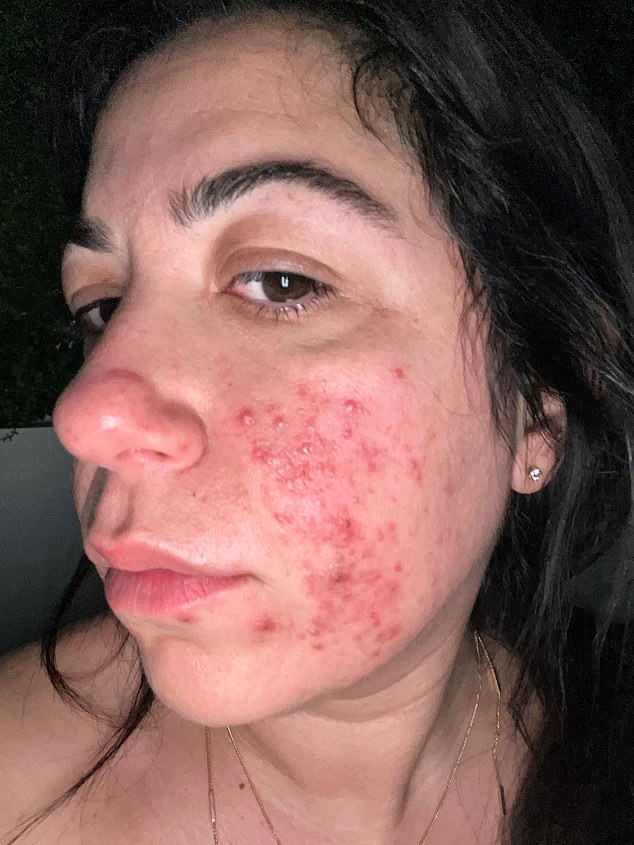
Nadine Arbiter developed a full face of bright red acne that was ‘incredibly sore’
‘Women who use a lot of different products – and specifically luxury products – seem to be developing contact allergies. That’s because a lot of the high-end products, whether cleansers, serums or creams, include ingredients such as fragrance that can cause these types of allergies,’ says Dr Veraitch.
‘It’s really common among beauty journalists and women who spend a lot on their skincare, mistakenly thinking it’s better for their skin. And just because you’ve not had a reaction to an ingredient before doesn’t mean you won’t.’
‘Immune cells sit in the skin and when you repeatedly expose them to allergens – such as certain fragrance ingredients – they eventually react,’ she explains.
The problem is that as your skin doesn’t react straight away – it may be weeks later – and not necessarily in the spot where the product was used, people don’t always make the connection. And once you’ve caused the problem, it may trigger serious issues requiring more than just a skincare switch-up.
That was the case with one of Dr Veraitch’s patients, Nadine Arbiter, now 39, who developed ‘a face of full-blown acne that was bright red and incredibly sore’ despite never previously suffering from acne. Nadine, a school receptionist from Hertfordshire, was devastated.
‘I remember people who hadn’t seen me for a while would come in and do a double take. It was covering my face and red raw. I couldn’t put make-up on it. I just felt so self-conscious and was so depressed.’
She tried a number of approaches, from the high-end products that she’d used in the past to a skin clinic that ‘tried to sell me a million products and acid peels’. But nothing worked.
‘Eventually my mum told me, “You need to stop. I’ve found a dermatologist and booked you in to see her.”’

Nadine hasn’t had any spots for the last nine months following Dr Veraitch’s treatment

Dr Emma Craythorne, a consultant dermatologist, agrees that a simple skincare routine of non-fragranced, non-foaming cleansers is best
The first thing Dr Veraitch did was tell her to scale back her skincare regime entirely.
‘If your skin is really badly inflamed, you need to go back to basics. I tend to recommend non-fragranced, non-foaming cleansers such as Cerave or Cetaphil, and Cetraben if you need a moisturiser.’
Dr Craythorne is also a fan of this approach, recommending the Cetaphil Gentle Cleanser and Day Moisturiser as well as the La Roche-Posay Toleriane range.
‘These can be incredibly helpful for just trying to restore the skin barrier,’ she says.
A lot of people are tempted to self-treat with over-the-counter spot treatments such as benzoyl peroxide and salicylic acid, but Dr Veraitch warns that these can be quite aggressive. She recommends seeing your GP – who may be able to pinpoint the cause.
‘A course of antibiotics – which I prescribed Nadine and which GPs can prescribe – can also help a cystic flare,’ she says. ‘But it may be that you need to tweak your HRT, rethink your contraception, or that you require medication, such as a topical retinoid.’
Dr Craythorne agrees that the gold standard treatment for any acne is 0.025 per cent tretinoin – a form of vitamin A that is stronger than retinol and only available with a prescription
Second to that is 20 per cent azelaic acid, she says, so a combination of the two is perfect.
She and Dr Veraitch are also both fans of spironolactone – a drug which blocks some male hormones that play a key role in the development of acne.
It’s also the drug that Dr Veraitch prescribed to Nadine which she is still taking.
‘I haven’t had any spots for about the last nine months so we’re thinking of lowering the dosage,’ says Nadine.
‘Within three months, my skin was much less red.’
That, plus a course of Fraxel laser – a treatment to resurface the skin that starts at around £600 – for scarring and redness, has cleared her complexion.
‘I’ll never take my skin for granted again,’ she says.
As for swanky skincare?
‘Never again, I honestly believe a simple skincare routine is the answer to everything.’
And if that’s not the case, seek medical help. ‘While there are some things you can do, usually it requires medical intervention and treatment to get acne under control,’ says Dr Craythorne.