Chances are you’ll spend some extra time in bed with your partner over the Christmas period – but are you dreading it or delighted by the prospect?
Do you drift off blissfully wrapped around them or do you cling resentfully to the mattress edge? Experts suggest your preferred sleeping pose could reveal much about the health of your relationship.
Professor Richard Wiseman of the University of Hertfordshire surveyed 1,000 sleepers and found 94 per cent of couples who touched during the night classed themselves as happy, compared with 68 per cent who kept their distance.
And a 2025 poll of 2,000 people by the bed company Dreams showed a third of couples admit they are not ‘sleep compatible’ thanks to snoring or duvet-hogging, and one in five already decamp to separate rooms.
So what does your sleeping position say about you and your love life? Here’s the experts’ verdict…

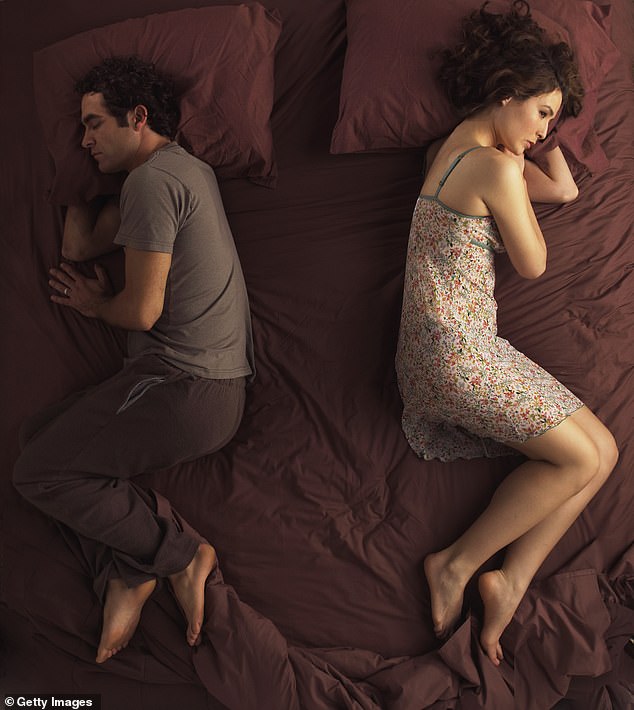
Partners face away with a gap between them: This can signal healthy independence – or resentment. If this isn’t a normal sleep position, it may be because there is an unspoken tension
THE SPOON
What it looks like: One partner curls protectively around the other from behind.
Wiseman’s study found that spooning – classic, cosy, and rom-com endorsed – is a favourite of about 31 per cent of couples.
It’s a pose that floods the brain with oxytocin, the ‘love hormone’ key to bonding, higher levels of which are linked to fewer sleep problems.
‘This position usually shows intimacy, closeness and trust,’ says psychotherapist Yasmin Shaheen-Zaffar. ‘This dynamic can be healthy and comforting when both partners feel safe and content, but can lead to imbalance if one partner’s needs overshadow the other’s.’
THE DIVORCE RED FLAG
What it looks like: The woman wraps around her partner.
Sounds cosy, but a survey of nearly 10,000 divorced Britons found 86 per cent had slept this way before splitting. With women initiating 63 per cent of UK divorces, researchers suspect the pose may reflect a last bid to chase closeness when she feels he has turned his back on romance.
Shaheen-Zaffar says this position ‘can reveal an emotional imbalance’. Think about whether the daytime workload – emotional or practical – is just as lopsided, and look for ways to rebalance things together.
HONEYMOONERS ONLY
What it looks like: Partners lie nose to nose, with their hands or legs intertwined.

Couple lie nose to nose, with their hands or legs intertwined. The position suggests passion and is common in new relationships
Only 4 per cent of couples fall asleep nose-to-nose. The position suggests passion and is common in new relationships. However, it can feel claustrophobic, and morning breath does little to enhance romance.
‘Sleeping face-to-face indicates emotional closeness and open communication,’ says Shaheen-Zaffar. ‘But it can also indicate insecurity. Think about whether the intimacy feels natural or driven by anxiety.’
Sleep expert Dr Neil Stanley says it is unrealistic to think you can sleep well if entangled all night. He adds: ‘If you say you like knowing your partner is there, they’re disturbing your sleep, or you wouldn’t notice.’
BACK TO BACK
What it looks like: Partners face away, but backs, bottoms or feet stay in contact.

Partners face away, but backs, bottoms or feet stay in contact is especially popular with extroverts, who get energy from connection
Chosen by 42 per cent of partners, 94 per cent of whom report relationship happiness. Professor Wiseman says it’s especially popular with extroverts, who get energy from connection.
Shaheen-Zaffar says: ‘There’s an unspoken message in this position: I’m here for you, and I trust you’re here for me.’ Light physical contact promotes sleep-enhancing, bond-building oxytocin, while each body enjoys its own cool flow of air.
BACK TO BACK – BUT SEPARATELY
What it looks like: Partners face away with a gap between them.
A gap can signal healthy independence – or resentment, says Shaheen-Zaffar. ‘If it isn’t your normal sleep position, it may hint at unspoken tension.’
But Dr Stanley says not touching can reflect personal comfort rather than an emotional statement. ‘At night, we move for pressure relief or to find a cooler patch, but if you bump into an obstruction, it can wake you. Prioritise your sleep.’ If your distance feels emotionally frosty, schedule a chat during your waking hours.
THE CLIFFHANGER
What it looks like: Both partners cling to opposite edges of the bed.
Professor Wiseman’s study shows happiness plunges from 86 to 66 per cent once the gap between sleeping couples exceeds 30 inches – though only 2 per cent drift that far.
‘Context matters,’ says Shaheen-Zaffar, and some simply crave space. Consider investing in a bigger bed. If rolling over takes the duvet with you, that can trigger conflict. A simple solution: Two single duvets. You can hold hands but wake warm and resentment-free.
THE STARFISH
What it looks like: One partner sprawls spread-eagle, the other hugs a sliver of sheet.
‘This can signal subconscious dominance or an unconscious need for more personal space,’ says Shaheen-Zaffar.
‘It might also reflect one partner feeling undervalued or overlooked, subconsciously taking up more space to assert their presence.’ However, Stanley points out couples in a standard double bed each have nine inches less room than a child in a single bed.
Consider upgrading to a king size – and apply a nudge with an elbow when needed.
THE ‘SLEEP DIVORCE’
What it looks like: Separate beds or even separate rooms.

‘Think of separate rooms as a luxury rather than a sign of emotional failure. If you sleep better apart, you might just love each other more in the morning,’ says Dr Stanley, author of The Sleep Divorce: How to Sleep Apart, Not Fall Apart
In 2020, one in six UK couples snoozed separately – twice the number in 2009. Actress Cameron Diaz, married to rocker Benji Madden, has previously said sleeping in separate beds should be ‘normalised’.
Dr Stanley, author of A Sleep Divorce: How To Sleep Apart, Not Fall Apart, says separate bedrooms can be a pragmatic solution to a problem, rather than a reflection on your relationship.
‘You can kiss and cuddle, then go to your own bed. That’s better for your relationship than waking up exhausted.
‘Think of separate rooms as a luxury rather than a sign of emotional failure. If you sleep better apart, you might just love each other more in the morning.’