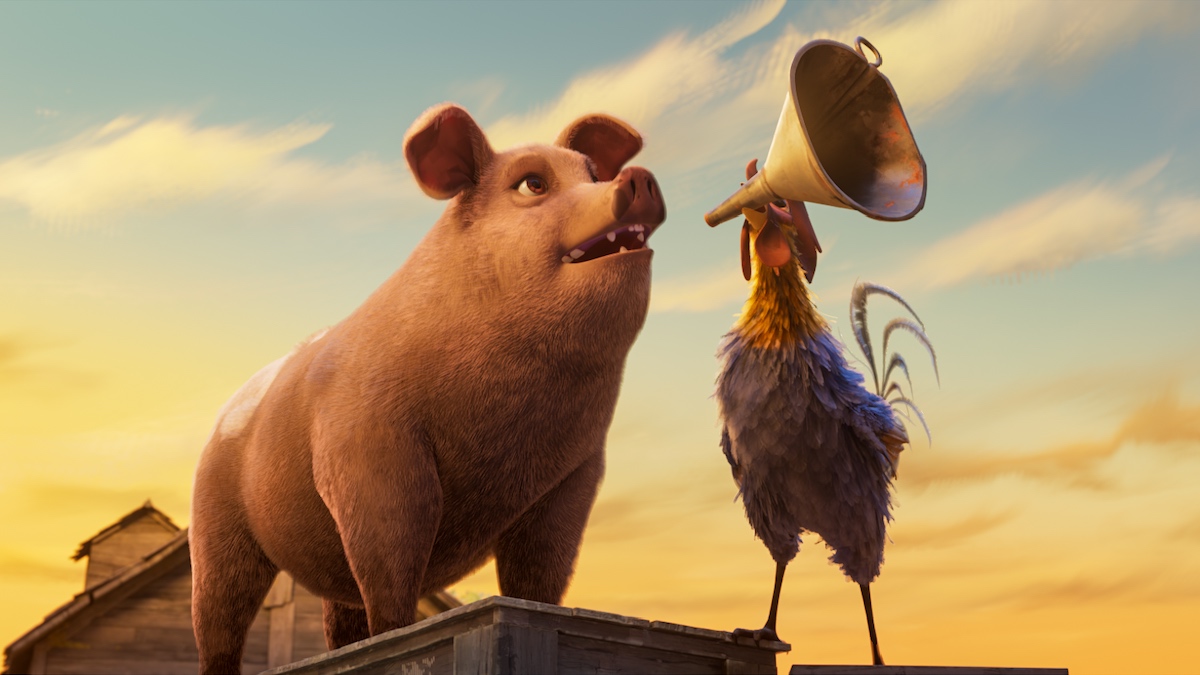

All kids’ movies are equal, at least in some way. They fundamentally exist to entertain the youngest members of a studio audience, which requires broad jokes, over-the-top visuals, and simplistic morals. But some kids’ movies are more equal than others, as anyone who has seen a great Hayao Miyazaki or Pixar movie can attest. There’s a difference between simple and artless.
Judging by its latest trailer, it’s hard to tell where the big screen adaptation of Animal Farm will fall. The film certainly has the pedigree to be a higher-end kid’s film, as it draws inspiration from the 1945 George Orwell novella and is directed by Andy Serkis, a great motion-capture actor and solid filmmaker in his own right. But the trailer leans hard into jazzy music, obvious gags, and celebrity voices, suggesting that the picture resembles lesser Illumination and not even the 1954 Chuck Jones version of Animal Farm.
As any English teacher worth their tweed can tell you, Animal Farm is an allegory about the Russian Revolution and rise of Joseph Stalin. Set on Manor Farm in England instead of 1917 Russia, the story follows boars Napoleon and Snowball as they overthrow the human Mr. Jones and establish a new regime in which all the animals rule equally. However, when Snowball and Napoleon fall out over plans to build a windmill, the latter chases the former away and establishes himself as supreme leader. As the book goes on, Napoleon asserts more control, turning against his fellow animals and, in an ironic closing, adopts the same posture as the humans he once considered his enemies.
Between its ingenious use of allegory, its political relevance to the 20th century, and its fairly short length (at least compared to Orwell’s towering 1984), Animal Farm has long been a staple of high school English classes. But in the U.S. at least, Animal Farm has joined 1984 as a frequently misunderstood text, with too many readers missing the book’s pointed criticism of Stalin. Instead, they read it as a satire against all forms of communism, ignoring Orwell’s own democratic socialist beliefs (and, it must be said, Orwell’s warnings about misuse of the English language).