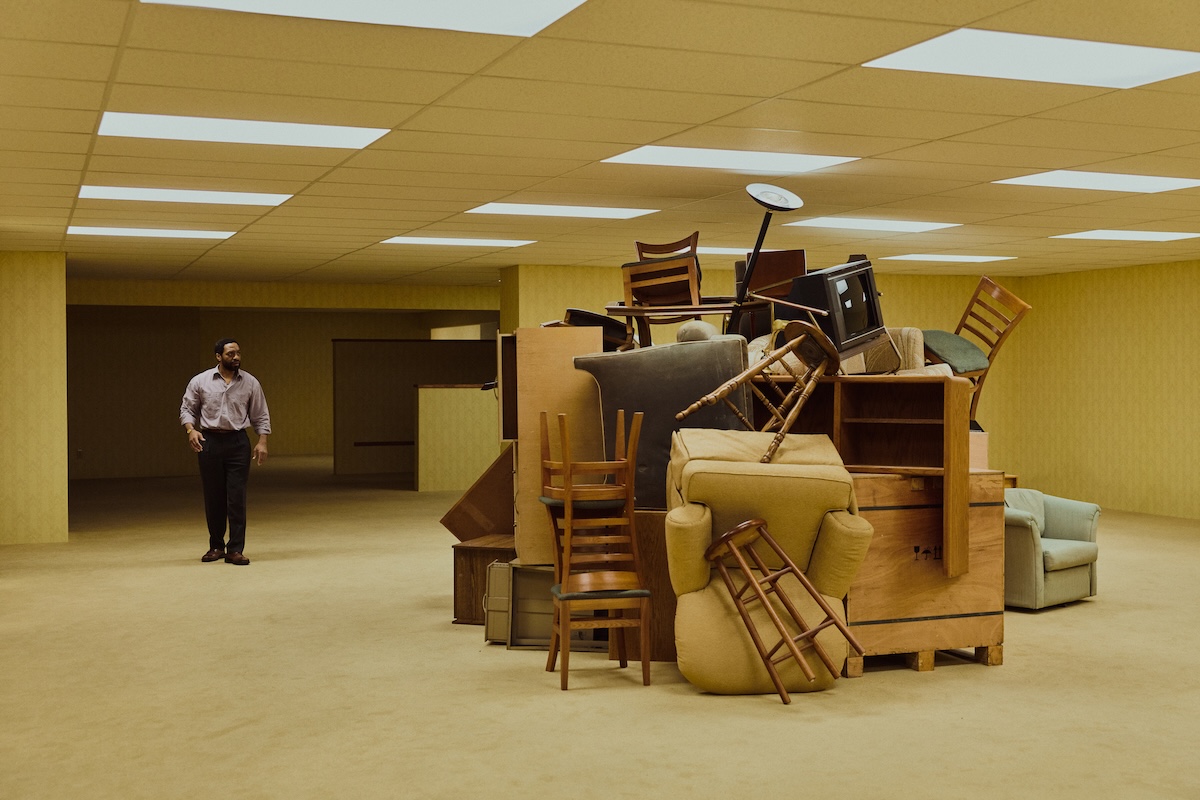

As Clark explores further into the backrooms, he finds more of the same. Each of the rooms have hallways, but the hallways lead to more hallways and the rooms serve no purpose. Couches appear would no one would place them, let alone sit in them. Windows let in no light and let no one look through.
To his credit, Parsons doesn’t offer an explanation for how or why the space works. Even the scientist (Mark Duplass) who rescues Mary at the end has no real insight into the space’s function. Instead, we just know that the space remembers things, and as it returns to each memory, it gets something wrong. It hyper-fixates on a specific detail while overlooking the generalities. So we see a room with chairs, but the chairs are scattered in front of the door or stacked up one another. We see a bathroom with a line of sinks in the middle and a tub sunk into the floor.
The horrors climax with four people: a small man fused to his wheelchair who can only turn on a light, a large man with cascading eyes and noses, a woman with a shuddering effect on her face, and lumbering, giant recreation of Clark in his pirate costume.
These images bring to mind the images that have littered the internet since techies started really pushing generative AI as a creative tool, bodies that blend together as they move past each other and arms jutting out of nowhere, topped by hands with too many fingers. Or, more befitting the “copy of a copy” language of Backrooms, they recall the game where users ask ChatGPT to replicate an image, each result growing more grotesque.
As that last example underscores, most people have been making ChatGPT replicas as a type of a game. But the terror invoked by the uncanny in Backrooms shows that there’s nothing funny about it at all. AI has no concept of the human, and thus its attempts to replicate life only make a mockery of humanity, twisting and reflecting in ways that feel all the more monstrous because of how normal it wants to be. When we look at an AI image, whether Owen Wilson staring dead-eyed in a simulacrum of Wes Anderson directing Star Wars or a fake pitch woman selling home improvement services, we feel ourselves slightly diminished, and it’s terrifying.
Moving Forward, Better
Of course, nothing in the text of Backrooms is about AI. Instead, the movie is explicitly about holding to memories and refusing to evolve. In perhaps the most heartbreaking moment of the film, Clark submits to the nightmare of conformity that he’s confused for safety, declaring to Mary, “I don’t want to change.”