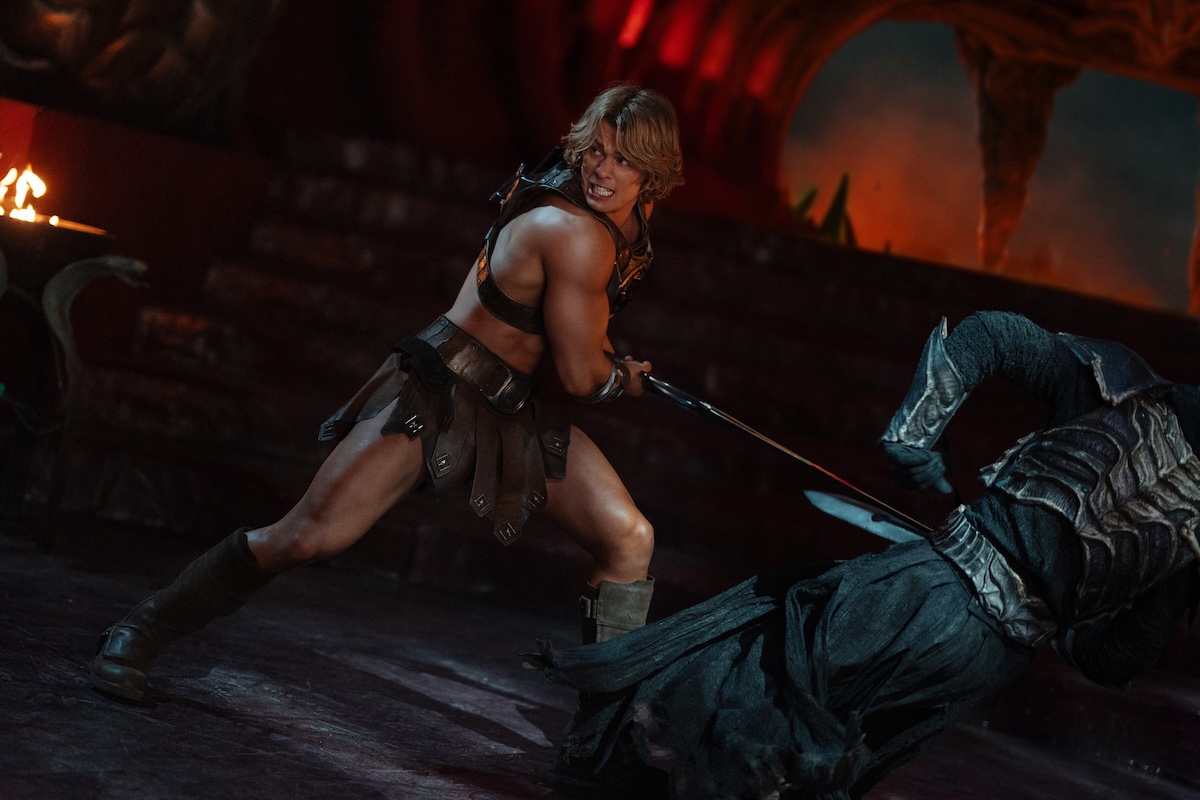

Furthermore, Masters of the Universe enters a cinematic landscape defined by self-awareness. Love or hate it, nerd culture still exists in the shadow of Joss Whedon, who wrote characters that were both pop culture savvy and unimpressed with the whole thing. Whedon brought that approach to movies by writing and directing the first two Avengers movies, in which Tony Stark dismissively refers to the team as “Earth’s Mightiest Heroes,” dismissing the tagline that debuted in 1963’s Avengers #1.
Moreover, Masters of the Universe sits in the shadow of Barbie, a wildly successful adaptation of Mattel’s other toy line. Greta Gerwig and co-writer Noah Baumbach filled their movie with jokes about the appropriateness of a pregnant doll sold to kids or the uselessness of Alan. But those quips came with a point.
Take one of Barbie‘s best gags, when Stereotypical Barbie bawls about never being conventionally attractive enough, a claim undercut when Helen Mirren’s narrator interjects to point out that Margot Robbie is the definition of conventionally attractive. That’s a metajoke about the silliness of the story and the scene, but it has a point, one tied to the history of the toy line. As a product, Barbie has reinforced limited standards of beauty, and the knowing gag operates less as the filmmakers’ condescension and more like their acknowledgment that these toys matter, that they have larger social effects. The film feels an obligation to address those effects, and it does so through a metajoke.
Get More Stupider
Masters of the Universe has no such obligations. The screenplay tries to say something about how Skeletor uses power to hurt and how He-Man uses power to help, and how listening and friendship is its own type of power. But all that falls flat, for the exact reason stated by the film. Adam tries to talk it out with a blue-skinned pirate monster or to an evil wizard with a skull for a face, who openly declares that he loves being evil. By the climax of the film, even He-Man says “The time for talk is done,” and wallops Skeletor with his bare fists.
In short, He-Man doesn’t have same cultural impact as Barbie and doesn’t have nearly as much to say about masculinity. Moreover, attempting to talk about masculinity and power undermines the sole reason for Masters of the Universe‘s existence, the opportunity to watch crazy musclemen beat each other up.
The same is true of the metatextual jokes in Masters of the Universe. Yes, we all know that it’s silly for Ram-Man to slam into people with his head. And, yes, all of us grown-ups now realize that the name “Fisto” has an extreme double entendre. But when Fisto (Jóhannes Haukur Jóhannesson) declares that he’s going to fist all the bad guys and tells Ram-Man to “give them head,” we don’t need him to then stop and apologize with embarrassment.