
In the broadest of strokes, director Antoine Fuqua and screenwriter John Logan show no interest in breaking the standard musical biopic tropes, even when they stretch believability. So when Michael turns on the television immediately after saying that he wishes his music could make a difference in the world, you know that he’s going to see something about street gang violence. Fuqua cuts from grainy news footage of Crips and Bloods swearing undying hatred back to Michael, looking on with endless compassion. In the very next scene, he’s assembled actual gang members to watch him practice “Beat It.”
In contrast to the barbarity shown on the news, the Crips and Bloods barely seem annoyed with one another in Michael’s soundstage. Nor do they poke any fun at the professional dancers cosplaying as street toughs who come to do choreography with MJ. Instead reaction shots reveal them looking on with awe and delight. Such is the power of Michael.
Or so we assume, as the gang members never appear again in the film, having done their duty in proving the star’s incredible goodness. Such is the case with all of the normal people not fit to touch the hem of Michael’s glove. Throughout the movie, Michael will stop to give autographs to children or visit victims in the hospital. But outside of one or two minute-long conversations, the adoring public exists to do nothing more than that: adore.
Astonishingly, Michael almost pulls it off. Not because of anything Fuqua does with the camera. While he does sometimes interject notes of style, such as giving the arrival of Bubbles the Monkey a full superhero-style reveal, or cutting from Joseph Jackson signing a promotional deal with Pepsi to Michael watching Charlie Chaplin struggle with a conveyor belt in Modern Times. Mostly though, he plays things straight.
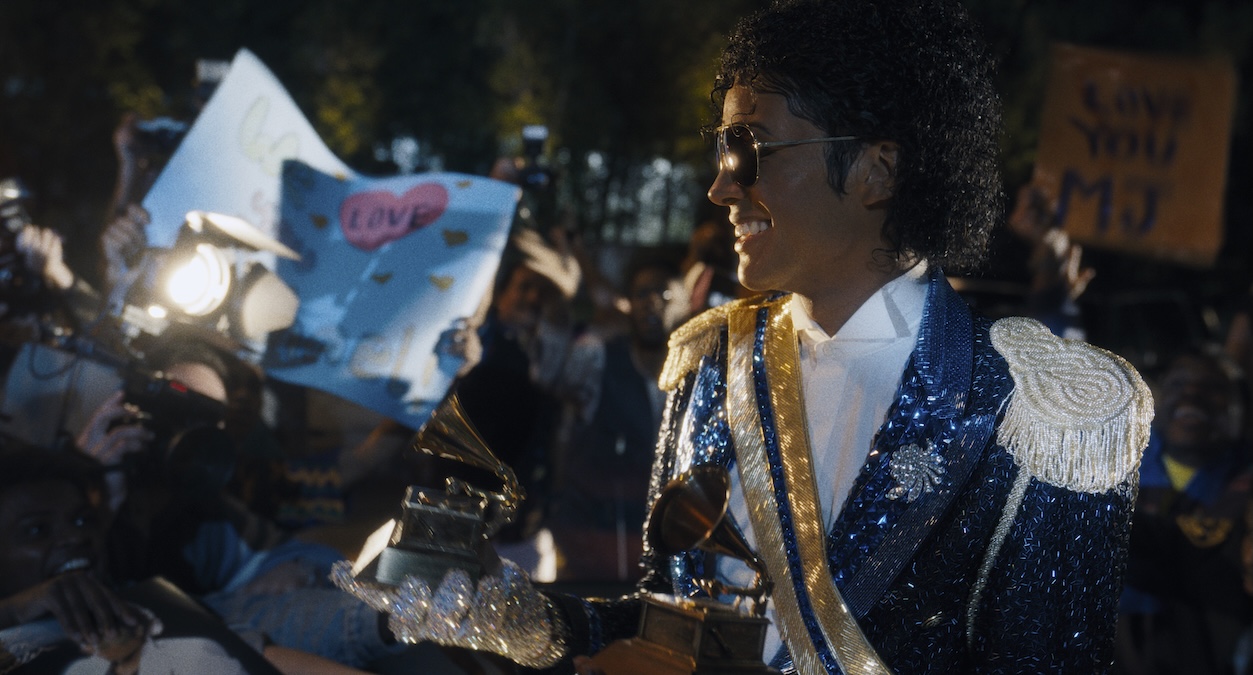
Still, the film almost works because of the central performances. Jaafar Jackson has an incredible smile and he knows how to use it on camera. He embodies both the gentle warmth of this movie’s Michael and can do the jaw-dropping dance moves of the real-life performer. The film doesn’t give him much interiority—even the brief acknowledgment of Michael’s predilection for plastic surgery is immediately externalized to be an extension of his father’s demands, with papa repeatedly calling his son “big nose.” But Jaafar delivers as a singing and dancing saint.
Even better is Domingo, in an utterly over-the-top performance as Joseph. Bringing even less subtlety than he does playing a literal cartoon supervillain in Your Friendly Neighborhood Spider-Man, Domingo seems to channel Al Pacino as Big Boy Caprice in Dick Tracy, and not just because of his wig and prosthetics. Domingo is all feral energy as Joseph, prowling around the Jackson home, staring down his family and letting his mouth dangle open, ready to devour his sons. Even before he meets in a lacquered office with promotor Don King (Deon Cole) to share cigars and cackle over their big business plans, Joseph is evil incarnate, and Domingo embraces the role without embarrassment.