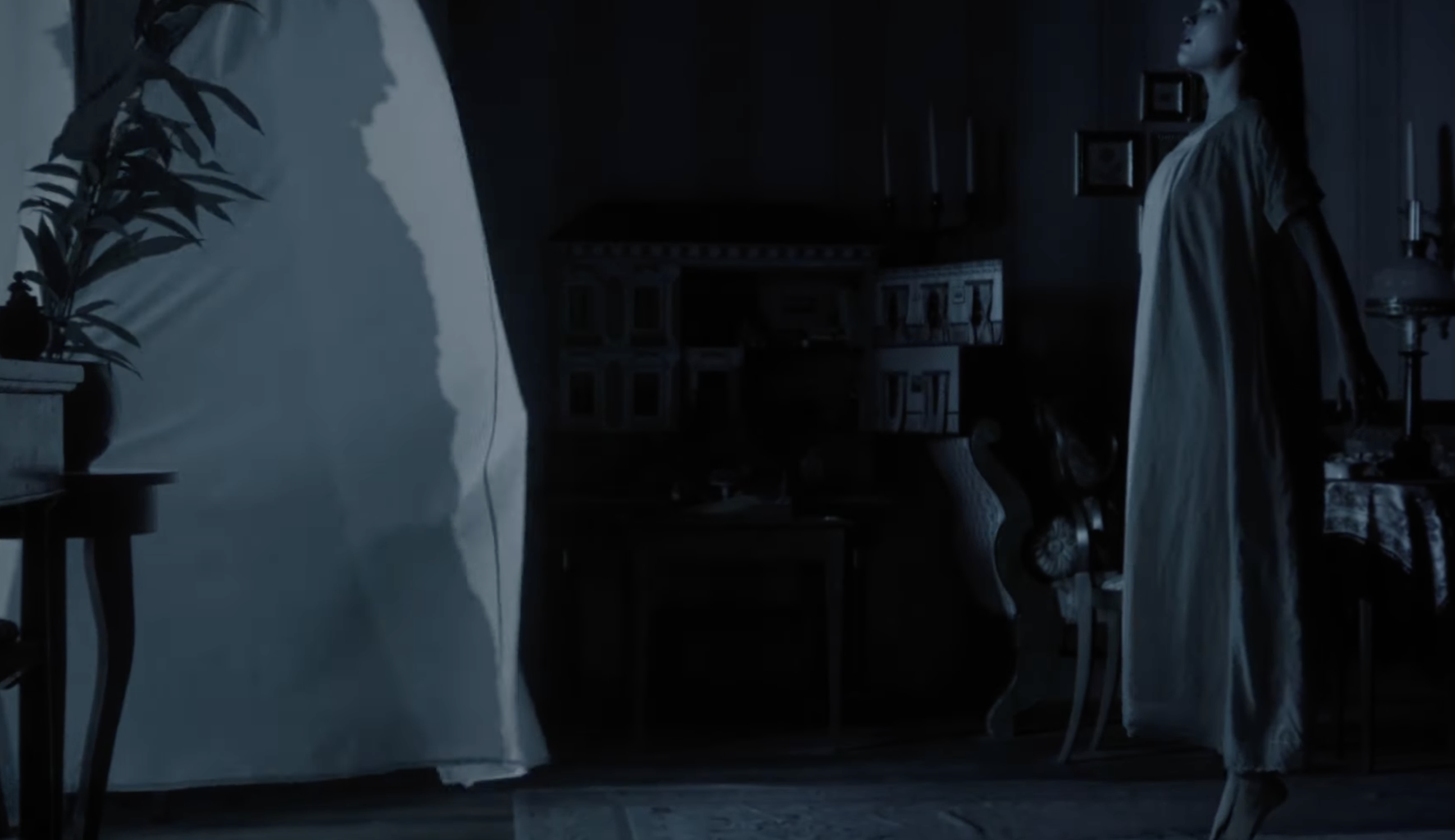

Even if you don’t know Nosferatu, you know Nosferatu. Part of that knowledge comes from the promotional trailers that Focus Features has been running for the past several months, building excitement for the film’s Dec. 25 release. The latest one, in fact, focuses on Lily-Rose Depp as the story’s Ellen Hutter, a Mina Harker equivalent if you know your Dracula, and her desire for the titular vampire. As her husband Thomas (Nicholas Hoult) and Prof. Albin Eberhart Von Franz (Willem Dafoe) look on in confusion, Ellen explains the fear mixed with excitment that draws her to the bloodsucker Count Orlok (Bill Skarsgård).
The trailer ends with a profile shot of Ellen staring out an open window, the breeze blowing the blue curtains toward her. Through the rustling curtains we see the outline of a vampire. We see Orlok.
Orlok’s silhouette is the other reason you probably know Nosferatu. An unauthorized adaptation of Bram Stoker’s Dracula, the 1922 German film, Nosferatu: A Symphony of Horror, remains one of the most recognizable movies of the silent era. Although it didn’t properly enter the public domain in the U.S. until 2019, Nosferatu was often treated as copyright-free, with shots from the film integrated into other works (the opening credits to Ernest Scared Stupid, for example).
For that reason, most people have seen Orlok’s (Max Schreck) shadow, complete with clawed hands, creeping along the wall. But it isn’t just the movie’s cheap availability that made the shadow shot so popular. Director F. W. Murnau was one of the key figures in the German Expressionist movements, which used sharp angles and exaggerated proportions for surrealist effect. Orlok’s shadow suggests something inhuman and twisted, all because of the way the darkness hits the wall.