
A loose adaptation of Joseph Conrad’s Heart of Darkness transplanted into the Vietnam War, Apocalypse Now follows Captain Willard on a mission deep into the Vietnamese wilderness to assassinate the AWOL Colonel Kurtz (Marlon Brando). Along the way, Willard introduces viewers to the absurdities and excesses of America’s actions in Vietnam, none more absurd and excessive than the Ranger unit led by Duvall’s Kilgore. Willard describes Kilgore as a leader beloved by his men for his commitment to fun, trying to make the front feel like home. For example, when Kilgore learns about incredible waves in the area where Willard needs to go, he dismisses concerns that the Viet Cong (“Victor Charlie” in G.I. slang) control the point by bellowing, “Charlie don’t surf!”
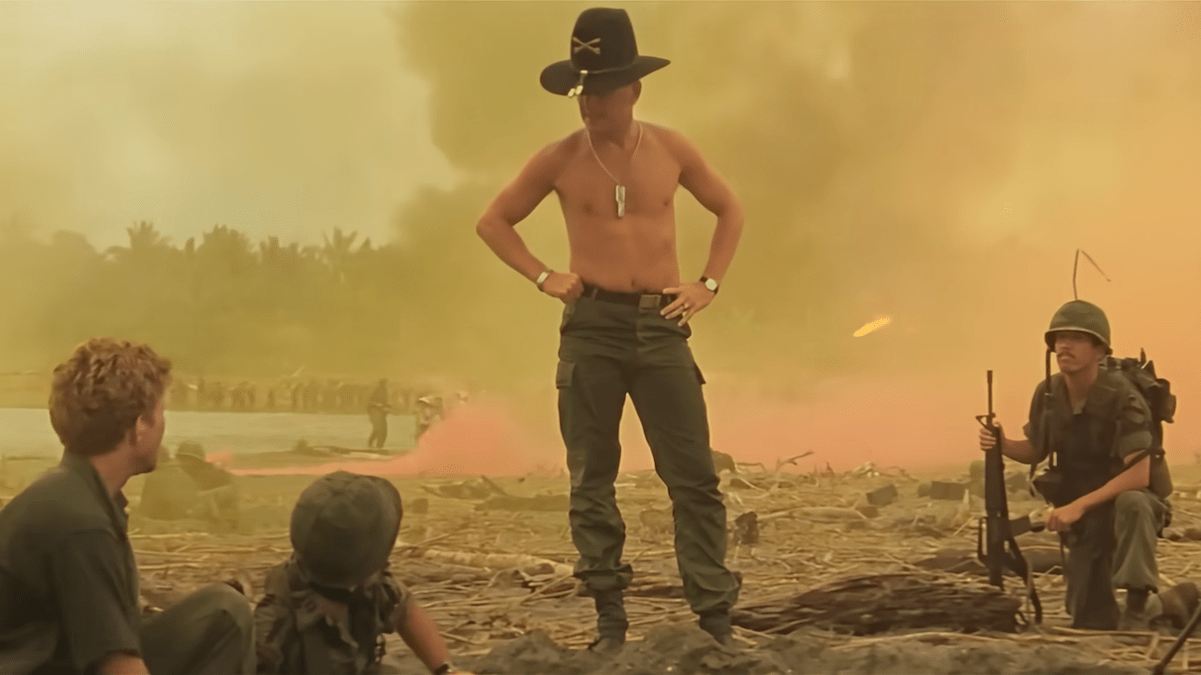
It’s Kilgore who sends his choppers over the beach, set to the strains of Richard Wagner’s “Ride of the Valkyries.” It’s Kilgore who strips off his shirt and orders a napalm strike, all while stopping to hurry a Vietnamese mother and young child to safety and to urge a champion surfer in Willard’s charge to hit the waves. And it’s Kilgore who pauses a moment to enjoy the smell of napalm.
Quiet Within Kilgore
His chest puffed out and his arms on his side, Kilgore is all American pride. “That’s napalm. Nothing else in the world smells like that,” he tells his men, before crouching down to get closer to them. He almost casts aside the line “I love the smell of napalm in the morning,” getting it out of the way so he can recall for his men a napalm attack that wiped out the enemy before they could even fight them. Coppola and cinematographer Vittorio Storaro push the camera in on Duvall’s face as Kilgore wraps up his story, his vocabulary running out as he tries to come to the point. “It smells like…” Kilgore says, pausing and twisting his face as he looks for the right word to capture the magnitude of the moment. Finally, satisfaction fills his face and he allows himself a smile. “Victory,” he declares.
Kilgore follows up his statement with a small smile and nod, and then looks off into the distance to let the moment sink in. Despite, or because of, the mustard yellow smoke drifting past, Kilgore seems fully at home, if not happy, thanks to the twinkle that Duvall puts in his eye. A small explosion behind him doesn’t shock Kilgore out of his revery, but it does mark a change in Duvall’s body language. The beefy stance he once held has become limp, and the confidence on his face has dropped.
“Someday this war is gonna end,” he observes to Willard, with just a hint of frustration. He gives a consoling smile and nod, but even he can’t keep up the facade. Instead, he sulks away in frustration, tossing aside the bit of straw he had been chewing on, as if now embarrassed by all of his bluster.
The Real Within the Ridiculous
Apocalypse Now is an over-the-top take on a war film, and Colonel Kilgore is its most cartoonish figure. As much as writers such as Tim O’Brien have told us that the inexplicable happened in Vietnam, we viewers still have a hard time believing that the conflict would have someone who surfed in the middle of battle or blasted Wagner from his chopper. Even if an actor wanted to locate some humanity in Kilgore, they couldn’t find it with what was on the page.