
Hobie gained his powers while squatting in a property owned by Norman Osborn, the slum-lord-turned-fascist president. Joined by Captain Anarchy (his world’s version of Captain America, represented by Karl Morgenthau a.k.a. Flagsmasher instead of Steve Rogers) and the tattooed Robbie Banner a.k.a. Hulk, the Anarchic Spider-Man resists the Kingpin’s businesses, Osborn’s police, and even the Nazi punks Kraven and the Hunters.
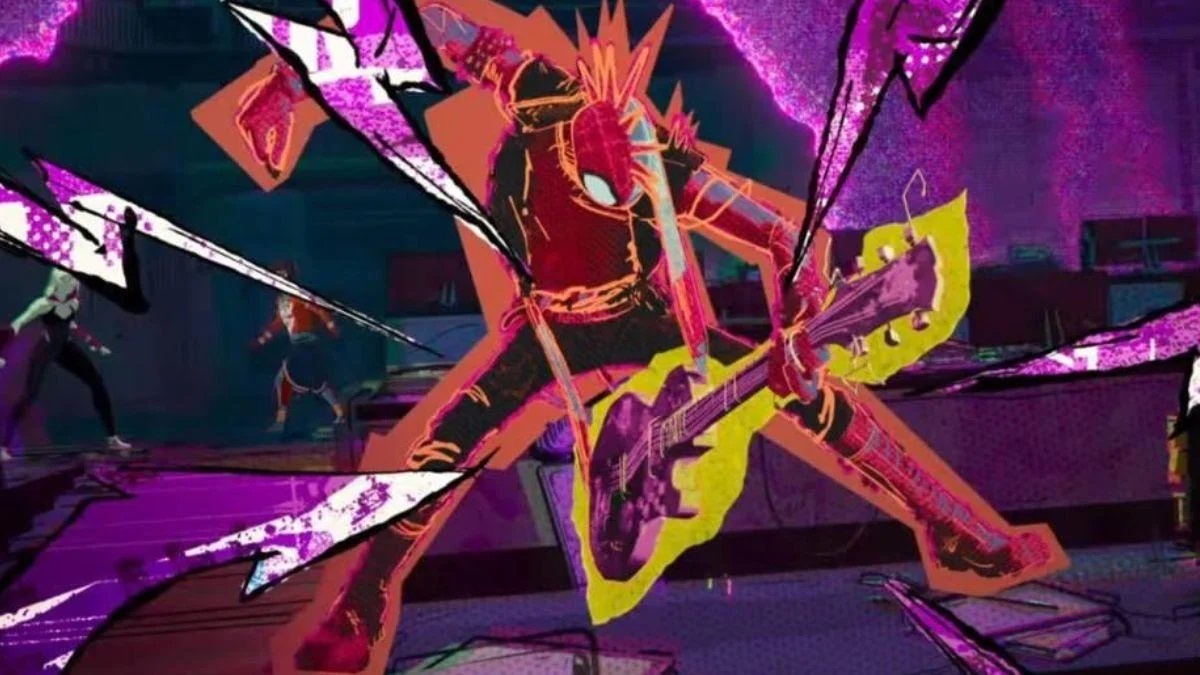
Surprisingly, a lot of that back story makes it into Spider-Punk’s introduction in Across the Spider-Verse. Rendered in unstable newsprint, Hobie brags about “antagonizing fascists” and staging “unpermitted political action/performance art pieces” and, um, briefly being a runway model. Amidst the collage of images accompanying his backstory, we see Hobie and his pals defacing the Kingpin’s advertisements, punching cops, and leading riots. We even notice the blue laces on his boots, indicating ACAB sentiments.
While Spider-Verse leaves space for poking fun at Hobie (“I thought you didn’t believe in labels,” quips Miles Morales after Spider-Punk calls anyone who wants to be a hero an “autocrat”), it’s also quite clear in the character’s morals. He hates the police, he mistrusts government.
Obviously, those sentiments are unpopular in popular culture. Cop shows remain mainstays on television and military action makes up a good chunk of film and video games. Moreover, studio heads seek increased profits by appeasing conservative forces in power, as demonstrated by Disney suspending Jimmy Kimmel and Paramount head David Ellison seeking President Trump’s approval. The consolidation of Warner Brothers into Netflix only makes things more difficult.
Yet, if Kaluuya and Singh are going to do anything with Spider-Punk, they must be anarchic, they must be against the police. Obviously, it isn’t up to them, and their bosses—the global megacorporation Sony—will have to approve it. But if they don’t make a Spider-Punk who hates cops and capitalism, then they aren’t making Spider-Punk at all.