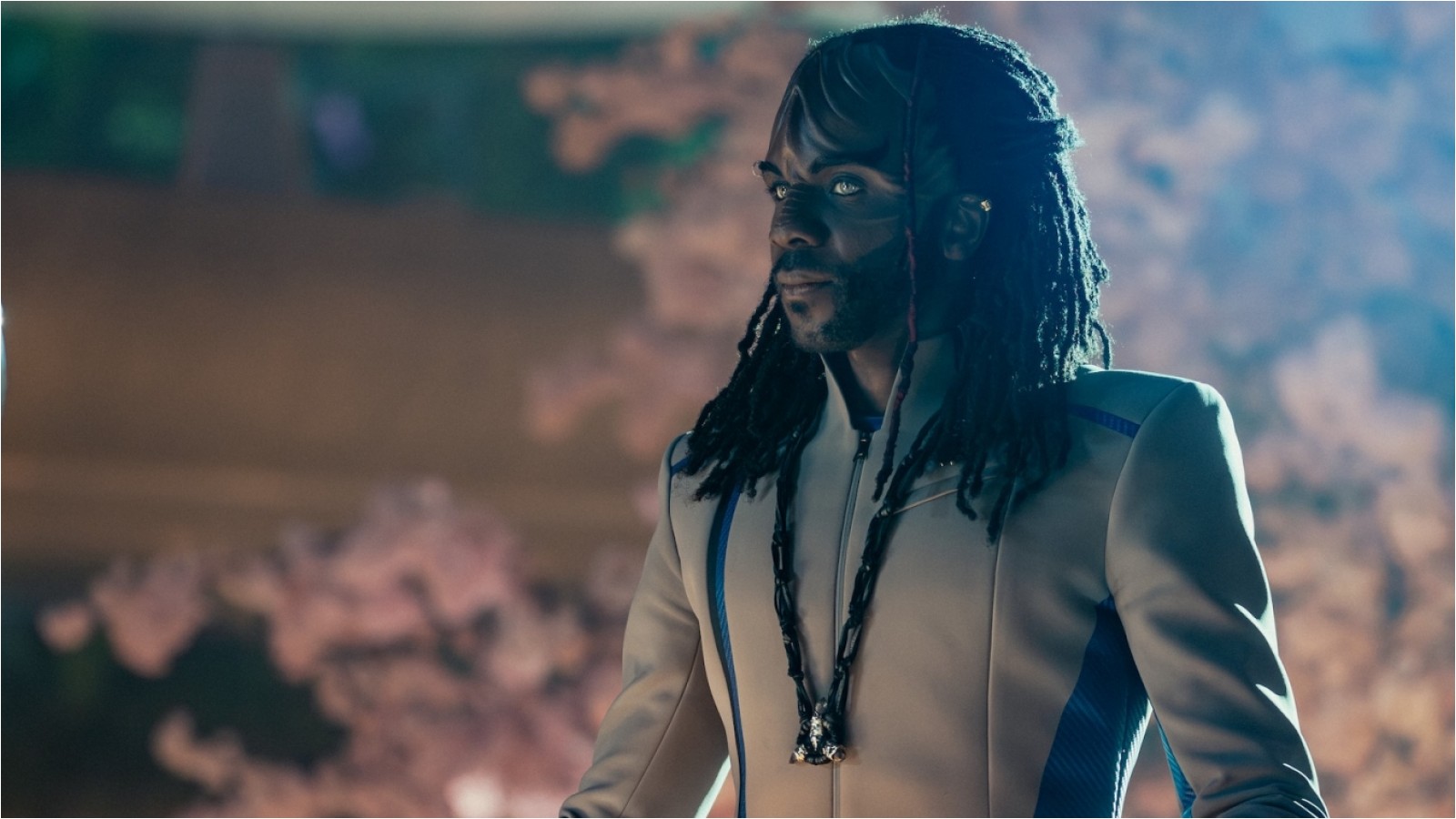

“I’m definitely not a traditional man,” Karim Diané, who plays Jay-Den, told Den of Geek, when asked about crafting such an unconventional take on a familiar kind of character. “I’m not this macho guy who goes to sports games or plays football on the weekend. I am the opposite of that. I like to think that I’m…soft. Gentle in my tone and in the way I carry myself. I think maybe that’s what I just naturally exude. And I’d like to imagine that that’s what brought me to this role. But full credit to Noga and Alex [Kurtzman], who wrote this character this way and left it up to me to find it. To find him. The challenge for me was finding his voice and getting comfortable in the way he looks. But the softness kind of comes naturally to me.”
For Diané, playing Jay-Den has also been about finding a balance between embodying the kind of Klingon Trek fans were familiar with while finding a way to create something new.
“I’m new to all of this, right?” Diané said. “So I really had to look to the people [who were] leading me. I looked to Doug [Aarniokoski], my director, who really, really helped bring out this character. I looked to Michael Dorn [who played Worf on Star Trek: The Next Generation and Star Trek: Deep Space Nine], to really know what the standard of a Klingon is. But then I also had to look to myself, and just really trust that my natural sensitivity and softness are okay to bring to this character.”
Jay-Den’s quieter, conflict-avoidant character isn’t the only way that Starfleet Academy is shaking up the story of one of the franchise’s foundational alien species. Klingons have apparently had it rougher than most since the Burn, spending the better part of the last century as a people without a homeland, living on the verge of extinction and shuffled from place to place in the wake of Qo’noS’ destruction.
“It was all very intentional,” showrunner Noga Landau said when asked about reimagining Klingon society in a post-Burn world. “We are big Klingon fans in the Starfleet Academy writers’ room. And we obsessed about every detail with the Klingons, even down to the warrior stew. We just wanted everything to be perfect. And honestly, the question we asked ourselves was, what haven’t we done with the Klingons yet in Star Trek? What is a new story? What thrusts this mighty empire of warriors into a very new situation that sheds light on who they are to their core?”
The Klingon diaspora has caused its people to double down on the sanctity of their remaining culture and traditions, the things that connect them to the home they once knew and the history they still share. These beliefs often draw them into conflict with the Federation — their resistance to admitting weakness or accepting help in any form runs the gamut from rejecting lifesaving Starfleet technology to refusing the gift of a new home planet — and illustrate why Jay-Den has such difficulty feeling as though he belongs in a society that privileges its standalone warrior ethos more than ever. (Though, if you want to get technical about it, Klingon healers aren’t particularly rare, historically speaking.)