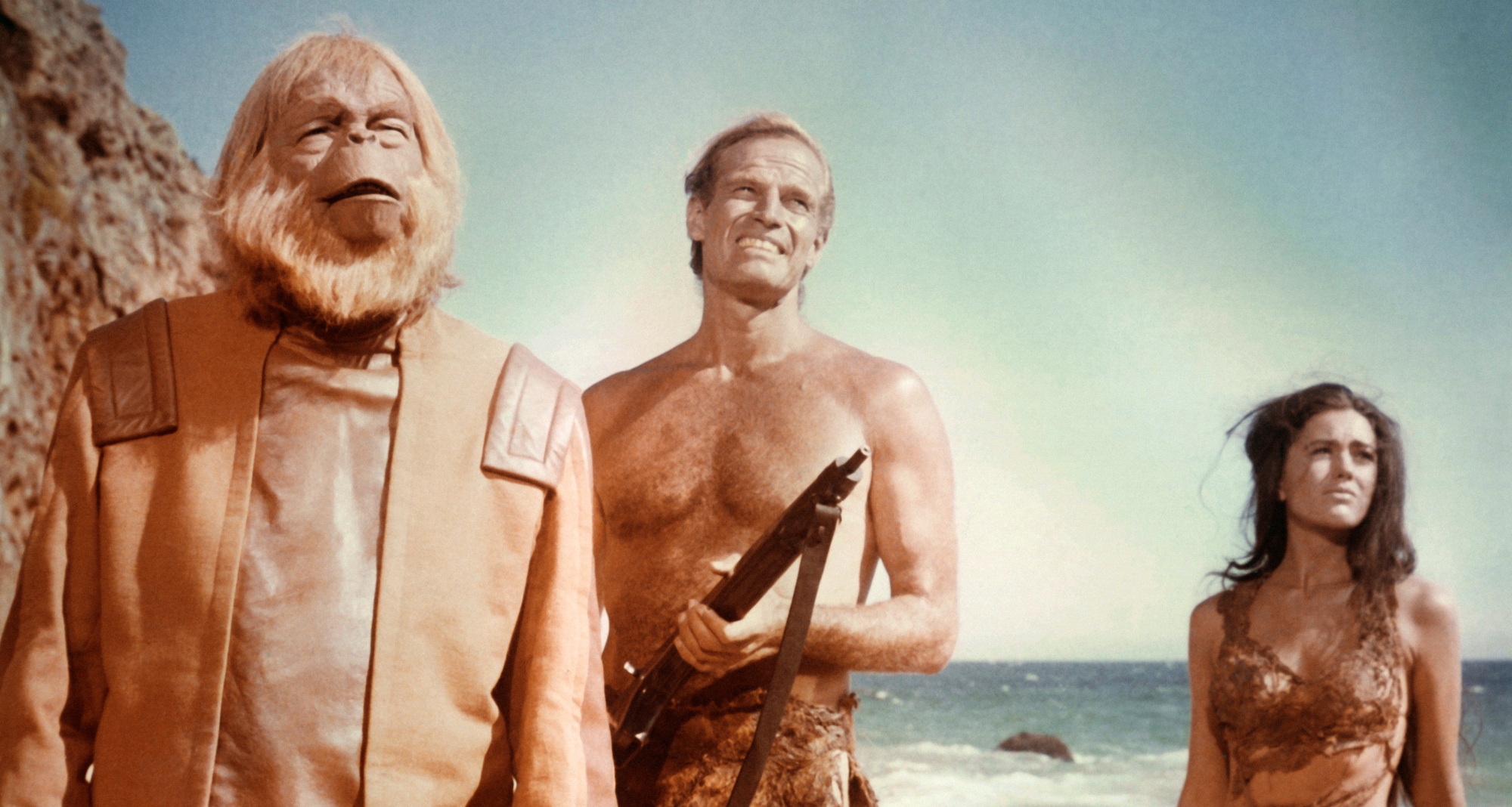

Schaffner directed the test, which was enthusiastically received by Zanuck. But there was one more hurdle to overcome: showing it to an audience. “Everyone thought that no one would believe an ape talking to a man, and I said, ‘I will prove to you that they will believe it,’” Jacobs told Cinefantastique. “We packed the screening room with everyone we could get ahold of, and Zanuck said, ‘If they start laughing, forget it.’ Nobody laughed, they sat there tense, and he said, ‘Make the picture.’”
Voyage to the Planet of the Apes
Well…apparently that’s not exactly what happened, even though that’s how Arthur Jacobs (and Charlton Heston) later told it. According to the book Planet of the Apes Revisited by Joe Russo (not that Joe Russo), Larry Landsman, and Edward Gross, associate producer Mort Abrahams had a different memory of how things went down with the screen test, which nevertheless played a key role in eventually getting the movie produced.
“We all thought it worked,” Abrahams recalled. “We edited this piece, we put it together, we ran it, and Fox said, ‘Yeah, we think it will work, but…we’re gonna pass.’” Undaunted, Jacobs continued to develop the project, hiring Michael G. Wilson to revise Serling’s screenplay while also bringing down the proposed budget (one way in which this was done was turning the urban, modern ape city of Boulle’s novel and Serling’s script into a smaller, more agrarian culture with only limited technology).
But then something happened that changed the fate of Planet of the Apes once and for all. This was now 1966, and Fox had just opened a movie called Fantastic Voyage, in which a miniaturized team of scientists pilot a microscopic vessel into a world leader’s body to save his life. According to Abrahams, he and Jacobs watched the strong box office grosses for the film – which they described, like Planet of the Apes, as a “gimmick picture” – and brought them to Zanuck’s attention.
“[Zanuck] said, ‘I’ll tell you what – you guys have a point. Let’s see if Fantastic Voyage has legs. Come back in four weeks,’” remembered Abrahams. The pair returned to see the Fox executive exactly four weeks later, by which point Fantastic Voyage was a bona fide hit. Zanuck squeezed one more concession out of them – he asked for the budget to be cut from $5.8 million to $5 million (it ended up costing $5.8 million anyway) – and took it to the Fox board of directors. “They fought him bitterly,” said Abrahams. “And he convinced them. He came back and said, ‘Okay, go.’”
The Legacy of Planet of the Apes
Released in April 1968, Planet of the Apes, of course, became a blockbuster hit and one of the biggest pictures of that year, grossing $33 million – a huge success in 1968 dollars. It arguably saved 20th Century Fox, which was reeling up to that point from monster money losers like Cleopatra (1963) and Arthur Jacobs’ own Doctor Dolittle (1967).