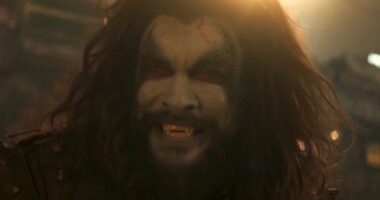
Even as Voyager attempted to make the Kazon work, fleshing out their culture in episodes such as “Initiations,” they never came off as anything more than pale imitations of the massively popular Klingons. The best the series managed was a storyline about how young Kazon earned their place in society. Which amounted to just “kill somebody.” So much depth.
Yet despite the Kazon’s clear failure, series co-creator Michael Piller, speaking in Captains’ Logs Supplemental: The Unauthorized Guide to the New Trek Voyages, was adamant at the time of Voyager’s second season that they’d become “perhaps one of the top five adversarial alien races in Star Trek‘s history.”
That season put all its hopes on the Kazon. They prominently featured in Voyager’s first attempt at a serialized story…which was an unmitigated disaster. While Deep Space Nine was blazing a trail for multi-season arcs in the franchise, Voyager haphazardly tossed “arc” moments into episodes with no rhyme or reason. Remember “Threshold,” the episode where Tom Paris turned into a salamander? It has a bewildering scene where a traitorous Voyager crew member informs the Kazon of the salamander-creating technology. The Kazon never followed up, sadly. It’s telling that as time went on, the entire Kazon race was subsumed into the soap opera antics of Cardassian agent Seska and her baby drama with Commander Chakotay.
Voyager finally abandoned the Kazon as a viable adversary in the season three premiere and never looked back, outside of time travel shenanigans where the Kazon were shorthand for “hey, it’s early Voyager!” The failure of the Kazon, especially as main villains for Voyager’s attempt at serialization, can easily be seen as a contributing reason why the show avoided serialized stories for most of the rest of its run. The writers looked at how badly the Kazon arc went and decided to throw serialized stories out with the Kazon bathwater.
The reputation of the Kazon hasn’t improved over time. No one’s rushing to flesh out the race, like Discovery attempted to do with the Breen. They haven’t gotten a semi-ironic reappraisal like “Tom Paris as a Salamander.” The best they’ve received are small appearances in Star Trek: Prodigy where their main purpose is to be a signifier to the audience that “this is gonna be a show with a lot of Voyager elements in it.”
It’d be easy to say everyone’s agreed the Kazon were off-brand Klingons and move on, but that observation hides the real core problem behind them. One that goes back to their earliest conception. As revealed in the behind-the-scenes book, A Vision of the Future: Star Trek Voyager, the earliest notes for the Kazon from co-creators Jeri Taylor, Michael Piller, and Rick Berman describe them as “gang”-like villains: “They come in and ‘squat’ on a planet. They’re basically bullies. At least two gangs, Crips and Bloods, in competition for influence.”
Nope. With all respect to the work of Taylor in particular, this is somehow worse than the way she attempted to portray gay discrimination in TNG’s “The Outcast,” which had nonbinary aliens as the villains in what feels like a straw man argument from Fox News.