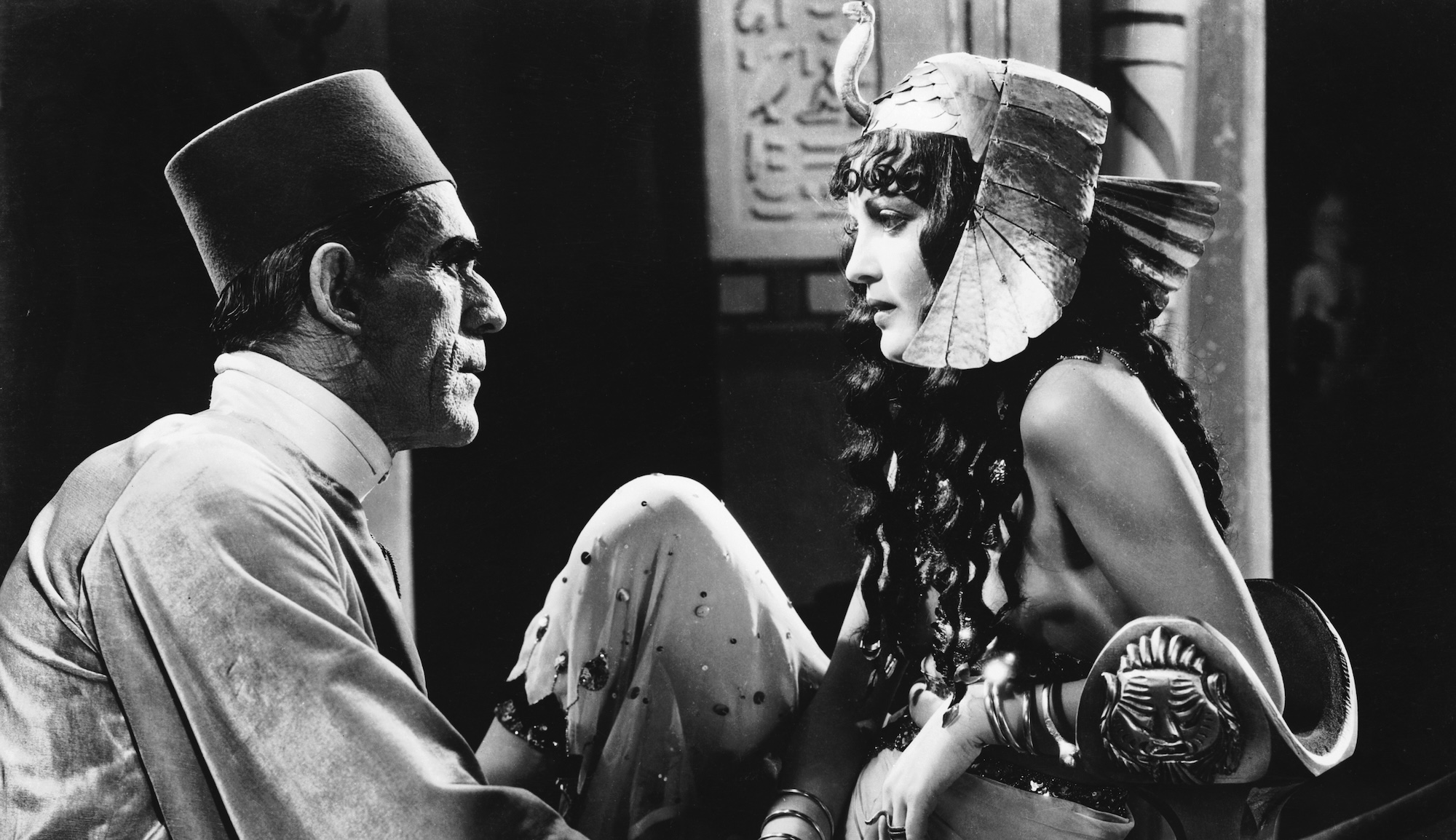

So, yes, the original Mummy film is a product of its time. However, when accepted on its own merits and its specific context, it remains perhaps the only film about Ancient Egyptian corpses rising from the grave to set a tone that is at times genuinely unsettling, and at others eerily romantic. Not only did the O.G. Mummy set the standard for mummy movies, it also arguably shaped our understanding of vampires and Dracula as well…
Ancient Origins
When The Mummy was rushed into production by producer Carl Laemmle Jr. 95 years ago, it was viewed quite a bit like the Dracula clone. It was meant to duplicate the success of Bela Lugosi’s vehicle which also launched the original Universal Monsters cycle in 1931, as well as James Whale’s Frankenstein from the same year, which gave the world the Karloff. Initially screenwriters Nina Wilcox Putnam and Richard Schayer sought to even place the general outline of this plot into a film about Alessandro Cagliostro, a now largely forgotten 18th century alchemist, magician, and confidence man who convinced the last 18th century courts of France that he was an immortal. Presumably Imhotep’s hypnotic (and Dracula-adjacent) powers would have been more pronounced in this version of the story.
However, Laemmle ultimately found himself wanting to capitalize on the still thriving revival of Egyptomania which followed on the heels of King Tutankhamun’s tomb being discovered a decade earlier by Howard Carter. The greatest archaeological discovery in history, King Tut’s resting place was the first and still only pharaonic tomb discovered to be almost entirely untouched by looters since its sealing 3,300 years ago. It gave us a wealth of knowledge about New Kingdom culture, history, treasures… and at least one imagined superstition about the Pharaoh’s Curse, which plagued the dig following the freakish death of its benefactor, Lord Carnarvon, six months later.
The actual “Curse of the Pharaohs” was invented by the British and American press, of course. And among them was American journalist, writer, and adventurer John L. Balderston. He saw firsthand the removal of King Tut’s treasures from afar—only the UK’s Times got exclusive access to the excavation, hence a reason for embellishments about a “curse”—and lived in Egypt for more than a year. Balderston also saw its effect on pop culture, with newfound Egyptomania seeping into fashion, Art Deco architecture, and eventually the Hollywood where he landed as a screenwriter at Universal. He was at first brought out to California to adapt his own 1927 Broadway version of Dracula, which itself was a riff on Hamilton Deane’s 1924 British play of the same name. Ironically, very little Bram Stoker was involved in either.
The vampire movie proved such a success, Balderston was tapped to rewrite what became The Mummy. Producer Laemmle selected Balderston because of Dracula, and the scribe dutifully rehashed plot elements from the Lugosi classic, including a kindly old professor—now Dr. Muller and played again by Van Helsing actor Edward Van Sloan—who would dare to believe in the supernatural. There are also ancient charms to ward off evil and a living corpse obsessed with the bodies of much younger, pretty things.
Yet what Balderston also brought to the material was a genuine understanding of Ancient Egyptian culture and modern colonized Egypt, albeit from a distinctly Western, early 20th century perspective. Unlike virtually every Mummy film made after, Balderston’s script does not mix up Egyptian gods Thoth and Osiris, or Anubis and Seth. He sprinkles in a real understanding of that mythology, including by making Anck-es-en-Amon a priestess of Isis. Even the name Anck-es-en-Amon is based on Ankhesenamun, the real bride of King Tut (and his half-sister), whose fate was far more tragic than what Balderston dreamed up. Meanwhile the name Imhotep is nicked from the real priest and architect who designed the very first pyramid in the Old Kingdom for the Pharaoh Djoser.