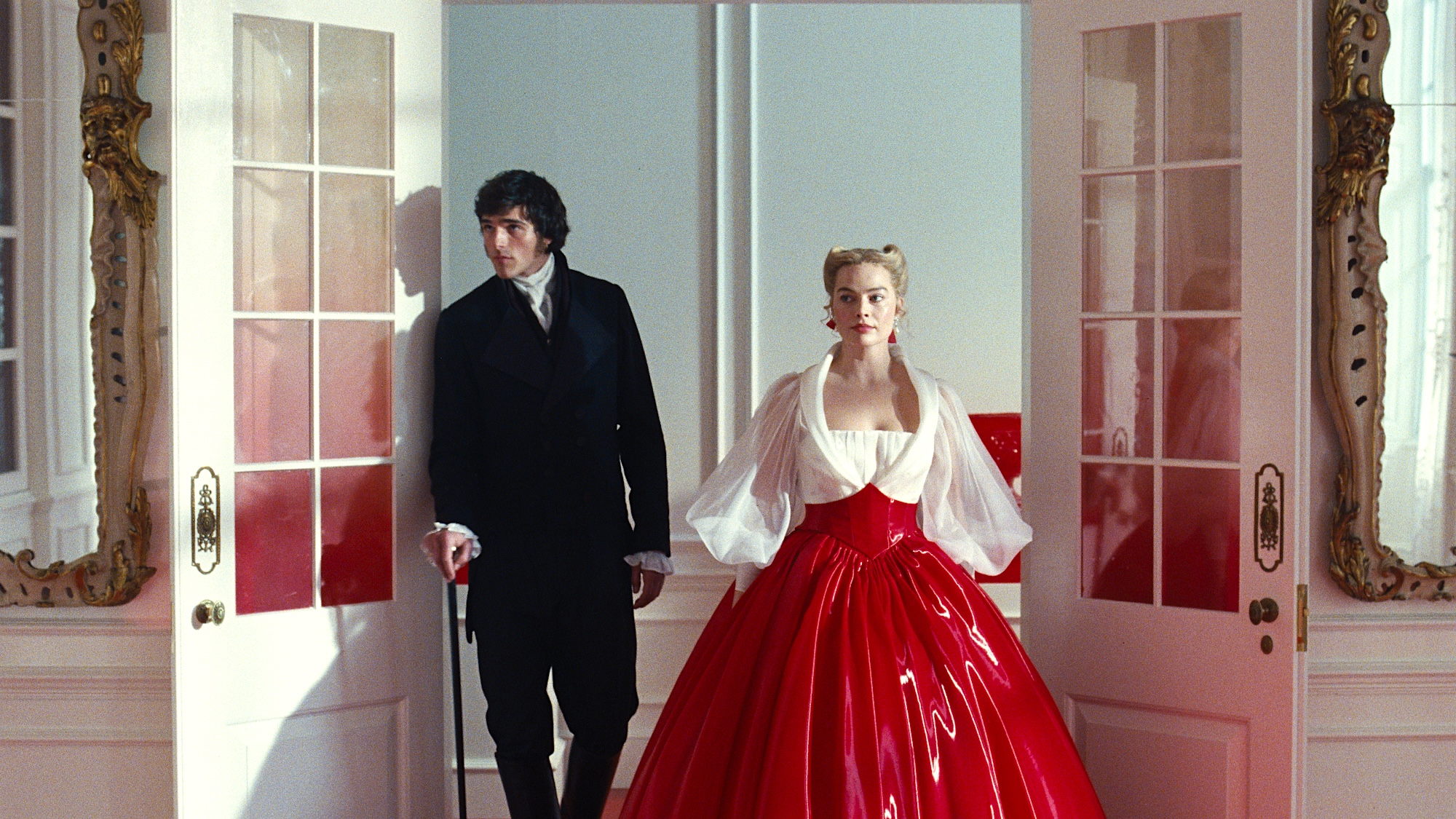

There’s a Whole Lot of Sex
The literary version of Cathy and Heathcliff never explicitly consummate their relationship, and most of the heat between the two is generated through Brontë’s outstanding prose. The pair finally shares a passionate embrace only as Cathy is literally dying.
Fennell’s film is bursting with sex, from the opening moments in which the sounds of a man hanging could be easily mistaken for the throes of passion. Soon thereafter, Cathy and Heathcliff are banging constantly: on the moors, in a bed, out in the rain, even in a carriage, Bridgerton-style. She cheats on her husband with full awareness of the moral implications of her actions, and Heathcliff even offers to kill Edgar for her at one point. But this Wuthering Heights’ horniness isn’t limited to its central couple. There’s BDSM play, masturbation, and multiple inanimate objects that exist only to be penetrated in some form or other.
Heathcliff Is A Much Bigger Dirtbag In the Book
Let’s just get it out of the way: The literary Heathcliff is a villain. We can’t really argue about it. He’s a monster, one admittedly shaped by trauma and tragedy, but his choices are ultimately his own. And he repeatedly chooses cruelty and revenge, making much of his life a quest to punish those he believes have wronged him, up to and including his own son. Yes, there are reasons for this: His loss of Cathy, lingering pain from the abuse he suffered at the hands of Hindley, Linton, and even Cathy herself, a lifetime of being told he was lesser, and an awareness that his position prevented him from being with the woman he loved. There are moments of grand tragedy that if one were to, ahem, stop the story at its midpoint would render him a complex Byronic hero. But he’s not, and probably shouldn’t be, anyone’s dream man.
Fennell’s take on Heathcliff is much more in line with the Byronic hero archetype. Her Heathcliff is moody, angsty, frequently shirtless, and fully obsessed with Cathy. (Plus, he’s played by Jacob Elordi, who can literally pick Margot Robbie up by her corset laces.) We’re only given glimpses of his cruelty and pettiness, primarily through his treatment of Isabella. (And ditching the second half of the novel means Fennell doesn’t have to wrestle with how to present him at his absolute worst.)
Nelly Becomes the Story’s Villain (Sort of)
Nelly Dean is the narrator of Brontë’s Wuthering Heights, a housekeeper who serves three generations of the Earnshaw and Linton families. Less a character and more a narrative device, she doesn’t have a terribly active role in the story or much agency of her own.
Fennell turns Nelly into something that comes quite close to the story’s villain, howver: she’s a bastard taken in to serve as a companion and maid to Cathy. She’s resentful and jealous, both of her charge’s close friendship with Heathcliff and her social position. The Earnshaw family finances aren’t great at the time of this story, but they’ve been landowners in Yorkshire for hundreds of years. She has a great deal more agency than her book counterpart, but in Fennell’s adaptation, she’s the deliberate cause of multiple misunderstandings and seems to work to keep Cathy and Heathcliff apart.