
Shortly after my mother’s funeral at Chichester Crematorium, the undertaker handed me an anonymous two-litre maroon vase, about the size of an old sweet-shop jar, containing her ashes. It seemed sadly inappropriate to hold my wise and wonderful mother’s earthly remains after such a vibrant life.
Still grieving, I hadn’t thought what to do with them and put the ashes in a bedroom cupboard, behind some of her clothes that I hadn’t yet had the nerve to take to the charity shop. They stayed there, out of sight, for the next 13 years.
Friends kept telling me it was time I found a suitable last resting place for Mary, who died in 2013, just short of her 100th birthday. It wasn’t that I was uncaring. Without coming over all Norman Bates, I was reluctant to let her go. Also, I couldn’t think of anywhere she would have been happy to spend her earthly eternity.
As we mark Mother’s Day today, the time we have to say a final farewell to the woman who gave us life may seem far into the future. But as I have discovered, the scattering of ashes, much as I dreaded it, can be an uplifting celebration of a life well lived and, unlikely as it seems, it can have its lighter moments, too.
Many will carry out this last duty for their mothers by burying urns in a church graveyard with a small headstone. The more adventurous will scatter ashes at sea or on a river. Passionate football fans, and that includes women too, leave instructions to have their ashes scattered on the centre circle of the pitch, if the club agrees.

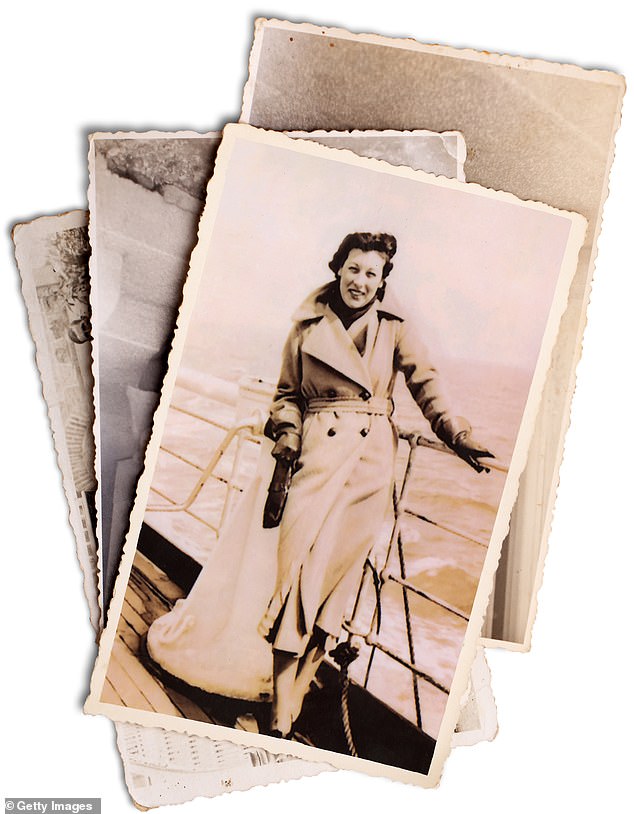
Mary, aged 37.
For most people, superstition, nostalgia and religion are the dominant drivers of where to bury Mum’s remains. Hiking in the Cairngorms, I was told of urns buried in the heather, presumably the last wishes of romantic souls who wanted their spirits to roam free around the Scottish mountains. These are sensitively removed by National Trust For Scotland rangers and, where possible, returned to relatives. ‘If we didn’t do this the hills would be turned into a cemetery,’ one of them told me. Even drones are now being used to scatter ashes from the sky. Aerial Ashes, formed by an ex-RAF pilot, charges from £745 for a sky-high goodbye, depending on location. And a few companies have sent ashes into space on Elon Musk’s rockets.
Back on earth, a friend told me she scattered her mother’s ashes in London’s Berkeley Square, where a nightingale once sang, because that’s where the family home was and she was happiest.
A devout Quaker, my mother wanted nothing to do with the ceremony of funerals and because she loved the sea, would have been happy to have a Viking farewell. Being launched into the Channel at Bosham, Sussex (where King Canute tried to halt the waves), on a burning long boat before sinking beneath the briny, would have suited her.
She was a hospital theatre sister during the Blitz and didn’t fear death. For most of her life she was haunted by the badly burned soldiers from the evacuation of the beaches at Dunkirk. ‘We could only give them morphine to dull their pain before they died,’ she told me. She herself cheated death many times. On 14 October 1940, a number 88 bus plunged into a massive bomb crater outside Balham tube station, South London, killing 66 sheltering there underground. Mary was on her way to catch the number 88 but at the last moment turned back to collect papers she had left at St John’s Hospital, where she worked. After that brush with death she determined to live every day to the full.

Winning a beauty contest in 1935
Not that she, too, didn’t greatly suffer. Before marrying my father Jim, who served in the Royal Navy on destroyers escorting convoys across the Atlantic, through U-boat packs, Mary was sweet on a US bomber pilot, lost when his Flying Fortress was shot down over Berlin. Later, a doctor she clearly loved died when the Lancastria, a ship carrying 6,000 souls escaping the Nazis from France, was sunk by Stuka diver bombers. She later dedicated her life to teaching special needs children in London’s tough East End.
My mother was born the eldest of 11 children to a tenant farmer in the rural Scottish Highlands at the start of the First World War. Always feisty, you certainly knew when she was around. When I was five, I contracted meningitis, my temperature soared to 105F in the middle of the night but still the local doctor refused to come out. Mary found out where he lived and threw stones at his bedroom window until he appeared. I was taken to hospital for an emergency lumbar puncture, to drain fluid from my spine, which saved my life.
Though I loved Mary dearly, it would be wrong to suggest she was a saint. Like all mums, she had her moments. When I was 12 I bought a cheap guitar in a junk shop and banged away relentlessly playing Eddie Cochran hits in my bedroom. Tired of this racket she picked up the guitar and, to my horror, threw it out of the window, ending my hopes of making the pop charts. Yet this was one of the stories about family life that was to be retold through the years to great laughter. All families have tales like this – they help provide the loving glue that holds you all together.
Although born a Highland lassie, Mary later lived by the North Sea near St Andrews and it was in those freezing waters that she learned to become a powerful swimmer. This is how I recently came to find myself walking along the town’s ancient stone harbour wall, which stretches out into the swelling sea, clutching the aforementioned urn.
Without wishing to indulge in Ortonesque black humour, anyone who has ever scattered ashes on the sea knows this can be a perilous task. The wind is likely to blow them back into your face, robbing the ritual of its gravity, and turning the occasion into a messy comedy.
I was warned about the blow-back if I stayed with my original choice of scattering Mary’s ashes on St Andrews West Sands, where the opening scenes of athletes training for the 1924 Olympics were filmed in Chariots Of Fire. Fortunately, on the end of the pier on the East Sands there are sheltered steps leading down to the water where fishermen board their small boats.
I emptied the urn into the churning sea. Behind me stood a group of excited, shivering female university students in swimming costumes. They had just finished their exams and wanted to celebrate with a bracing dip.

Rod and his mother, Mary, 1996.
As the ashes drifted away on the water, one asked me: ‘Are you feeding the seagulls?’ I hadn’t the heart to tell her it was my mother’s ashes I was scattering to a mumbled Lord’s Prayer.
Mary, a former Scottish beauty queen, was also for many years a midwife and while these giggling undergraduates weren’t exactly new to the world, they had the freshness of youth serving as an unknowing farewell party that she would have appreciated.
Like all Celts, my mother had a deep spirituality and often said to me, ‘After I’ve gone and you feel the wind, that will be me.’ On the train journey south, I felt a great sense of calm, knowing that her remains were finally resting in the element she loved.
I envy those celebrating Mothering Sunday with the matriarch of their family, talking about times past and times to come. I’d remind them to take comfort that even after she is no longer with them, she will continue to live in their hearts, as my mother does in mine.