There was one vow that carried particular poignancy for Anita and Gary Goundry-Smith on their wedding day: to love one another ‘in sickness and in health’.
After all, it was a commitment they were already living, day in, day out. And they knew that, with the passage of time, it would become one of the defining features of their union.
For at just 51, a year before meeting Gary, Anita was given a devastating diagnosis of Alzheimer’s disease and vascular dementia.
At the time, her shockingly bleak prognosis encompassed a steep cognitive and physical decline – and death within four years. ‘I was left reeling,’ says Anita, now 57. ‘My life as I knew it was over.’
Her devastation was further compounded when the strain of her prognosis caused her 22-year relationship to come to an end within months of her diagnosis.
‘Not for one moment did it cross my mind that I would fall in love, marry and not only defy that terrible prognosis, but forge a new and happy life, supported by a man who adores me,’ she recalls now of meeting Gary. ‘When did you last hear about someone with Alzheimer’s going on to find their soulmate? And yet, against all odds, I did just that.’
While it’s perhaps understandable that someone in Anita’s position would grab the opportunity of a loving relationship, it is Gary’s decision to commit himself to a woman who is unlikely to grow old with him that is more surprising. Particularly considering her care needs will inevitably increase as time passes.
Gary, 54, insists he never had a moment’s doubt about becoming Anita’s husband. ‘I went into our relationship, and marriage, with my eyes wide open,’ he says. ‘Anita told me on our first date about her condition, and I know she fully expected me to run a mile. But I already felt a connection with Anita and wanted to see where things went between us. Soon, I was in love with her and knew she was the woman I wanted to spend my life with, irrespective of what challenges lay ahead.’

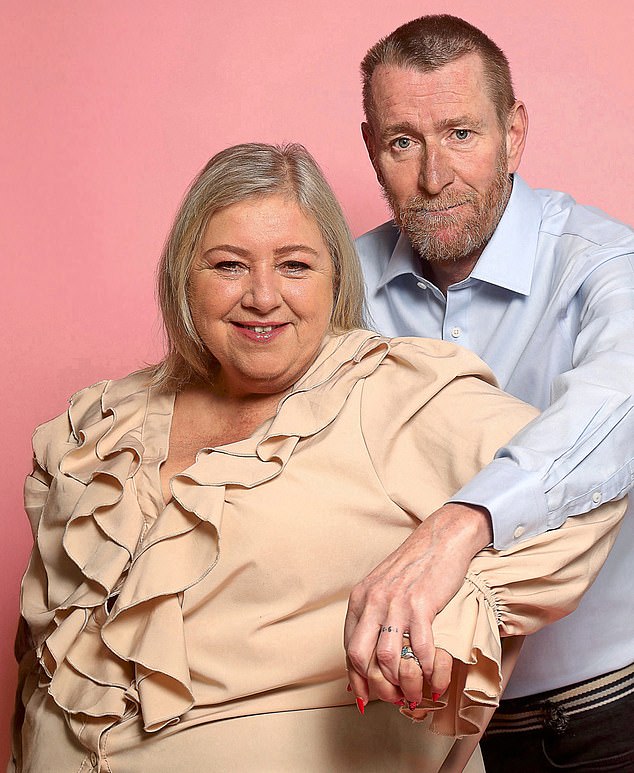
Anita and Gary Goundry-Smith. When aged 51, the former was diagnosed with Alzheimer’s

Gary insists he never doubted for a moment becoming Anita’s husband, despite her ill health
As for the reactions of friends and family – Gary has grown-up children from a previous relationship – he says: ‘If they thought I was crazy, they knew better than to say anything. Nothing would have deterred me from being with Anita.’
Although Alzheimer’s is most commonly diagnosed in over-65s, around one in ten people develop it between 50 and 65. The Daily Mail’s Defeating Dementia campaign, in association with the Alzheimer’s Society, aims to raise awareness of the disease, increase early diagnosis, boost research and improve care.
Anita was only 44 when symptoms, including memory loss and issues with her mobility, began. ‘I’d always had a sharp memory but I found I couldn’t remember people’s names, my computer password or where I was travelling to,’ she explains.
‘My balance was also affected, and I started to stumble and trip over, even breaking my ankle. A mum of two, and in a long-term relationship with my then partner David, I was juggling my job as a pub landlady with a degree in social work. I was usually so organised, but I’d forget to pick my daughter up from school or miss university classes.’
Multiple visits to her GP saw Anita dismissed as being ‘stressed’ or ‘menopausal’, with no investigations into her symptoms. ‘I was described in my medical notes as a ‘hysterical hypochondriac’, which was really upsetting and humiliating.
‘I felt like a nuisance, but I knew deep down something wasn’t right. As time went on, and I grew more scared and frustrated, I developed anxiety and depression.’
In 2019, Anita suffered a TIA (transient ischemic attack), often known as a ‘warning stroke’.
‘I was rushed to hospital but discharged a few hours later with just some blood-thinning medication, and no further investigations.’
A year later, in 2020, a full blown stroke would finally lead to her diagnosis. Brain scans revealed not only the stroke, but Alzheimer’s and vascular dementia, both progressive and incurable diseases.
‘My life as I knew it imploded,’ she says. ‘It didn’t make sense. I was just 51 – those were conditions that affected older people. I had nursed my own late mother when she had dementia, after being diagnosed in her early 60s, as her own mother had been too. I now suspect my condition is hereditary.’
Anita was told that, even though medication could be prescribed to slow the diseases, she should prepare herself for needing full-time care – and that four more years was the best she could hope for.
‘In short, there was no hope for me – and all that lay ahead was the loss of all my faculties and then death,’ says Anita. ‘It was the lowest moment of my life.
‘I also felt angry it had taken so long to diagnose me, despite so many red flags. An earlier diagnosis and treatment would have meant my condition wasn’t as advanced.’
The diagnosis had a catastrophic effect on Anita’s personal life. While her son, then in his early 20s, coped better, her relationship broke down and her daughter, then 18, struggled to come to terms with her mother’s altered state and prognosis.

‘It turned her life upside down as much as mine,’ says Anita. ‘She was so young to be facing losing her mum. It put an emotional distance between us for a time.’
Anita felt so hopeless she even made plans to take her own life: ‘What was the point in prolonging my life when I was going to lose everything – my personality, my independence, my dignity? I also wanted to spare my loved ones from watching me deteriorate.’
Fortunately, Anita didn’t act on her plan and instead made what she calls a life-saving call to the Alzheimer’s Society. ‘I needed help and a belief that I could find a way through this nightmare, and they gave me that.’
With help from the charity and social services, in December 2020, Anita moved into an adapted bungalow in Spennymoor, Co Durham. Her daughter and ex-partner remained in what had been the family home, a few miles away.
Anita says it took time to adjust: ‘Losing my driver’s licence, navigating the benefits system after working all my life, being single after a long-term relationship . . . everything was very different. It was a lot to accept, on top of my ongoing struggles with my mobility and memory.’

Everyone experiences dementia differently. Use this checklist to help you make a note of your symptoms before you talk to your GP.
In September 2021, an evening out brought a welcome change, however. ‘Gary and I still joke about how we first met,’ chuckles Anita. ‘Friends had taken me to a local bar and it was great to be out. Needing the loo, I got off my high stool but stumbled and fell into the lap of a man at the table next to us.
‘I was mortified, but he couldn’t stop laughing, and introduced himself; I recognised him from the local area. I thought he was in a relationship, but he said he’d recently become single after 28 years.’
The couple spent the night chatting before sharing a kiss and arranging to meet again. It was on their first proper date a week later that Anita revealed her condition.
‘I assumed it would be our first and last date. What man would want to get involved with someone like me?’ says Anita.
Yet, unfazed, Gary asked to see Anita again.
‘Of course it was shocking and sad to hear what she’d been through and what she was facing,’ he says. ‘But I listened, appreciated her honesty and told her I wanted to see her again anyway.
‘I wasn’t naive, but at that very early stage I didn’t even know if it would work out between us anyway. I wanted to find out though.’
For Anita, being in a new relationship came with mixed emotions. She was scared to let her guard down in case Gary decided he couldn’t cope and left. ‘He refused to give up on me though, and in time I accepted he loved me and was going nowhere.’
But becoming a couple did raise some eyebrows – and questions.
‘It was hard for my daughter at first,’ says Anita, ‘because she had to get used to a new man. But both her and my son soon saw how much Gary cared for me and how happy I was with him.’
Friends also expressed concerns about the possible repercussions of the relationship. But Anita says: ‘Once they met him they could also see how much I was benefiting from the relationship, and my cognitive ability improved because I wasn’t at home alone.’
After a year together, Gary moved in with Anita, becoming her carer alongside his job as a warehouse operative. In September 2023, they got married.
Anita says: ‘The registrar said I was the happiest bride she’d ever married. There was a poignancy too: promising our future to one another, neither Gary nor I knew what that looked like.’
For Gary, it was a day filled with certainty that Anita, in spite of her condition, was the best thing to have ever happened to him. ‘Hearing Anita say ‘I do’, I felt like the luckiest man,’ he says.
More than two years on, Anita’s health continues to deteriorate slowly, but the couple live a happy, fulfilling life together.
‘Gary takes care of the house, cooking and our finances,’ she says. ‘I can no longer deal with money, and there is too much risk of me leaving a pot on the hob, with my poor memory. I am slow and my balance is poor.
‘I now have a good relationship with my ex, and he takes me to hospital appointments and the shops if Gary is working. I’m very lucky to have them both.’
Despite these challenges, Gary and Anita love to travel and are avid fans of their local football team. Anita also volunteers at her local community centre and has plans to turn it into a ‘dementia hub’ for residents.
But the spectre of Anita’s incurable condition is always present. Considering what the late stages of Alzheimer’s and dementia involve, Anita has made a heartbreaking decision: ‘If assisted dying is not made legal in the UK, I will go to Dignitas in Switzerland, while I still have the mental capacity, and die there.’
Gary is completely supportive of Anita’s wish: ‘All I have ever wanted is for Anita to be happy. If this is what she feels is right for her, that’s all I need to know but, of course, it’s very, very painful to contemplate a life without her.’
The couple insist that, rather than dwelling on the future, they’re cherishing the time they have together. ‘I have already defied the prognosis I was given in 2020; I should be dead by now,’ says Anita. ‘And I believe if I hadn’t met Gary, I would be. Our relationship has brought me so much joy, I feel sure it’s prolonged my life. Why waste this precious, extra time I’ve been given worrying about what I cannot control?
‘When the future arrives, I know I’ll have Gary to help me face it.’