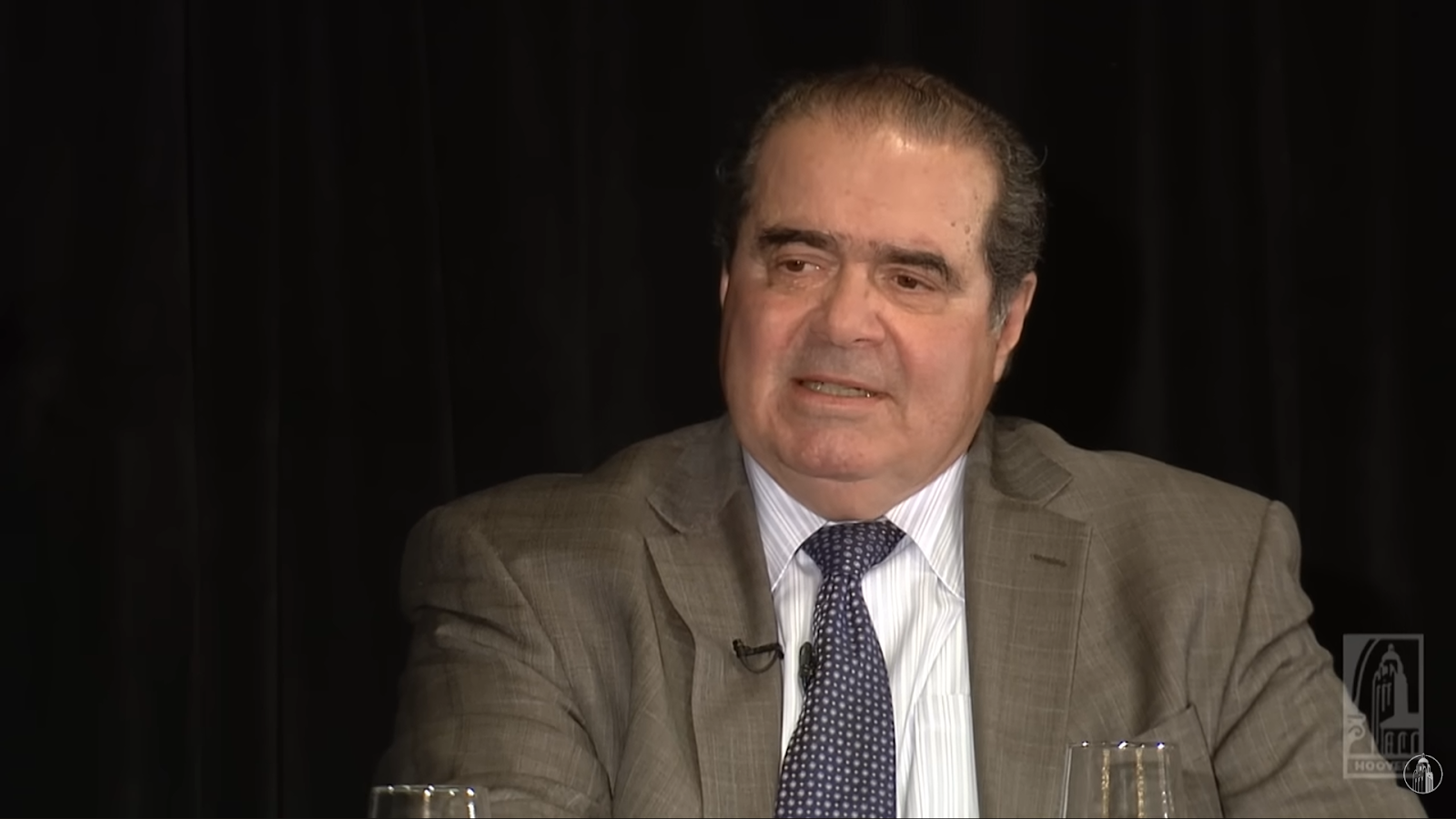
Supreme Court Justice Antonin Scalia was a larger-than-life figure. Which is why it’s hard to believe that Friday, Feb. 13, 2026, marks 10 years since his passing.
Often viewed as a chief pioneer of the modern originalist movement, Scalia was instrumental in laying the groundwork necessary for restoring proper jurisprudence to an institution that had swayed from its intended purpose. With his crafty wit and skilled penmanship, the Reagan appointee authored some of the most thought-provoking and memorable legal opinions in the court’s recent history.
Encapsulating the best moments from Scalia’s nearly 30-year Supreme Court career into one article is no easy task. But The Federalist is here to give you its best shot.
Consequences of Judicial Activism
As a staunch originalist, Scalia was a firm believer that a judge’s role is to interpret the Constitution and laws before him as they were written at the time of their enactment — not to create new legal “rights” and provisions through activist rulings based on public opinion. Seemingly foreseeing the rogue nature of today’s lower courts, the justice warned in a 2004 conference speech about the disastrous consequences that would await the country should such a reality come to fruition.
“As long as judges tinker with the Constitution to ‘do what the people want,’ instead of what the document actually commands, politicians who pick and confirm new federal judges will naturally want only those who agree with them politically,” Scalia said, as reported by the Los Angeles Times.
Courts Are Not Lawmakers
Reaffirming that judges are not lawmakers was a persistent theme Scalia hammered home throughout his tenure on the Supreme Court. In a 2011 interview, the Reagan appointee emphasized that it’s not the job of nine unelected lawyers to change the Constitution, but the American people if they choose to do so.
“You don’t need a constitution to keep things up to date. All you need is a legislature and a ballot box,” Scalia said. “Persuade your fellow citizens it’s a good idea and pass a law. That’s what democracy is all about. It’s not about nine superannuated judges who have been there too long, imposing these demands on society.”
Upholding Gun Rights
One of Scalia’s most notable opinions came in the Supreme Court’s 2008 District of Columbia v. Heller decision, in which the justices affirmed Americans’ Second Amendment right to possess and use firearms for self-defense. Writing for the majority, Scalia noted that while D.C. officials have an interest in adopting policies that combat gun violence in the federal district, infringing upon Americans’ constitutional rights in order to so is “off the table.”
“Undoubtedly some think that the Second Amendment is outmoded in a society where our standing army is the pride of our Nation, where well-trained police forces provide personal security, and where gun violence is a serious problem. That is perhaps debatable, but what is not debatable is that it is not the role of this Court to pronounce the Second Amendment extinct,” Scalia wrote.
Fiery Obergefell Dissent
The Supreme Court’s 2015 Obergefell v. Hodges decision inventing a “right” to so-called “gay marriage” is arguably one of the worst rulings in the court’s history. And Scalia made sure the majority knew it.
In his dissent, the justice blasted the majority opinion as “the furthest extension in fact — and the furthest extension one can even imagine — of the Court’s claimed power to create ‘liberties’ that the Constitution and its Amendments neglect to mention.” He further chastised the court for engaging in “constitutional revision[ism]” by bestowing upon Americans new “rights” that it has no authority to grant, and taking the ability to decide the issue away from the people.
“Hubris is sometimes defined as o’erweening pride; and pride, we know, goeth before a fall. The Judiciary is the ‘least dangerous’ of the federal branches because it has ‘neither Force nor Will, but merely judgment; and must ultimately depend upon the aid of the executive arm’ and the States, ‘even for the efficacy of its judgments,’” Scalia wrote. “With each decision of ours that takes from the People a question properly left to them — with each decision that is unabashedly based not on law, but on the ‘reasoned judgment’ of a bare majority of this Court — we move one step closer to being reminded of our impotence.”
Jokes with Justice Thomas
While they may have come from two very different backgrounds, Scalia and fellow Justice Clarence Thomas would go on to form a lifelong bond after the latter’s arrival at the court in 1991.
Oftentimes finding themselves on the same side of cases, the justices also enjoyed a warm, personal friendship, both on and off the bench. So, it should come as no surprise that the two colleagues would often joke around with one another when the opportunity presented itself.
During a 2013 Federalist Society event featuring Thomas, moderator and 7th Circuit Court Judge Diane Sykes asked the Bush 41 appointee if it was fair to say that the court’s sharply divided, end-of-term cases produce some “frayed nerves” and “the need to separate for a while.” Thomas said he “never ha[s] a problem with it,” and looked in the audience at Scalia to seemingly get his thoughts. As expected, the Reagan appointee held nothing back.
“I get out of there as soon as I can,” Scalia shouted, sending Thomas and the audience into raging laughter.
Kids and Flapjacks
If you couldn’t tell already, Scalia’s sense of humor was a trait he wasn’t afraid to show off. That was the case when the father of nine once jokingly compared his first child to a pancake.
“In a big family the first child is kind of like the first pancake. If it’s not perfect, that’s OK,” the justice said. “There are a lot more coming along.”
Fools for Christ
As a devout Catholic, Scalia regularly spoke about his Christian faith when speaking with audiences far and wide. During a 1997 speech at the Acton Institute, the justice encouraged attendees to be “fools for Christ” and not be ashamed of their faith.
“If I have brought any message today, it is this: Have the courage to have your wisdom regarded as stupidity. Be fools for Christ. And have the courage to suffer the contempt of the sophisticated world,” Scalia said.
God in the Public Square
Scalia notably pushed back against efforts to remove God and Christianity from the public square throughout his career. In a 2014 speech at Colorado Christian University, the Reagan appointee encouraged attendees to reject the argument that America’s founding document requires a “separation of church and state.”
“We do Him [God] honor in our pledge of allegiance, in all our public ceremonies. There’s nothing wrong with that. It is in the best of American traditions, and don’t let anybody tell you otherwise. I think we have to fight that tendency of the secularists to impose it on all of us through the Constitution,” Scalia said.
‘Pure Applesauce’ and ‘Interpretive Jiggery-Pokery’
The use of colorful language was a hallmark of Scalia’s writing prowess. And the justice’s dissent in the Supreme Court’s 2015 King v. Burwell decision on Obamacare subsidies was no exception to this rule.
The justice characterized the majority’s analysis as “interpretive jiggery-pokery” that “involves other parts of the [Affordable Care] Act that purportedly presuppose the availability of tax credits on both federal and state Exchanges.” He further blasted the court’s reasoning for its decision as “pure applesauce.”
“The Court has not come close to presenting the compelling contextual case necessary to justify departing from the ordinary meaning of the terms of the law. Quite the contrary, context only underscores the outlandishness of the Court’s interpretation,” Scalia wrote.
The Constitution is Dead
During a 2012 speech at Princeton University, Scalia rejected arguments put forth by left-wing legal scholars and judges that the Constitution is a “living” document that updates itself over time. Echoing the core tenets of originalism, the justice emphasized that the Constitution is “dead” as a matter of judicial interpretation.
“I have classes of little kids who come to the court, and they recite very proudly what they’ve been taught, ‘The Constitution is a living document.’ It isn’t a living document! It’s dead. Dead, dead, dead!” Scalia said. “No, I don’t say that. … I call it the enduring Constitution. That’s what I tell them.”
Shawn Fleetwood is a staff writer for The Federalist and a graduate of the University of Mary Washington. He is a co-recipient of the 2025 Dao Prize for Excellence in Investigative Journalism. His work has been featured in numerous outlets, including RealClearPolitics and RealClearHealth. Follow him on Twitter @ShawnFleetwood