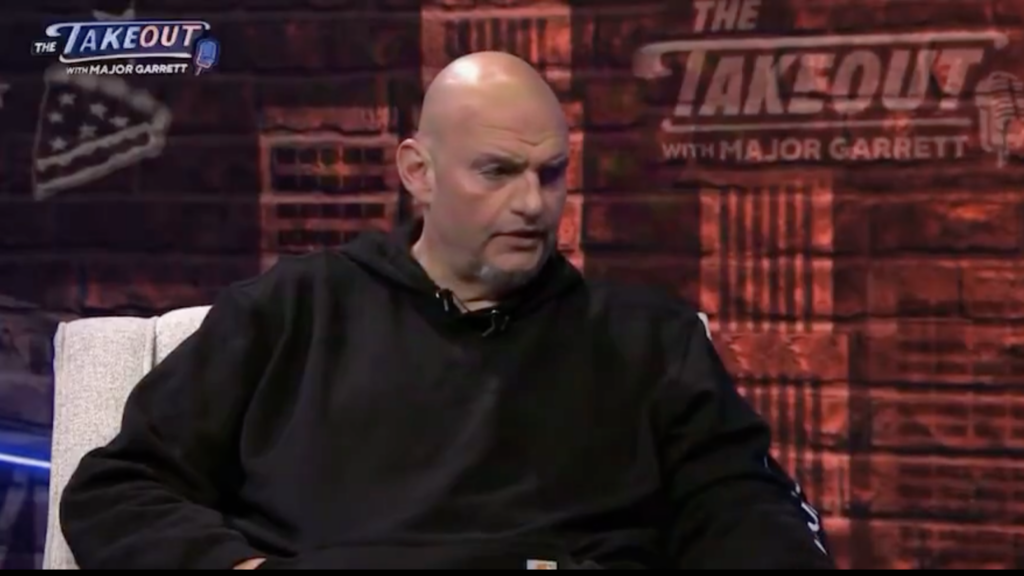
Sen. John Fetterman says he no longer would support the SAVE America Act in its “current state,” and that President Donald Trump is “constantly critical on mail-in voting,” which, according to Fetterman, is “safe.”
But mass mail-in voting is highly insecure — and the SAVE America Act would help solve several critical issues with voting by mail.
Mail-In Voting Enables Ballot-Box Stuffing
In 2023 a judge overturned a mayoral race in Bridgeport, Connecticut, after incumbent Democrat Joe Ganim won a primary race by 251 votes despite having trailed his opponent, John Gomes, by hundreds of votes. The race was nullified after footage “appeared to show Ganim’s affiliates ‘stuffing ballot boxes.’” The redo was also plagued by allegations of voter fraud.
In another prominent example of ballot-box stuffing, three members of the Milbourne Borough Council were sentenced to prison in 2025 for preparing fraudulent ballots and stuffing ballot drop boxes in a 2021 election.
Mail-In Ballots Can Be Fraudulently Requested or Submitted
An Alabama Democrat, Terry Andrew Heflin, was charged with seven felony counts of voter fraud in 2024, and in May 2025 he pleaded guilty to one count of absentee ballot fraud while the other charges were dismissed. Heflin admitted to requesting, completing, and submitting another person’s absentee ballot in violation of the law.
Zul Mirza Mohamed, a resident of Texas, was sentenced in 2024 to four years in jail for forging mail-in ballot applications using residents’ names during a 2020 race in which he was a candidate. He “had the ballots sent to a Lewisville mail store where he leased a virtual mailbox using fake IDs,” the Denton-Record Chronicle reported.
This kind of fraud is enabled by vote-by-mail’s weak or nonexistent identity verification measures. Many states rely on signature verification, a notoriously unreliable method of discerning a voter’s identity.
Mail-In Voting Relies on a Miscue-Ridden Postal System
Aside from intentional fraud, there are also issues with mail-in ballots simply not arriving. A tray of ballots from Grand Rapids, Michigan, went missing, and the Associated Press previously reported that USPS “failed to deliver an unknown number of ballots in Coos County, Oregon, and it didn’t deliver up to 300 ballots in Whitman County, Washington.”
Further undermining confidence in the mail-in ballot system, a July 2024 audit of the primary elections by the USPS Office of the Inspector General found that “over half of the delivery units and processing facilities … visited were not properly” following USPS guidance on election-related mail.
Election Officials Warn of Structural Problems With Mass Mail-In Voting
Notably ahead of the 2020 election, the Cybersecurity and Infrastructure Security Agency (CISA) admitted there are a host of issues associated with mass mail-in voting, including difficulty in the “process of mailing and returning ballots,” “high number of improperly completed ballots,” and the “shortage of personnel to process ballots in a prompt manner.”
But the SAVE America Act would help fix these insecurities.
How the SAVE America Act Would Help
The legislation includes several safeguards that would address many of the aforementioned vulnerabilities with mass mail-in voting. It would require voters to provide documentary proof of citizenship in person to register to vote before being able to obtain a mail-in ballot. When requesting or submitting a mail-in ballot, voters would be required to include a copy of a photo ID.
Those safeguards would make schemes like the one executed by Zul Mirza Mohamed far more difficult. Requiring a photo ID would make impersonating another voter far more difficult.
The legislation would also prohibit states from sending mass mail-in ballots to voters who do not request them. Instead, voters would have to request mail-in ballots instead of automatically receiving one.
Limiting ballots to those requested by voters would reduce the number of ballots circulating or sitting in drop boxes. This could help prevent incidents where fraudsters take advantage of the tens or hundreds of thousands of ballots in circulation to stuff drop boxes.
The safeguards would also reduce some of the mail system’s difficulties with processing large amounts of ballots.
Notably, there is evidence that changes to mail-in voting are just as popular as the other provisions of the SAVE America Act. A 2023 survey conducted by the Honest Elections Project found that 76 percent of voters say “voting in person is better than voting by mail” and 73 percent “reject automatically sending ballots without a voter’s request.”
Brianna Lyman is an elections correspondent at The Federalist. Brianna graduated from Fordham University with a degree in International Political Economy. Her work has been featured on Newsmax, Fox News, Fox Business and RealClearPolitics. Follow Brianna on X: @briannalyman2