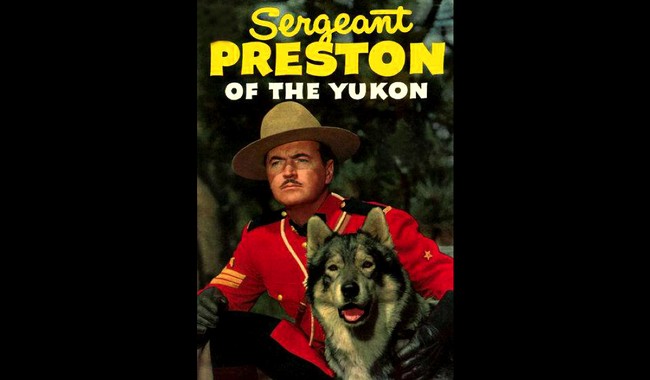

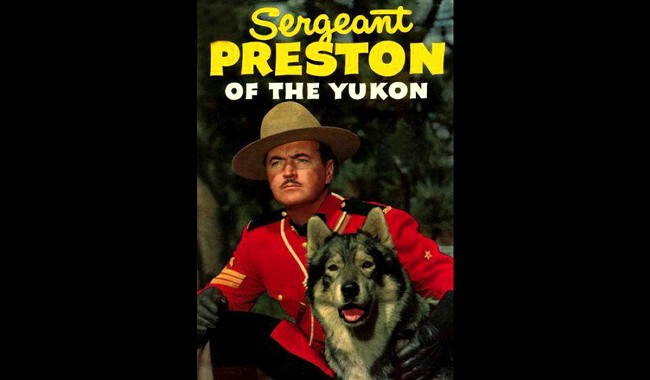
My favorite childhood radio show was “Sergeant Preston of the Yukon.” He roamed that vast, wild land that’s 11 times larger than Ohio.
Sports aside, I’ve always enjoyed radio more than television because it sparked my imagination. In each episode, you could hear the wild winds of the Yukon, the Mountie’s dog King, and their dogsled team. “On King. On you huskies!”
Little did I know, or care, that each one of the episodes actually took place in a WXYZ studio in Detroit by the same creators as “The Lone Ranger” and “The Green Hornet.” Later, Sgt. Preston became a TV show.
So, when my long career as a newspaper correspondent took me to Canada, you’ll never guess one of the first places I went to do a story: The Yukon, to see the actual life of a real Mountie.
Cpl. Reid Tait was a thoroughly modern Mountie, one of 90 members of the Royal Canadian Mounted Police assigned there.
That force is a unique agency combining elements of an F.B.I., highway patrol, city police, secret service, and park ranger exercising sovereignty over the corporal’s assigned territory of some 5,000 square miles, about 2,500 miles northwest of San Francisco.
I slept on a couch in the double-wide trailer of the 29-year-old Tait, his wife Bonnie, and three children before another regular patrol on snowmobile. The RCMP abandoned dogsleds in 1969.
His duties were varied: prepare next year’s budget estimate, appear in a distant courtroom, break up a violent family fight, clean up a grisly traffic accident in below-zero weather, counsel a troubled Indian youth, walk around the tiny town to be seen, and talk, seemingly idly, with anyone about what’s going on. It was community policing before there was community policing.
“The only thing I never do around here,” he said, “is give out a parking ticket.”
The modern Mountie’s day began to the sounds of “Sesame Street” and ended 15 hours later and 30 miles away with a couple of trappers in an unheated cabin in a moonlit mountain pass where the only sound was the roar of wind tearing snow from the cliffs above.
It’s magnificent country, full of deep forests and snows, wild animals, frozen rivers and lakes faintly feeling the touch of Spring at this time of year. I stood on the back of the supply sled he towed, which he stopped at two isolated homes miles apart to sip tea and, not accidentally, describe some new firearm regulations and ask about neighbors.
“In the cities,” the corporal said, “no one wants to see a policeman, but out here they’re insulted if you don’t stop.”
He delivered supplies and mail to the trappers’ cabin, shared moose steaks, helped with cabin chores before an hour’s worth of cards and chatting.
After a final hand of hearts and a few minutes outdoors staring through the frigid air at more twinkling stars than anyone can imagine, Corporal Tait pushed a button on his radio.
There was a click as a relay station 20 miles away turned itself on. Three more buttons. A ringing sound. Bonnie Tait and the children were on the other end. A family conversation, and then goodnight.
The corporal slept in a chair. I was on the log table.
Oh, of course, like Sgt. Preston, the Mountie had a dog. His name was Smokey, not King. He was just a mutt and didn’t come when called.
I used to travel a lot. Often, upon arrival, I’d ask the crew where the plane was going next. They never knew. They were done for the day.
That was the genesis of one of my most-fun stories ever. Where do the planes go next?
United Airlines was not interested in my idea. But American was, and so was my employer.
I spent 24 hours and 10 minutes on the same plane, learning what the air and ground crews do, the precise choreography of luggage, foods, people, and equipment as the airline sought to minimize ground time and maximize income.
This was in the early days of airline deregulation, when competition was freed from government bureaucracy. Simply put, they could fly any route and compete as best they could, using imagination and computers.
That day, I finally found out where the passenger plane went next — a whole lot of places. And I went along.
We started in San Francisco shortly after midnight, using the darkness to make a little red-eye money and position the 767 airplane No. 308 for a full day on busier routes.
I went to Dallas, then Boston, then Dallas, then San Diego, then Los Angeles, and back to Dallas. I was the only person onboard for every leg.
Twenty-four hours of flying might seem awful to some. But I wasn’t confined to a tiny seat. I had free rein: baggage areas, airport kitchen, boarding gate, cockpit radio. It was heaven for me, finally assuaging my curiosity on how everything worked that I had wondered about so often.
A computer had advised Capt. Allen Amsbaugh that he needed to use only 95 percent of his engines’ combined 96,000 pounds of thrust to lift off in San Francisco’s 51-degree weather.
It also suggested he could make better time at 41,000 feet instead of the planned 37,000. So, he got permission and climbed. Over Fresno, the 243,000 pounds of Flight 98 were moving at 565 miles an hour, three minutes early. Over Albuquerque, it was four minutes ahead of schedule, and the captain had saved 300 pounds of fuel.
Before the plane was 900 feet off the ground, American’s mother computer in Tulsa had calculated its flight times, weather, and anticipated traffic, and posted arrival/departure times on video monitors at its first two stops.
At that same moment, three time zones away, Robert Brest awakened in his suburban Boston home to prepare for his rendezvous with our plane, still 3,000 miles away.
As we approached Dallas in the dark, Air Traffic Control suggested landing on Runway 17 Left. The pilot asked to use Runway 17 Right. He turned to me in the cockpit darkness: “That’s 100 yards less taxiing.”
To encourage such fuel conservation, American gave pilots a share of fuel savings.
Sixty-seven minutes after landing, having paid the airport $467.30 for twice using the DFW runways, the same pilot and crew broke through clouds into sunshine. “Hello, beautiful day!” said Amsbaugh.
Flight attendant Katie Baker had been alerted by a cockpit printout that William George in Seat 4A was an AAdvantage Gold member to be coddled by name. Had it been afternoon, the computer would have told her his favorite drink.
Capt. Amsbaugh inched the throttle up to regain time lost in the takeoff line and got permission to descend faster than usual for the landing. That saved two minutes, and at 11:05 a.m., he shut down the engines at Boston’s Gate 22, nine minutes early.
Sixty-three minutes later, with a new crew, new flight number, and 154 passengers, No. 308 was taxiing toward Runway 22R. But a runway light had burned out, causing a delay that would ricochet through the plane’s schedule for the rest of the day.
Then, more trouble. Unbeknownst to anyone outside the cockpit, headwinds of 140 miles an hour slowed the westbound plane, threatening expensive missed connections for many aboard. Taking a gamble, the pilot got permission to fly 8,000 feet higher, hoping for reduced winds.
He got them. Saved time and 250 gallons of fuel.
And so the day went for me and No. 308. That day, American Airlines hauled 85,948 passengers; another 6,152 were no-shows.
For its part, Airplane No. 308 carried a total passenger load of 718, about 59 percent of capacity and, in this case, a modest tick above the break-even point. The craft was in the air 14 hours and 39 minutes. It flew 8,079 miles and consumed 151,000 pounds of fuel, or 22,537 gallons. It carried 60,600 pounds of cargo and 143,600 pounds of people.
Altogether, it cost American $46,028 to operate the plane on that day back in the 1980’s. That was $52.36 for every flying minute. On a lightly-traveled day in the early Darwinian world of deregulation, No. 308 more than held its own.
If you want to read my full-length magazine article on that day, here is a free guest link that I hope works.
This is rather related to air travel. When I grew up in rural Ohio, we always had Smucker’s jams and jellies in the fridge. My mother believed in supporting local companies, and no one could resist the slogan: “With a name like Smucker’s, it has to be good.”
It was an Ohio company founded in 1897 by a Mennonite family to make apple butter. The founder, J.M. Smucker, dictated that every jar had to be filled with a smidge more product than the label promised.
I’ll likely write about my visit with the famous family in Orrville, Ohio, someday. Tim Smucker, the fourth-generation family chairman at the time, told me of an awkward air travel moment.
On a long flight to California, he was eating breakfast next to another businessman. The meal was pancakes. But when that man opened a small packet of Smucker’s syrup, it exploded onto his suit in a sticky mass.
The men got to talking later and introduced themselves. The Smucker executive gave his name simply as “Tim.”
“With a name like Smucker’s,” he said, smiling, “you have to be careful.”
This is the 41st in an ongoing series of personal memories. The others are below.
Explaining the Easter Bunny to People Who Never Heard of Him
Malcolm’s Memories: Me and Huck Down by the River
Malcolm’s Memories: Making Oscars & Johnny’s Toilet Paper Joke
Malcolm’s Memories: She Loved Books So Much She Opened a Little Library
Malcolm’s Memories: The Day Bill Buckley Asked My Help; Small Town Etiquette
Behind Johnny’s Desk, Before Ford Was POTUS, and a Dog Makes Her Rounds
A Hooker in the House, Whistle War, and Ann Landers’ Worst Mistake
More Neat People and a Nuclear Sub I’ve Met Along the Way
Malcolm’s Memories: A Toddler’s First Fourth
Malcolm’s Memories: Train, Streetcars, and Grandma
The True Story of an Unusual Wolf, a Pioneer in the Wild
That Time I Wore $15K in Cash Into a War Zone
I Fell in Love With the South, Despite That One Scary Afternoon
Wildfires I’ve Known
More Memories: Neat People I’ve Met Along the Way
Unexpected Thanksgiving Memory, a Live Volcano, and a Moving Torch
The Horrors I Saw at the Three 9/11 Crash Sites Back Then
The Glorious Nights When I Had Paris All to Myself
Inside Political Conventions – at Least the Ones I Attended
Political Assassination Attempts I Have Known
The Story a Black Rock Told Me on a Montana Mountain
That Time I Sent a Message in a Bottle Across the Ocean…and Got a Reply!
As the RMS Titanic Sank, a Father Told His Little Boy, ‘See You Later.’ But Then…
Things My Father Said: ‘Here, It’s Not Loaded’
The Terrifyingly Wonderful Day I Drove an Indy Car
When I Went on Henry Kissinger’s Honeymoon
When Grandma Arrived for That Holiday Visit
Practicing Journalism the Old-Fashioned Way
When Hal Holbrook Took a Day to Tutor a Teen on Art
The Night I Met Saturn That Changed My Life
High School Was Hard for Me, Until That One Evening
When Dad Died, He left a Haunting Message That Reemerged Just Now
My Father’s Sly Trick About Smoking That Saved My Life
Encounters with Fame 2.0
His Name Was Edgar. Not Ed. Not Eddie. But Edgar.
My Encounters With Famous People and Someone Else
The July 4th I Saw More Fireworks Than Anyone Ever
How One Dad Taught His Little Boy the Alphabet Before TV – and What Happened Then
Muhammad Ali Was Naked When We Met
When I Met Santa Claus in Indiana, He Knew My Name
Editor’s Note: Do you enjoy RedState’s conservative reporting that takes on the radical Left and woke media? Support our work so that we can continue to bring you the truth.
Join RedState VIP and use promo code FIGHT to receive 60% off your membership.