
On hearing that the president of the United States has implemented an executive order titled “Stopping Wall Street from Competing with Main Street Homebuyers,” the first thing that comes to mind for any proponent of individual rights and limited government is that it is a very bad idea.
Although housing affordability is certainly a serious problem, “stopping” people from “competing” with one another is no way to reduce prices for the consumer.
In addition to the economic incoherence of such a position, it seems a classic case of executive overreach.
It is, however, a solid example of the dilemma that decades of leftist success pose: Reduction of government overreach requires action by that very government, which will often look like even more overreach and may in fact be just that.
In present circumstances, it may be that some good overreach is exactly what we need.
President Trump makes an important point that I have noted regularly: The current housing affordability crisis is an acute, short-term problem caused by bad government policies, specifically massive increases in federal spending unleashed during the first two years of the Biden administration, on top of a long-term housing supply deficit caused by government regulation and a huge population increase through mass immigration.
“[B]ecause of the recent high inflation and interest rates caused by the previous administration, that American dream has been increasingly out of reach for too many of our citizens, especially first-time homebuyers,” Trump writes.
That is accurate and sound economics. Trump then turns to the issue of competition, which he considers from the demand side of the price equation: “A growing share of single-family homes, often concentrated in certain communities, have been purchased by large Wall Street investors, crowding out families seeking to buy homes.”
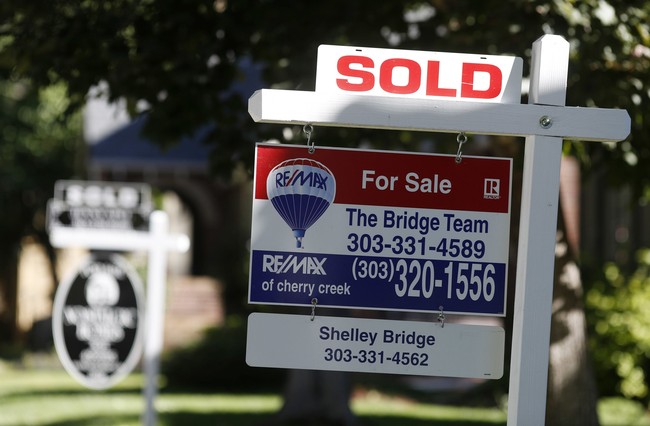
That is true too. A November 2025 report from the Lincoln Institute of Land Policy and the Center for Geospatial Solutions states that 8.9 percent of all residential parcels “are owned by corporations of various sizes.” The share of rental properties owned by individual investors dropped from 92 percent in 1991 to 73 percent in 2021, the study states.
Big companies have been on a residential-property buying spree in recent years. Corporations’ share of home purchases in the United States has more than doubled since 2000, with institutional investors accounting for almost one-third of all U.S. single-family home purchases in the first half of 2025, the report notes.
With all that corporate demand competing for houses and pushing up prices, “Record numbers of households are now cost-burdened, spending more than 30 percent of their income on housing,” the report states.
Trump’s executive order reflects those insights, stating, “Hardworking young families cannot effectively compete for starter homes with Wall Street firms and their vast resources.”
RELATED: Trump to Davos Elites: ‘America Will Not Become a Nation of Renters’
Making Homeownership Great Again: Trump Has Bold Idea to Make American Dream Affordable
Still, none of this makes an economic case for the government to intervene in the market, nor a constitutional case for the president to do so on his own initiative.
Trump, however, generally confines his executive order to actions appropriate in both regards: stopping federal agencies from encouraging corporations’ purchases of residential property. The president directs federal agencies to halt any actions that contribute to large institutional investors’ purchases of single-family homes “that could otherwise be purchased by an individual owner-occupant” or “disposing of Federal assets in a manner that transfers a single-family home to a large institutional investor.”
Instead, Trump directs these agencies to “promote sales to individual owner-occupants.”
Those directives are defensible as limitations on the enormous damage the federal government has been doing in the housing market and an attempt to reverse government-devised market distortions. They also are appropriate responses to an acute, short-term problem that will recede if the government does not further suppress economic growth and increase inflationary deficit spending.
Two other provisions of the executive order are problematic. First, Trump orders the attorney general and the chairman of the Federal Trade Commission to identify “anti-competitive effects” of large institutional investors’ purchases of single-family homes across the country “and prioritize enforcement of the antitrust laws, as appropriate” in “local single-family home rental markets.”
Antitrust laws amount to government grabbing additional power to deal with problems it previously created through its own interference, imposing further restrictions on the market in response to the damage it has already done. Antitrust is a thoroughly bad idea.
However, it is important for presidents to enforce the laws as written and intended (although I would argue that all these interventions in the economy are unconstitutional). This provision is clearly aimed at that.
Trump then directs his team to develop legislation for Congress to give his executive order force of law and make it impossible for a future president to reverse without congressional approval.
That is the right way to implement policy changes. Ironically, it is the one thing in the executive order that is truly worrisome.
The federal government’s countless interventions in the nation’s economy have led to the very problems Trump is trying to solve in the executive order. New legislation would be additional government overreach. It would create new problems, as history amply demonstrates, which a later government would “solve” with even more restrictions.
Government intervention in the economy does not remedy government intervention in the economy. Only government retrenchment can do that: removal of the bad laws that are causing the problems.
I know: There’s no chance any Congress and president will rescind the laws that have created these market distortions, nor will they rein in the Federal Reserve’s monetary manipulation that makes everything even worse. New laws, however, will increase the governmental distortion of the nation’s economy and further reduce the affordability of the most desirable goods and services.
The only way for the federal government to solve our problems is to stop creating them.
S. T. Karnick ( is a senior fellow at The Heartland Institute and author of the Life, Liberty, Property weekly e-newsletter.
Editor’s Note: Do you enjoy RedState’s conservative reporting that takes on the radical left and woke media? Support our work so that we can continue to bring you the truth.
Join RedState VIP and use the promo code FIGHT to get 60% off your VIP membership!