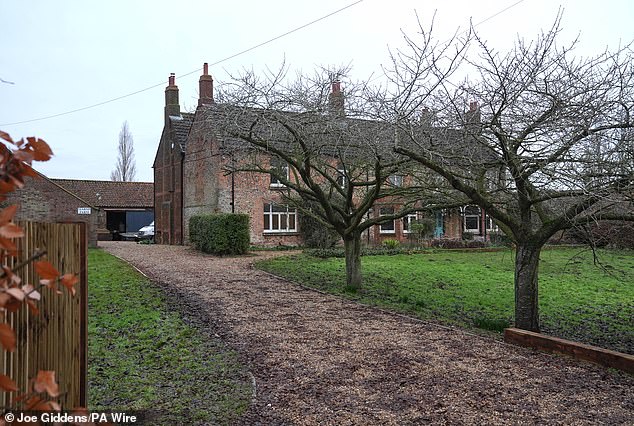
Andrew Mountbatten-Windsor faces signing up to an Environment Agency warning system because his anticipated new home is in an area with ‘a high probability of flooding’.
The disgraced former prince’s likely home Marsh Farm at Wolferton on the Sandringham estate is surrounded by land below sea level, according to the Royal Family’s own website.
Planning documents reveal that the five bedroom farmhouse is in an area rated by the Environment Agency as being a Class 3 flood zone where properties are at risk.
While the designation rates the area as being at ‘a high probability of flooding’, much of the risk at Wolferton is mitigated by strong sea defences and a modern pumping station.
But Andrew’s neighbours have already been urged to join the Environment Agency’s Floodline Warnings Service which alerts people to likely flooding by phone, text or email.
It is expected that the former royal will be given similar advice if he moves as expected into Marsh Farm following his departure from Royal Lodge at Windsor.
Details of the area’s risk of flooding were revealed last year in a report drawn up on behalf of the Sandringham estate when it wanted to change the use of two barns next door to Marsh Farm from agriculture to commercial use.
The document drawn up by Ellingham Consulting stated that the surrounding area would be at risk of flooding if there was ‘breach of the tidal defences’ offering protection from the North Sea around a mile away.

The disgraced former prince’s likely home Marsh Farm (pictured) at Wolferton on the Sandringham estate is surrounded by land below sea level, according to the Royal family’s own website

Andrew’s neighbours have already been urged to join the Environment Agency’s Floodline Warnings Service which alerts people to likely flooding by phone, text or email (Pictured: Andrew Mountbatten-Windsor riding his horse around Windsor Castle on January 19)

Andrew Mountbatten-Windsor’s likely home Marsh Farm in Wolferton, Norfolk, is at risk of flooding
It stated that the defences formed by a natural shingle ridge with a raised flood embankment were currently in ‘a fair condition’, with a secondary grassed earth embankment running parallel around 500m inland offering further protection.
The defences, coupled with the effectiveness of the pumping station at Wolferton, meant the barns next door to Marsh Farm were at a low ‘actual risk’ of flooding, the document said.
But it added that there was an annual one in 200 chance every year of the Sandringham estate’s farmland at the rear of the property being flooded, taking into account climate change and ‘combined breaches to the coastal defence’.
An assessment map showed that such flooding would potentially put Andrew’s front garden and driveway under up to 25cms of floodwater, although it would fall short of flooding into his home
The report added that the estate should ensure its tenants were ‘sufficiently aware of the risk of flooding, and the standard of the existing defences’.
It added: ‘The Environment Agency operates a flood warning system for properties at risk of flooding to enable householders to protect life or take actions to manage the effect of flooding on property.
‘Floodline Warnings Service is a national system run by the Environment Agency for broadcasting flooding warnings. The user of the site should register to receive flood warnings.
‘During an extreme event it is anticipated that sufficient time would be available to take precautionary actions to limit the potential impact of flooding.’
The report stated that the flooding risk was also reduced by the Wolferton Pumping station operated by the King’s Lynn Internal Drainage Board which collects water in a series of drains around the farmland and pumps it back into The Wash.
It stated: ‘Failure of Wolferton Pumping Station may occur due to long term mechanical breakdown or power supply being disrupted.
‘However, in these circumstances, if conditions were such to put properties and land at risk of flooding, the IDB would take emergency action to maintain the drainage level of service by using temporary pumping equipment.’

The Environment Agency flood map from April 2025 shows Marsh Farm (red square) in Wolferton Norfolk within the flood zone

The Wolferton Pumping Station was initially opened by the late Queen’s father King George VI (right) in 1948, allowing 7,000 acres of marshland to be drained, dried out and farmed

The new station was officially opened in 2020 by the late Queen, following in her father’s footsteps from 72 years earlier. She toured the facility and met long serving staff before signing a visitor’s book and unveiling a plaque

A Sky engineer pictured on January 14 at Marsh Farm with a ladder against the side wall of the property
King’s Lynn and West Norfolk Borough Council ruled that the change of use for the two barns could go ahead automatically without the need for planning consent.
Work is said to be continuing this week to prepare Marsh Farm for the arrival of Andrew.
Contractors were seen last week adding a 6ft tall fence around the front of the property, along with CCTV, security lighting and equipment for the former prince to receive Sky TV.
The Wolferton Pumping Station was initially opened by the late Queen’s father King George VI in 1948, allowing 7,000 acres of marshland to be drained, dried out and farmed.
The Royal family’s official website tells how the former King ‘took a personal interest in the scheme’ to drain the land and ‘designated’ the area on the estate where the pumping station could be built.
Its installation meant that the land at Wolferton became ‘some of the most productive on the Estate, and produces organic crops including wheat, barley, oats and beans’, the website adds.
The pumping station was rebuilt in 2019 to make it ‘cleaner, more efficient and environmentally friendly’ and better able to protect local wildlife, including nesting birds on the neighbouring marshes.
The new station was officially opened in 2020 by the late Queen, following in her father’s footsteps from 72 years earlier. She toured the facility and met long serving staff before signing a visitor’s book and unveiling a plaque.
It was revealed last October that Andrew was being stripped of his ‘prince’ title and leaving Royal Lodge, following weeks of intense scrutiny over his links to the late paedophile sex offender Jeffrey Epstein.
The move came after he was forced to give up his other royal titles, including the Duke of York, after facing more questions about his private life including claims that he had sex with 17-year-old Virgina Giuffre, an alleged sex slave of Epstein.

A workman measures up for the installation of new security lights on one of the red brick walls at Marsh Farm on January 13

Andrew has lived at the Royal Lodge (pictured) in Windsor since 2003 along with his ex wife Sarah Ferguson

Andrew with a young Virginia Giuffre (AKA Roberts) and Ghislaine Maxwell in a picture taken by Jeffrey Epstein in 2001
Andrew has always denied the claims, despite him having paid her a reported £12m out of court settlement before her death last year.
Sources confirmed that King Charles would be privately paying for Andrew to move to a new home at one of his properties in Sandringham.
There has been no official confirmation that it will be Marsh Farm, but speculation has mounted due to the work being carried at the house and a recent extension of the no-fly zone for drones around Sandringham to include the area around the property.
Marsh Farm is currently standing empty, but is said to be requiring extensive renovation work before it is fit enough for Andrew to move in.
Sources suggest Andrew must leave his Crown estate home Royal Lodge before January 25, and that he might have to move into a temporary home at Sandringham before Marsh Farm is ready.
Andrew and his former wife Sarah Ferguson had been living in 30-room Royal Lodge since 2008.