Delusional Rachel Reeves insisted her ‘plan’ is working today despite Brits facing a grim new record tax high – and fears the Middle East war will make things even worse.
The Chancellor has unveiled her Spring Statement, talking up easing inflation and left-wing policies such as scrapping the two-child benefit cap.
But Ms Reeves confirmed that the independent Office for Budget Responsibility has sharply downgraded growth for this year from 1.4 per cent to 1.1 per cent.
Unemployment is due to peak at 5.3 per cent in the coming months, worse than previously anticipated and the highest for a decade outside of Covid.
Details in the OBR’s assessment reveal that while Ms Reeves boasted about an improved outlook in the government’s books, that is driven by higher tax revenues – largely from the recent stock market rally.
That money is seen as offsetting billions of pounds in extra spending over the coming years.
The watchdog cautioned that a 35 per cent stock market correction would entirely wipe out the Chancellor’s ‘headroom’ for hitting her main fiscal targets.
The tax burden is now on track to reach never-before seen mark of 38.5 per cent of GDP in 2030-31, even higher than the 38.3 per cent envisaged before.
The OBR raised concerns the government is relying on a small base of better-off taxpayers for the bulk of revenues, while the ‘stealth raid’ of freezing earnings thresholds is very sensitive to changes in inflation and earnings.
And it gave a brutal insight into the pressures facing Ms Reeves amid the mounting threat from Russia and China, and chaos in the Middle East.
As the government mulls the impact of global events:
- The OBR said increasing defence spending to 3.5 per cent of GDP – a goal set by Sir Keir without a fixed deadline – would cost £40billion a year;
- Welfare spending is due to rise by £18billion this year – £900million more than forecast in November – as health benefits increase;
- An exodus of Britons is expected to keep net migration below 300,000 a year, despite inflows from outside the EU.

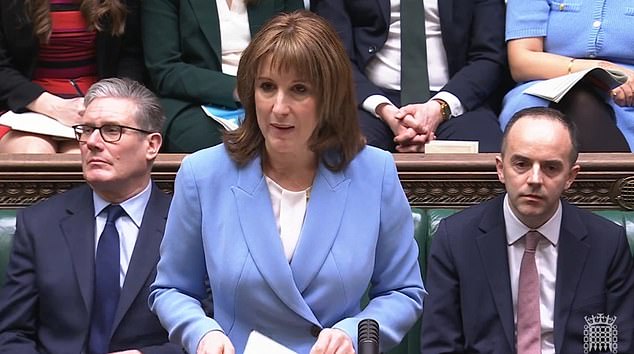
Chancellor Rachel Reeves is unveiling her Spring Statement in the Commons, with mounting questions over the performance of UK plc

The tax burden is now on track to reach never-before seen mark of 38 per cent of GDP in 2030-31

An increase in receipts has improved the appearance of the government’s books, covering up a rise in spending

Unemployment is expected to peak at 5.5 per cent in the coming months, significantly higher than the OBR foresaw in November
The set-piece comes amid mounting alarm at the developing war in the Middle East, which is already sending oil and gas prices spiralling. Concerns were raised today that the energy price cap could see a huge jump in July, while there are already signs of panic buying at the pumps.
Even before the latest turbulence official figures were showing Brits actually getting poorer – with GDP per head falling for six months at the end of last year.
Ms Reeves claimed that falling immigration meant that metric would rise by 5.6 per cent over the Parliament – the same as the OBR estimated in November.
With the government making clear there will be no big moves on tax or spending this afternoon, all eyes were on the forecasts from the OBR.
The Treasury watchdog followed the Bank of England in downgrading growth this year, with global instability and the impact of Labour’s massive tax raids weighing heavily on activity.
But it was still more optimistic than the Bank, which trimmed its estimate for expansion in 2026 to 0.9 per cent from 1.2 per cent, and to 1.5 per cent from 1.6 per cent for 2027.
Ms Reeves said that the OBR had delivered her some solace by nudging up the estimate for 2027 from 1.5 per cent to 1.6 per cent.
The watchdog has forecast 1.6 per cent for 2028 and 2029, marginally above the 1.5 per cent previously pencilled in.
Ms Reeves said: ‘I know that the economy is not yet working for everyone and that the deep economic scars left by the party opposite and their mates in Reform are still blighting the lives of too many people.
‘In today’s forecasts, unemployment is set to peak later this year and then fall in every year of the forecast period, ending the forecast period at 4.1 per cent, lower than it was at the start of the Parliament, but young people in particular are still suffering from the aftermath of years of Tory mismanagement.’
The OBR pointed to the ‘significant risks’ around the forecasts, saying there were ‘plausible outcomes both substantially above and below the central projection’.
‘Conflict in the Middle East, which escalated as we were finalising this document, could have very significant impacts on the global and UK economies,’ the Spring Statement document said.
‘In addition, trade policy developments, the evolution of productivity growth and the labour market, and changes in equity prices and interest rates are key risks within the economy forecast.’
The OBR has been barred from making a formal assessment of whether Ms Reeves is on track to meet her fiscal targets.
But Ms Reeves said the ‘headroom’ for hitting her main target had been upgraded from £21.7billion to £23.6billion in 2028-29.
That was largely due to the OBR increasing estimates for the tax take, which reduces projected borrowing by £13 billion in 2030-31.
‘Around two-thirds of this upward revision is due to higher-than-forecast growth in equity prices since November, which drives higher expected revenues from capital taxes, onshore corporation tax, self-assessed income tax, and interest and dividend receipts,’ the OBR said.
The FTSE 100 has risen by more than a third since September to record highs – but has been losing ground rapidly in recent days on alarm at the Middle East chaos.
The OBR said a 35 per cent fall in stocks this year would add around £26billion to borrowing by 2027-28, wiping out the Chancellor’s headroom.
A more limited 15 per cent correction would cost the Treasury around £15billion.
The OBR said: ‘A higher level of the tax take increases the risk that incentives within the tax system distort or constrain economic activity by more than expected. For example, capital taxes are paid by a narrow base of typically higher-income taxpayers and are often very sensitive to behavioural responses to policy changes.
‘The yield from the personal tax threshold freezes, which drives much of the forecast increase in the tax take, is very sensitive to future inflation and earnings growth.
‘And there are also risks that the tax gap, which is a measure of the degree of tax compliance, does not fall by as much as forecast.’
Hints have been coming out of the Treasury that Ms Reeves is desperately looking for ways to ease the burden come the election.
However, the Iran crisis could blow another huge hole in the government’s plans.
Former chancellor Jeremy Hunt said the Treasury’s rule of thumb was that a 20 per cent increase in global oil and gas prices would mean a 1 percentage point rise in UK inflation, and 0.5 percentage points off economic growth.
The Government has promised to restrict itself to one ‘fiscal event’ a year for tax and spending policies – the Budget in the Autumn.
The Chancellor told MPs this afternoon: ‘This Government has the right economic plan for our country… in a world that has become yet more uncertain.
‘Stability in the public finances, investment in infrastructure and reform to our economy.
‘Building growth not on the contribution of a few people or a few parts of the country, but in every part of Britain with a state that doesn’t stand back, but steps up.’
Ms Reeves added: ‘Because of the decisions we have already taken, we have a stronger and more secure economy. Inflation and interest rates falling. And in every part of Britain, working people are better off.’

Chancellor Rachel Reeves is unveiling her Spring Statement with mounting questions over the performance of the economy
Join the debate
Do YOU feel better off than a year ago?

The price per therm of natural gas touched 170p today – compared to the 72p the OBR expected it to average this year
Despite Ms Reeves’ positive tone, polling for the More in Common think-tank suggested voters remain gloomy about their own economic prospects.
The study found that 58 per cent of voters fear the cost of living crisis may never end, while a further 23 per cent do not think it will end this year.
The poll also found that Labour is losing the support of voters most concerned about the costs of living.
Overall, the party is holding on to 54 per cent of those who backed Labour in 2024. But the figure falls to just 38 per cent who fear the Chancellor will never get to grips with rising prices.