
After decades of effort and $15 billion in spending, California’s plan to connect Los Angeles to San Francisco with a high-speed rail line is falling apart. A pair of documents from the state’s High-Speed Rail Authority reveal an urgent effort to keep the project alive by making it much more modest in scope and effect, violating state law and undermining every promise made at its conception. And most of what passes for the news is badly misrepresenting the latest developments, celebrating retreat as rebirth.
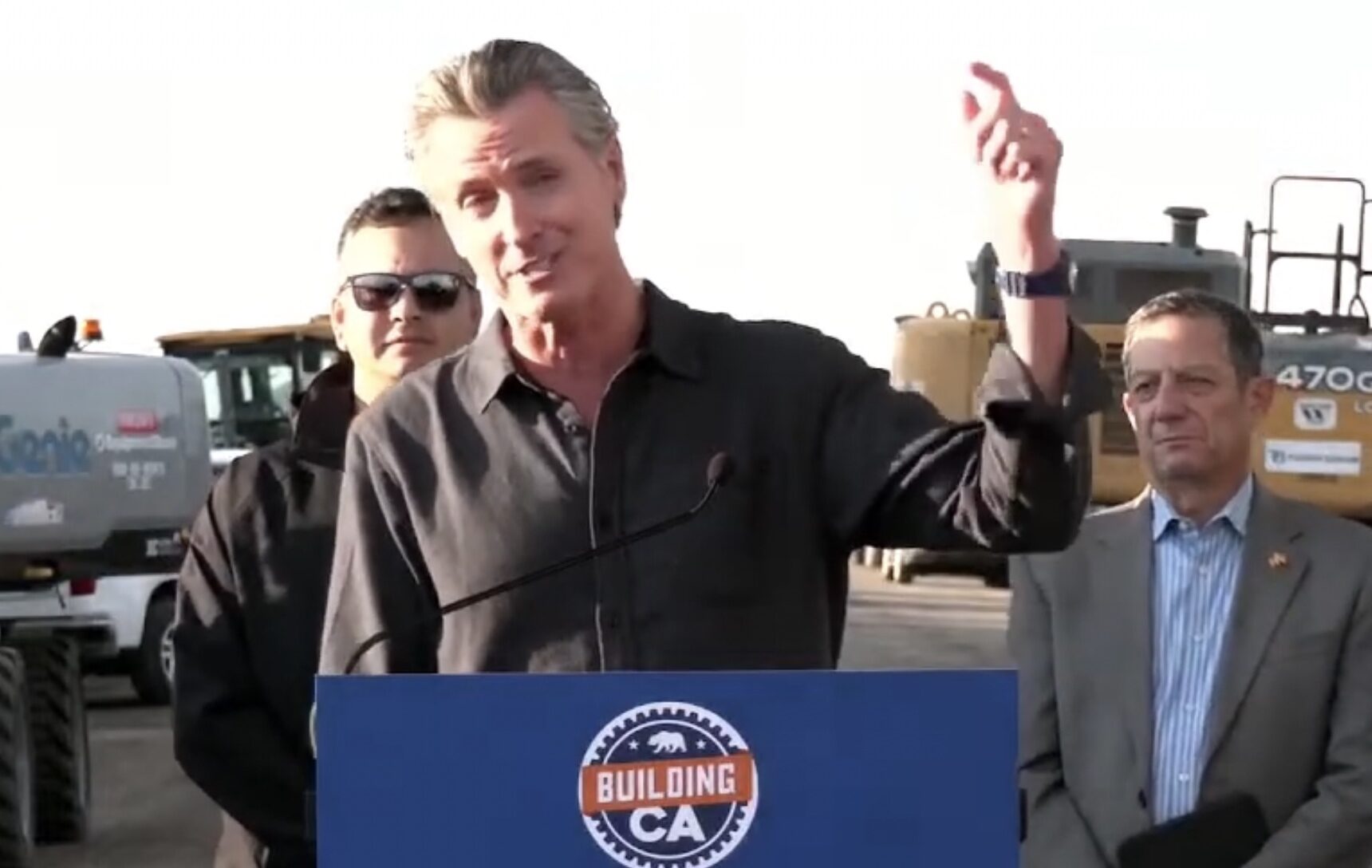
There are two lessons from California’s stillborn bullet train. First, Gavin Newsom can never become president, which would inject the appalling failure of blue state political culture into the national bloodstream. Second, the decision of the Trump administration to withdraw $4 billion in federal funds from the project is proof of competence, and a policy win for Transportation Secretary Sean Duffy.
Newsom’s bullet train has failed the way Hemingway’s protagonist went bankrupt: suddenly, and then all at once. There have been hints about the growing disaster, but they became very public on Monday at a long legislative hearing in Sacramento. To borrow a bit of phrasing from the legacy media, critics of the project pounced and seized on the open discussion of the emerging failure.
Did you notice those dates? California is hoping to pay for initial construction that ends in 2033 by borrowing against money that they hope to get through 2045, and analysts warn that the money may not actually turn out to exist. The whole hearing went about that well. (See also Marc Joffe’s longer discussion here, by the way.)
You can watch that entire hearing here, if you have nearly superhuman patience, but note before you click that the first 33:20 is dead air telling you to stand by for the stream to begin. Fast-forward to that point for the opening of the discussion. Two documents informed the testimony, and the first – “California High-Speed Rail 2026 Draft Business Plan” – was released a few days ago. The other document, the “2025 Supplemental Project Update Report,” was released last August, but the quirks of the legislative calendar meant that this week’s meeting of the Assembly Transportation Committee was the first time that the earlier report has been discussed in front of the people who have to vote to fund the project.
Both documents present a remarkable series of what-if moments, as the High-Speed Rail Authority proposes a much different project while trying to sell the alterations as a cost-saving reorganization of the same thing. Think of it this way: You order a banana split listed on the menu with three scoops of ice cream in three different flavors, three kinds of sauce, whipped cream, nuts, and a cherry, but then a waiter brings you a small scoop of vanilla ice cream, lukewarm and melting, and says that the restaurant found a way to save some money on the thing they’re still calling a banana split.
On Monday, the legislative policy analyst Helen Kerstein opened the march of doom. A project approved by voters in 2008 as a high-speed rail line between Los Angeles and San Francisco that would cost about $10 billion has been scaled down into a 171-mile initial segment (with a 119-mile core to be built first, a first segment of the first segment) that proposes to connect only the Central Valley cities of Bakersfield and Merced. But after $15 billion spent so far on a line with no working commuter rail, Kerstein warned that legislative analysts don’t see a way to finish paying for that much more modest initial segment. “In our assessment,” she said, “under the numbers in the supplemental project update report, we think it’s likely that there’s insufficient funding to complete Merced to Bakersfield.” A dramatically scaled-down project is still becoming financially untenable. This is where you begin to thank Sean Duffy for backing out on behalf of the rest of the country.
Even if the state solves that Phase One problem, she added, “we think the project still lacks a funding path to get outside of the Central Valley.” Getting outside of the Central Valley is the project that voters approved, so the project that was promised to voters in 2008 lacks a funding path in 2026. The subtext running through this discussion is that the thing which restores the whole project would be President Newsom throwing the federal treasury wide open to the state he used to govern, solving all the funding problems with infinite free cash.
Presenting ways to save money on the currently state-funded project, the High-Speed Rail Authority is gradually turning high-speed rail into not-high-speed rail. A project conceived as a dedicated bullet-train-only rail line, double-tracked for its full length to allow trains going north and south to fly by each other without slowing, is sprouting single-tracked sections that require trains to wait for clear track, and sections of shared track for a last stretch into Los Angeles, one day in the distant future, that would have bullet trains running on the same rails as other trains.
The other person who rained all over the project was Ben Belknap, the inspector general for the High-Speed Rail Authority, who made exactly this same point a few minutes later. “There needs to be a clear distinction between cost-cutting measures and scope changes,” he said. We’re back to that smaller banana split: The state has been presenting scope changes — a smaller, slower, less useful project — as cost-savings in the original project. They’ve substantially changed what they plan to deliver, so they say they’ve found ways to save money. This maneuver has played remarkably well in the news, which hasn’t noticed what’s actually happening. Sample of a recent headline from an infrastructure-focused blog: “New Draft CA High-Speed Rail Business Plan is LESS Costly than the 2022 Plan.” That post goes on to praise the High-Speed Rail Authority for “the new messaging that has taken root,” and a “more celebratory” institutional culture. Hooray?
Slowing their hypothetical future bullet trains, California is also proposing to make them far less convenient once they actually get you where you wanted to go. Train stations in downtown areas are turning into train stations at the outskirts of town. As Kerstein noted, a high-speed rail destination in Downtown Merced is being re-proposed as a station four miles to the south. So you might one day take a bullet train from Bakersfield to Merced, but then you’ll need Uber to finish taking you into the actual city.
As Belknap and Kerstein both noted, the routes and stations in the original high-speed rail plan were defined by law. In 2022, the legislature said that Merced would have a train station downtown in the bullet train plan they were funding. No it won’t, the High-Speed Rail Authority now says. So high-speed rail can still be delivered, if the phantom funding can be nailed down, but first the authority that runs the project needs the legislature to change that law, and a bunch of others. To throw yet another document at you, with my profuse apologies, Kerstein gave the committee a summary of her comments that includes a long list of state laws the California High-Speed Rail Authority wants to have changed. You can find that long list here, on the bottom of pg. 3 (which is the fourth page of the PDF file).
There are many more details that could be examined at great length, but they wouldn’t change the point. The California legislature created the High-Speed Rail Authority in 1996 (with the unfortunate signature of the Republican Governor Pete Wilson), voters approved high-speed rail funding and the scope of the project in 2008, and construction began in 2015. In 2026, California is trying to begin to figure out what the state actually intends to build.
California can’t build things, and turning America into California would have obvious consequences.
As a final note, the High-Speed Rail Authority’s 2026 Draft Business Plan first caught my attention because of a projection you’ll find way in the back, in Appendix B, and here’s that link again. You’re looking for Table B.6. It’s at the top of pg. 47, which is pg. 73 of the PDF file. If they get the Bakersfield-to-Merced segment built, the High-Speed Rail Authority projects, they’ll lose roughly between $88 million to $101 million a year by actually running it, depending on ridership numbers, so they’ll also need an ongoing operational subsidy after the construction subsidies.
Newsom 2028?