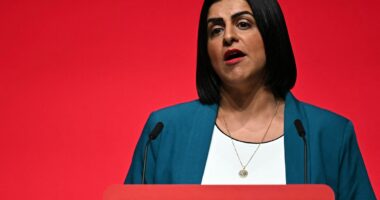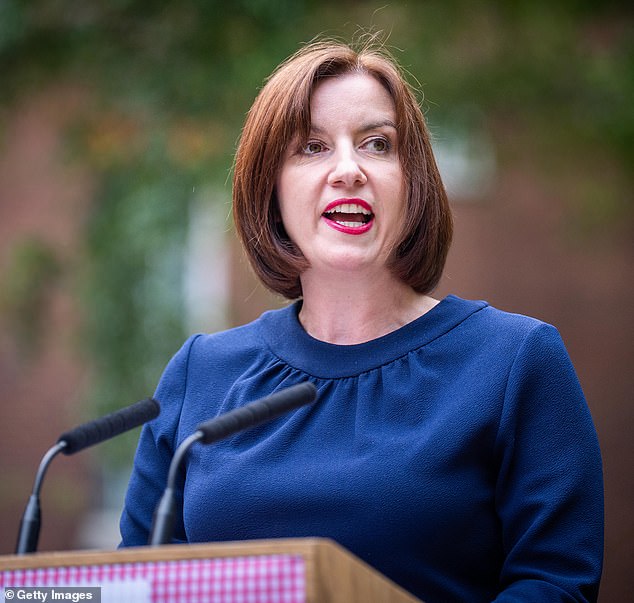

Education Secretary Bridget Phillipson is at the centre of a new ‘class war’ row over government plans to stifle the rights of council tenants to buy their homes – after her family benefited handsomely from the policy.
Labour MPs professed outrage last week when Tory leader Kemi Badenoch branded Ms Phillipson a ‘spiteful class warrior’ for her attack on private schools.
Undeterred, Conservatives last night ramped up the pressure on the Cabinet minister over Labour housing policies they see as yet another attack on aspiration.
Ms Phillipson’s family used the right-to-buy scheme to buy the council house she grew up in, later selling it at more than 900 per cent profit. But now Labour are drastically cutting access to the scheme, leading to accusations that senior figures such as her are ‘pulling up the drawbridge’ after benefiting from the policy themselves.
Conservatives claim the legislation currently going through Parliament is yet another example of ‘one rule for them and another for everyone else’.
In an extraordinary Commons spat last week, Mrs Badenoch took aim at the Education Secretary for imposing VAT on private school fees, which has been blamed for the closure of more than 100 institutions.
The Tory leader enraged the Labour front bench by saying of Ms Phillipson: ‘She taxed private schools to pay for more teachers, but the number of teachers has gone down. It turns out that appointing a spiteful class warrior as Education Secretary was a disaster.’
Prime Minister Sir Keir Starmer then tried to defend Ms Phillipson by referring to her background, saying: ‘She knows exactly what it means to grow up in poverty… She was once reluctant to tell her story, but I know her story and it is an incredible story of social mobility and success.’

Education Secretary Bridget Phillipson’s (pictured on June 1, 2026) family made a 900 per cent profit on their council home

Pictured: The terraced home where she grew up – and which her mother, Mary, was able to buy outright under Margaret Thatcher’s right to buy scheme
Ms Phillipson has frequently mentioned her working-class roots, talking about growing up on ‘a tough street of council houses’ in the North East and having to go to bed fully clothed in winter because their home had no upstairs heating.
In 1990, when Ms Phillipson was six years old, her mother Clare bought the two-bedroomed council house in Washington, Tyne and Wear, that they were living in for £9,600 – a 38 per cent discount on the £15,490 market value. It remained in the family’s ownership until May 2023 when it was sold for £99,950 – a profit of more than 900 per cent.
The property sits in the middle of a row of Victorian-style terraced houses, and was described as ‘beautiful’ and ‘delightful’ by estate agents when it was sold.
But Labour’s Social Housing Bill currently going through Parliament, will slash the number of families who are able to follow in the Phillipsons’ footsteps.
Among a series of measures, the legislation will extend the time tenants must have lived in the property before they can exercise their option to buy from three years to ten. And discounts will start at just five per cent of the property value, rising to a maximum of 15 per cent. Ministers say the measures are needed to increase the stock of social housing. They are expected to reduce sales from 8,200 a year to around 850, a drop of about 90 per cent.
The new rules were first put forward by Angela Rayner in 2024 when she was housing secretary. Ms Rayner personally benefited from the right-to-buy scheme – first introduced by Margaret Thatcher’s government – when she bought her council house in Stockport, Greater Manchester, at a discount and sold it eight years later for a profit of £48,000.
Last night, Tory chairman Kevin Hollinrake said: ‘Labour have once again been caught red-handed displaying their spiteful class-war hypocrisy.
‘They are gutting the very same right-to-buy scheme that Bridget Phillipson and Angela Rayner benefited from, pulling up the drawbridge after taking advantage themselves. As ever with Labour, it’s one rule for them and another for everyone else.’

Ms Phillipson pictured during her school days in uniform, wearing her school’s black blazer, a cardigan and red and yellow striped tie

Ms Phillipson’s mother was able to buy the two-bed home from Sunderland Council thanks to Thatcher (Pictured: Interior of the property)

The Education Secretary said the house (pictured: the kitchen) was ‘sandwiched between a disused railway line and an industrial wasteland’. She added it ‘wasn’t a desirable place to live’
Ms Phillipson has described her council house home as being in ‘a terraced street sandwiched between a disused railway line and an industrial wasteland’, saying: ‘It wasn’t a desirable place to live. People didn’t want to be there and the houses themselves were in pretty poor condition.
‘We had no upstairs heating; the windows were rotten. I would go to bed in the winter fully clothed.’
However, when it was put up for sale, the listing described the property as a ‘lovely Victorian terrace’ with photographs highlighting the ‘unique combination of character and modern comforts’ the property offered to potential buyers.
Ms Phillipson has told of how her mother struggled to raise her single-handedly after her father walked out on the relationship before she was born.
She said: ‘There was no childcare and my grandparents were both working so they helped when they could, they couldn’t look after me. So that meant until I started at school, she couldn’t work full time.
‘And that had a big impact on us as a family. When you’ve only got one parent anyway, and you’re dependent on that parent as the breadwinner, if they can’t work, then that pushes you into poverty and that was what we experienced.
‘For all we had it hard, there were kids in my street that had it far, far harder. And I feel incredibly fortunate that I’ve got to where I am and that I had a brilliant education, and that I’m able to give voice to those children and families today who were going through what I went through and who expect better from us as a country.’
But even though the right-to-buy policy helped the family’s social mobility, Ms Phillipson has said of its political architect: ‘I have never pined for anything associated with Margaret Thatcher. How could I, given the damage she caused?’
The Education Secretary referenced her background when responding to Ms Badenoch last week.
Writing on social media, she accused the Conservative leader of having ‘lost her head’, adding: ‘I wonder what it is about a working-class woman driving record investment in state schools by ending private schools’ tax breaks that the Tories hate so much?’
Ms Phillipson attended St Robert of Newminster Catholic comprehensive. Pupils from church secondary schools perform better on average than those from ordinary comprehensives.
Ms Phillipson was one of six people in her year who were admitted to Oxbridge, going on to read modern history and modern languages at Oxford.