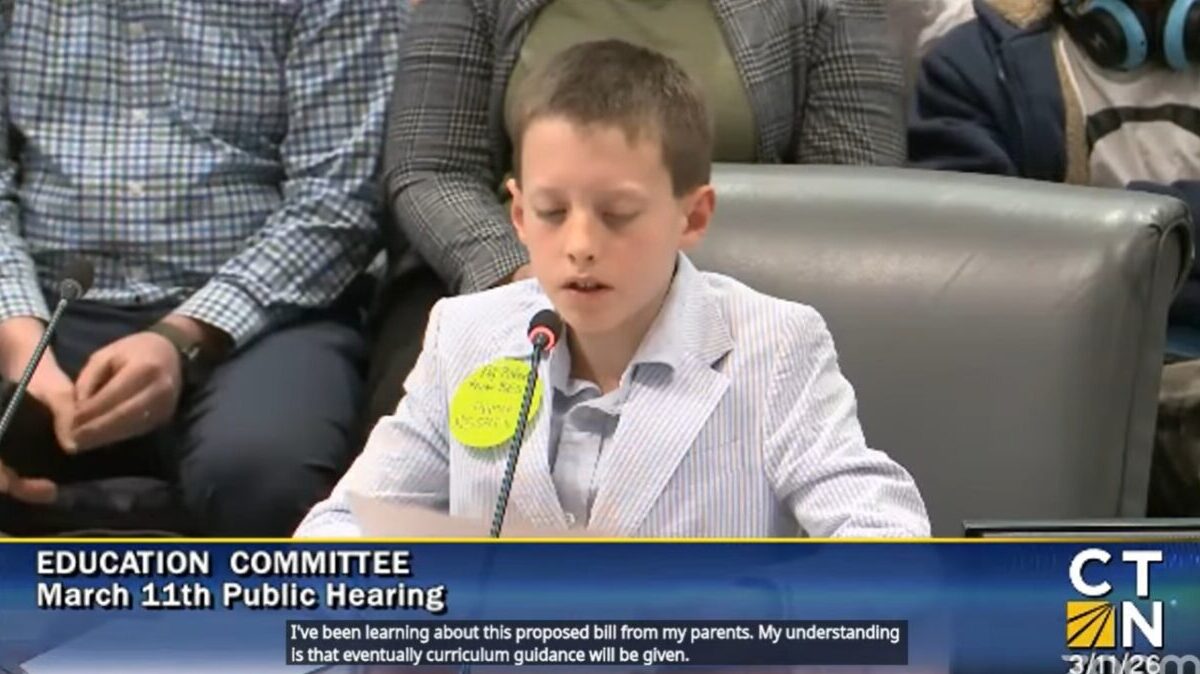

Nineteen hours after the hearing began, I finally stood before the Connecticut Education Committee to testify against House Bill 5468, which would end the state’s longstanding tradition of homeschool freedom. It was 4:45 a.m. on a Thursday.
Hundreds of parents, students, and supporters filled the hearing room and lobby of the legislative office building in Hartford and waited hours for their turn at the microphone, demonstrating an amazing commitment to take a stand against this bill.
Their concern: H.B. 5468 would impose a layered system of government oversight on homeschool families. Under the bill, families would be required to file in-person paperwork before beginning to homeschool and provide annual documentation of their children’s educational progress. After decades of a hands-off approach to homeschool regulation, the state would now be empowered to collect and maintain records on all children receiving home instruction.
What is arguably of greatest consequence is the provision that involves approval from the Department of Children and Families. Upon withdrawing one’s child from public school — for any reason — DCF would then conduct a check to see if the family had any prior involvement with the agency. Depending on the finding, DCF would then render the withdrawal as effective or ineffective.
If enacted, this bill means the presumption of innocence for law-abiding families is turned on its head and parents would need permission from the government to exercise their constitutional right to educate their children at home.
Taken together, these are not minor administrative details. They represent a fundamental shift toward an atmosphere in which families’ educational choices are restricted and monitored.
Bipartisan Coalition
The breadth of opposition to the bill in the 19-hour hearing was remarkable. This was not a narrow constituency defending a special interest, but a bipartisan coalition from every corner of Connecticut’s education landscape.
Homeschooling parents and their children testified, as expected. But so did public school teachers and school officials, as well as local school district superintendents, who expressed opposition to the bill because of the administrative burden it would place on budgets and staff. It is clear that this is not even a remotely popular bill despite what its proponents might believe.
In one of the more striking moments of the hearing, a DCF investigator took the microphone to oppose the bill, testifying against the very provisions that would have expanded her own agency’s authority over homeschooling families.
When the people who would administer a new regulatory power are telling lawmakers they do not want it, that is worth noting. This was not ideology. It was broad recognition, cutting across the usual divisions, that the bill gets the problem wrong.
Supporters of H.B. 5468 often frame homeschool regulation as a child protection measure. State oversight, they believe, will ensure that all children are safe and well-taught. Until now, state law has presumed that parents who choose to educate their children at home do not need surveillance. And homeschooling in Connecticut has produced generations of well-educated children whose parents were trusted to make good decisions.
New Hampshire Moving in Opposite Direction
At one point during the hearing, one of the committee’s co-chairs cited New Hampshire’s longstanding homeschool regulations as a model Connecticut should follow.
Just a little while later, a Connecticut mother stood at the microphone and informed the committee that the New Hampshire House of Representatives had just voted that same day to repeal those very regulations, including notification requirements, portfolio submissions, and annual evaluations.
Connecticut lawmakers are attempting to build a new regulatory structure on a foundation another state is tearing down. This should give the legislature pause. While Connecticut considers adding layers of oversight for the first time, New Hampshire is moving in the opposite direction after administering similar rules.
Claims about Protecting Kids
As far as the claim that homeschooled children need the state to act as a buffer between them and their parents — it’s worth being clear about what the research actually shows. Studies by multiple researchers, including peer-reviewed work examining the relationship between homeschooling and child welfare outcomes, have found no statistically significant connection between home education and elevated rates of abuse or neglect.
Decades of analysis by bodies such as the U.S. Commission to Eliminate Child Abuse and Neglect Fatalities have never identified homeschooling as a risk factor for child maltreatment. The actual demographic predictors of child maltreatment are well established: families experiencing domestic violence, substance abuse, poverty, and social isolation. Schooling type is not among them.
This is not to say that homeschooled children are never abused. But in such cases, more honest accounting typically reveals a failure of existing child protective systems. The solution is not a new regulatory structure for homeschooling families but better enforcement of laws that already exist and support for agencies responsible for child welfare.
What H.B. 5468 would actually do is bureaucratically burden Connecticut’s homeschooling families merely to create a paper trail that does not meaningfully address any of the real risk factors for child harm. By asking families to prove compliance to government reviewers on a regular basis, it creates an implicit presumption that their choices require justification.
Homeschooling works, in large part, because parents have the freedom to adapt. They can adjust the pace of instruction when a child struggles. They can pursue a subject in depth when a child shows great aptitude. They can choose methods and materials that suit their family’s values and their child’s learning style. A system that requires families to regularly obtain government approval introduces exactly the kind of rigidity that undermines these advantages.
The hundreds of people who waited through the night to testify were not there to argue that child safety does not matter. They were parents, students, teachers, and investigators, and they were there because they could see, from their own experience and expertise, that this bill would steer Connecticut in the wrong direction.
Connecticut lawmakers should listen to them.
Ralph Rodriguez is an attorney for the Home School Legal Defense Association and is directly involved in the opposition to HB 5468. He previously served as legal counsel with Alliance Defending Freedom.