
I can scarcely believe that I am writing these words, but the Government seems to be moving towards a ban on X. Not the Iranian or Chinese government, I add: the British government.
Left-wingers have never liked X, the name Elon Musk gave Twitter when he bought it four years ago. They had felt proprietorial about Twitter, which excluded some Rightist accounts altogether and made others less visible through its algorithms.
Twitter thus became a radical hothouse, where extreme ideas on race, gender and identity could grow without exposure to the wider population’s common sense.
Musk lifted the bans and allowed a free-for-all. Almost overnight, X became a way to circulate ideas and stories that mainstream broadcasters were too squeamish to touch. Yes, it could be cruel and conspiracy-addled; but it also allowed a crowd-sourced correction mechanism that few other media provided.
The people who had become accustomed to Twitter’s Leftist intolerance were first disoriented, then furious.
There is a telling difference between Left and Right when it comes to how to respond to ‘offensive’ ideas.
Even at the height of the demented BLM (Black Lives Matter) summer of 2020, when Twitter was full of accounts saying white people should be wiped out, few conservatives deserted the site, let alone called for it to be closed.
The reverse turns out not to be true. The moment Musk rescinded the prohibitions – which had even covered Donald Trump, whom Twitter banned on grounds that he was inciting violence – Leftists decamped en masse and began to call for censorship.
Now, at least in Britain, they think they have found a way to do it. Ministers are stirring up a moral panic about Grok, the AI program connected to X, which can show us how people of both sexes would look in bikinis, or even potentially naked. Government sources indicate that, unless Musk removes that tool, they will encourage Ofcom to sanction his company.

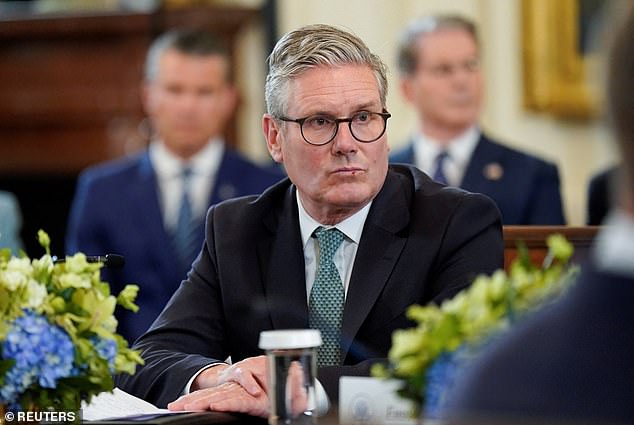
Keir Starmer is the ultimate cheerleader for a legal system that privileges the feelings of protected minorities over any normal understanding of free expression, writes Daniel Hannan

When Elon Musk, who bought Twitter and renamed it X four years ago, lifted the bans and allowed a free-for-all, the platform became a way to circulate ideas and stories that mainstream broadcasters were too squeamish to touch
Last night, it was reported that Grok had seemingly started to ignore some requests to generate images of women in bikinis – but was still doing so for men. Whether that will satisfy the British government is far from clear.
Under the lamentable Online Safety Act, foolishly passed by the previous Tory administration, Ofcom can levy a fine of up to 10 per cent of a platform’s total global revenue. X’s global revenue last year was put at above £2billion, making for a potential fine of more than £200million.
If, as seems inevitable, Musk refused to pay for what he regards as the exercise of basic free speech rights, X could end up banned in Britain. Labour would have shut down one of the most effective of all opposition media, one whose content is generated by the general public.
Think about that. We would recently have regarded the idea of shutting down critical media as unthinkable – the kind of thing that happened behind the Iron Curtain.
We have been boiled slowly, like so many frogs. Bit by bit, we have become accustomed to censorship.
We defended free speech during the Second World War and the Cold War. ‘It’s a free country,’ we used to tell one another, without irony. The idea that we might have our collars felt by coppers for saying something obnoxious or hurtful was unthinkable.
Not any more. Slowly but surely, we have got used to the idea that we might be arrested, charged or jailed for saying things that, while nasty, fall well short of what we understood as incitement.
Here is a statistic that ought to make every British subject squirm with embarrassment. We detain more people for social media posts than Russia, Iran or any other country.
According to figures from the Free Speech Union, Britain arrested 12,000 people last year for speech-related offences, far ahead of Belarus (6,000) or China (1,500).
It is true that countries compile their statistics differently, and the British figure includes arrests for stalking, harassment and threatening phone calls, not just online posts.
Even so, this has become a nation that puts people in prison for saying the wrong thing, as when a former policeman was jailed for 20 weeks in 2020 after making offensive jokes about George Floyd on WhatsApp – in a closed online group, where there was no possibility of a public order offence.
Sir Keir Starmer is the ultimate cheerleader for, and guardian of, a legal system that privileges the feelings of protected minorities over any normal understanding of free expression.
Almost from the day he took office, he was on a collision course with Musk, threatening X with legal sanctions in the aftermath of the Southport riots. It was a battle he could not win, but he seemed unable to understand that.
It was reported this week that Starmer is talking to his Leftist counterparts in Canada and Australia about a co-ordinated ban on X. Yet the chances of any other Anglosphere democracy taking on the US on this issue are negligible. They know how high the price would be.
For Americans, free speech is a fundamental right, just as it used to be for us. Labour MPs who can’t understand this, and who wonder why Musk and Trump are meddling in British affairs, should think about issues which they consider fundamental.
Successive British governments have, for example, put pressure on Afghanistan to ensure that girls can go to school. Well, believe it or not, US Republicans see free speech as an equally basic and universal entitlement.
Let’s deal with the excuse Starmer is giving, namely the ability of Grok to generate pictures of people undressed. To see why it is a bogus objection, consider that all AI programs can do the same thing. Google’s Gemini and OpenAI’s ChatGPT will also generate such images if asked. Facebook, Instagram and TikTok are awash with similar ‘deepfakes’. Yet Starmer doesn’t propose banning any of them.
None of us likes the idea of being undressed online, or of having that indignity inflicted on our relatives. That is why we have laws against the dissemination of salacious deepfake images of people, which is as it should be. The technology secretary, Liz Kendall, has described the content as vile and backs Ofcom’s probe.
Courts can tell the difference between, say, a cartoonist drawing a nude Donald Trump, and a lewd but realistic image of someone.
What is being proposed here is the targeting of one particular tool that allows Photoshopping. It is as if, in the aftermath of the spate of terrorist car attacks in 2017, we had tried to ban cars rather than pursue the terrorists.
No, this isn’t about bikinis. It is about Starmer’s unpopularity, the risk of a Labour leadership challenge and his commensurate desire to look tough by picking a fight with someone his MPs detest.
The trouble is that there can only be one winner.
I don’t just mean that people would find ways to remain on X through VPNs – which disguise a user’s location – just as millions have dodged the overreaches of the Online Safety Act through the same simple mechanism. I mean that a ban would prompt a needless trade war with a US government that came to office committed to concluding a deal with Britain.
We would find ourselves poorer and more isolated – and, worst of all, more repressive. Imagine finding ourselves, like so many Iranians, turning to X as a tool to use against a repressive state.
Imagine this country, the home of John Milton and John Stuart Mill, leading the world in banning media to which its leaders objected. Even to talk about the possibility is shaming.
Lord Hannan of Kingsclere is President of the Board of Trade