Prime Minister Anthony Albanese has apologised to Australia’s Jewish community, eight days after ISIS-inspired terrorists unleashed horror at Bondi Beach, allegedly killing 15 people and injuring 40 more.
Albanese was twice booed as he attended a vigil for the victims held at Bondi on Sunday night, while Labor NSW Premier Chris Minns got a standing ovation.
On Monday, Albanese for the first time acknowledged the raw emotions in the crowd and the anger directed at him over his government’s perceived failure to act on antisemitism before Sunday’s bloodshed.
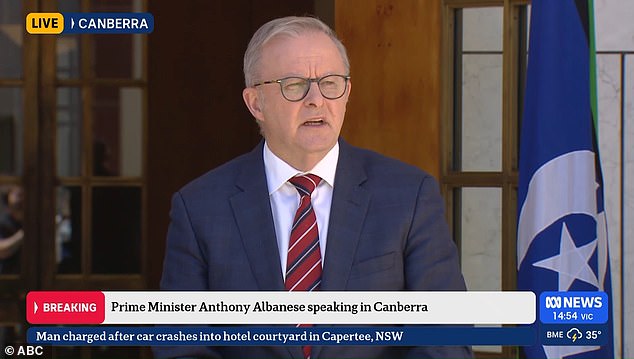
‘I feel the weight of responsibility for an atrocity that happened whilst I’m Prime Minister,’ he admitted at a press conference in Canberra.
‘And I’m sorry for what the Jewish community and our nation as a whole has experienced.’
Albanese unveiled his Cabinet’s suite of draft measures to respond to the attack – including changes to visa rules and hate preaching – as part of a drive to crack down on antisemitism.
But he resisted a push by the Opposition to order a federal Royal Commission into what led to the worst terrorist attack in Australian history.

Anthony Albanese (pictured) has apologised to the Jewish community after the Bondi attack

Albanese also acknowledged booing against him at the vigil on Sunday night at Bondi Beach
Albanese suggested a Royal Commission would take too long to set up and deliver its findings.
‘We want urgency and unity, not division and delay,’ he said.
Albanese also said that the Opposition proposal was too broad.
‘If you have a look at the broader issues that are proposed by the opposition, they are in education, the arts, culture, migration… the university sector, into Home Affairs, into the relationship between the Commonwealth and States and the nature of our Federation,’ he said.
‘What we need to do is to work immediately.’
The NSW government has suggested running a Royal Commission where federal agencies, such as ASIO and the Federal Police, would participate, rather than a full national inquiry.
Opposition Leader Sussan Ley slammed Albanese for rejecting calls for a Royal Commission, in a fiery statement released on Monday afternoon.
‘What Australians saw from the Prime Minister today was not leadership equal to the gravity of this moment,’ she said in response to his comments.

Albanese (pictured) is under growing pressure to establish a Royal Commission into the Bondi Beach terrorist attack
Ley said his reasoning against holding a Royal Commission ‘speaks volumes’.
‘He says he cannot support it because it would involve a full examination of the relationship between Commonwealth and state agencies and the parts of our society where antisemitism has been allowed to fester,’ she said.
‘That is not an argument against a Commonwealth Royal Commission, it is the case for one.’
Ley also reiterated her calls for the Parliament to be recalled before Christmas.
‘Repeating the words “unity” and “urgency” does not make them real,’ she said.
‘Urgency would mean recalling the Parliament this week to act now. Leadership is demonstrated through action, not slogans, and Australians can see the difference.’
Powers under consideration by the government include creating an aggravated offence for hate preaching that advocates violence against protected groups, and increasing penalties for existing hate speech offences – particularly those that advocate violence or property destruction.
Another measure would make hateful motivations a factor in sentencing for Commonwealth crimes.

Sussan Ley (pictured) criticised Albanese for rejecting calls for a Federal Royal Commission
The government has also proposed new powers to list prohibited hate organisations, making it a criminal offence to join, recruit or support any group named by the Home Affairs Minister and Attorney-General.
Draft options for fresh racial vilification or racial supremacy offences are under consideration.
Visa cancellation powers could be strengthened, allowing the Home Affairs Minister to revoke visas from individuals suspected of promoting hate speech, displaying hate symbols, or associating with terrorist or banned hate groups.
The government also plans to introduce a new mechanism to target extremist groups that have evaded terrorist listings by avoiding explicit calls for violence.
Home Affairs Minister Tony Burke said organisations such as radical Islamic group Hizb ut-Tahrir and the National Socialist Network have exploited legal loopholes to spread hate without crossing the threshold into illegality.
Under the proposed framework, authorities will be able to prescribe and ban groups whose conduct is considered unacceptable or unlawful, even if they do not meet the strict definition of a terrorist organisation.
Hizb ut-Tahrir, accused of infiltrating pro-Palestine protest organisations in Australia, is already a proscribed terror group in the United Kingdom, and has been banned in countries such as France, Indonesia and most Arab nations.
‘Their behaviour needs to be unlawful, their behaviour needs to be enough that we can prescribe the organisation and prohibit their activity in Australia,’ Burke said.
Asked about the possibility of recalling Parliament early, Albanese declined to give a direct answer, saying drafting new legislation would require time and consultation.