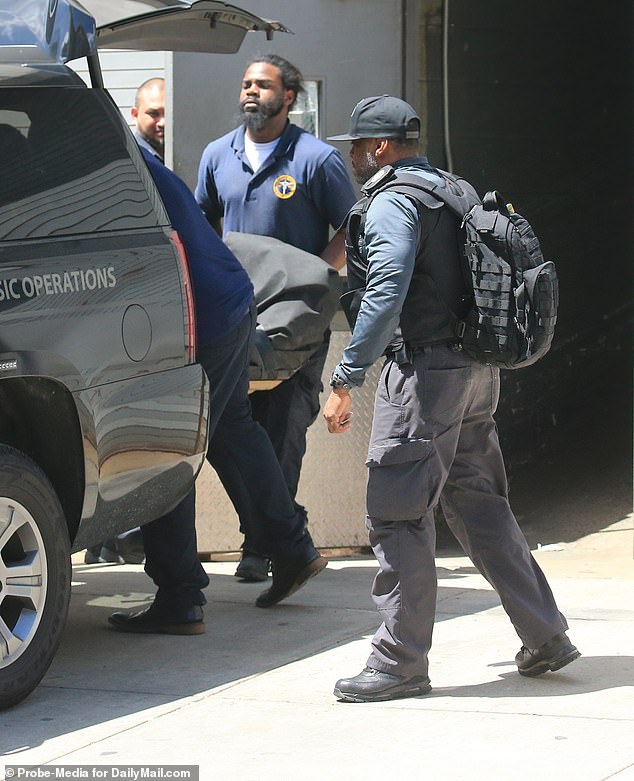
Jail guards overseeing Jeffrey Epstein used a decoy body to mislead reporters gathered outside the prison after his death, while his real corpse was secretly removed in a separate vehicle, newly unsealed files claim.
According to an internal memo, a jail supervisor told FBI agents that staff at Manhattan’s Metropolitan Correctional Center staged the ruse amid an intense media presence following Epstein’s apparent suicide in 2019.
The files allege that boxes and sheets were arranged to resemble a human body and loaded into a white van marked as belonging to the Office of the Chief Medical Examiner, prompting reporters to follow it as it drove away.
Unbeknown to the media, Epstein’s actual body was instead placed into a black vehicle that left the facility ‘unnoticed,’ allowing officers to transport the corpse privately.
The alleged deception was carried out after an official warned guards about the large number of journalists gathered outside the jail and said he would arrive at the loading dock with a separate black vehicle to remove the body.
The records also reveal investigators highlighted a handwritten note found inside Epstein’s cell at the time of his death, which was not treated as a suicide note by the medical examiner.
The note, which investigators said was ‘difficult to read’, appeared to list grievances about jail conditions, including complaints about food, showers and bugs.

Prison guards are alleged to have used a decoy body to distract reporters gathered outside the jail as Epstein’s body was transferred to the Office of the Chief Medical Examiner. This image shows his body being removed from a Lower Manhattan hospital, where he was pronounced dead

Newly released files allege that boxes and sheets were arranged to resemble a human body and loaded into a white van marked as belonging to the Office of the Chief Medical Examiner, prompting reporters to follow it as it drove away

Epstein’s real corpse was secretly removed in a separate vehicle, newly unsealed files claim

The records also reveal that investigators later noted a handwritten note found inside Epstein’s cell at the time of his death, although the medical examiner concluded it was not a suicide note
The records, included in a tranche of three million newly released documents, describe how officers responded to the heavy media presence outside the jail in the hours after Epstein’s death.
After Epstein was pronounced dead at hospital, his body was returned to federal custody at the prison while arrangements were made for its transfer to the Office of the Chief Medical Examiner.
One interview note states that because of the ‘large news media presence,’ staff devised a plan to ‘thwart’ reporters as the body was removed.
According to the document, officers ‘used boxes and sheets to create what appeared to be a human body, which was put into the white OCME vehicle which the press followed, allowing the black vehicle to depart unnoticed with EPSTEIN’s body.’
Other sections of the records describe how officers were stationed at a secure facility linked to the prison, where Epstein’s body was guarded while fingerprinting and other procedures were carried out ahead of its transfer.
Epstein was being held in the Metropolitan Correctional Centre in New York on sex trafficking charges at the time of his death on August 10, 2019.

Epstein was found dead in the Metropolitan Correctional Centre on August 10, 2019
He was found unresponsive in his cell early that morning by prison guards. After they tried to perform CPR, he was rushed to the New York Downtown Hospital, where he was pronounced dead.
The New York City medical examiner ruled that Epstein’s death was a suicide by hanging, a conclusion that has been repeatedly questioned following a series of failures inside the jail.
Those failures included guards falling asleep on duty and malfunctioning surveillance cameras, issues that later became the focus of multiple investigations.
Prison records show that guards assigned to monitor Epstein did not conduct required checks during the overnight hours before his body was discovered.
Scheduled rounds at 3am and 5am were missed, according to official findings.
Furthermore, cameras positioned outside Epstein’s cell were not functioning properly that night.
Investigators later confirmed that at least two surveillance cameras had malfunctioned, leaving critical gaps in visual monitoring of the area.
Because of those failures, officials were unable to establish a definitive timeline of Epstein’s final moments.