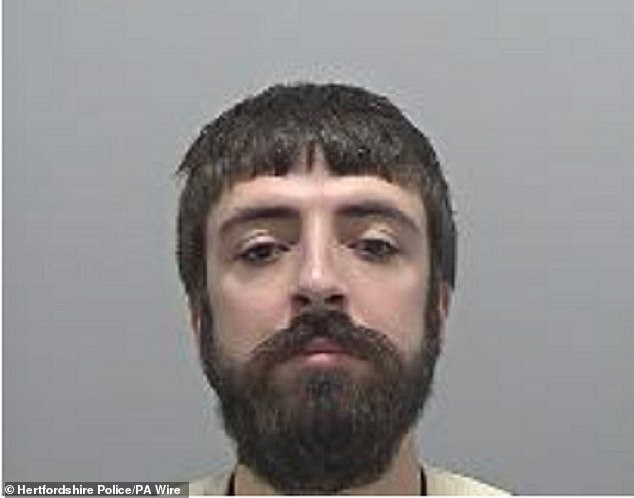

Kyle Clifford was a ‘psychopath who was able to disguise himself as an ordinary human being’.
Those were the words of BBC racing commentator John Hunt, whose wife Carol and daughters, Louise and Hannah, were savagely killed by the former soldier at their family home in Bushey, Hertfordshire, on July 9 2024.
The crossbow maniac carried out his sickening attack on the family just 13 days after Louise ended their 18-month relationship, telling him it was ‘sucking the life out of me’.
On the day of the murders, Clifford deceived Carol into letting him into the house by claiming he was returning Louise’s belongings. But when he made it inside, he knifed her to death while dog groomer Louise was working in a pod in the garden.
An hour later, Louise entered the house and Clifford restrained and raped her, with psychiatrists noting his sick ability to be ‘turned on sexually after killing’ Carol.
He then waited more than two hours for Hannah to return home before killing Louise with the crossbow.
Hannah, a beautician, went upstairs before realising Clifford was in the house. Shortly afterwards, she messaged her boyfriend asking him to call police.
When confronted by Clifford, she begged him to stop before he fired a crossbow bolt at her. Fatally wounded, she managed to call 999 but when emergency services arrived, they were unable to save her and her sister and mother were dead.
After a 22-hour manhunt, Clifford was tracked to Lavender Hill Cemetery, a five-minute walk from his family home, where he shot himself with the same crossbow, leaving him wheelchair bound.
He was jailed for life in prison last March, but refused to show up to his sentencing in a final insult to the family.
Now experts – ranging from psychiatrists, behavioural criminologists and detectives – have lifted the lid on what drove the ‘warped narcissist’ to plan and execute such a murderous plot.

Kyle Clifford (pictured) raped and murdered his ex-girlfriend Louise Hunt, 25, and killed her mother, Carol, 61, and sister Hannah, 28

John Hunt is pictured with his wife Carol, who was killed alongside two of their two daughters

The crossbow used by Clifford. Photo issued by Hertfordshire Police
ENTITLED NARCISSIST
Louise had ended her relationship with Clifford on June 26 2024, telling him: ‘I’m sorry Kyle but I feel I can’t continue with what we have, I feel like it has been broken and I can’t ignore how I’ve been feeling.
‘I just feel right now I owe it to myself to take some space and walk away for my own sanity and health.’
Despite exploding into a violent rage after the text, it later emerged that Clifford had hidden relationships with other women from Louise and went on a dating site moments after receiving her break-up message.
I will remember her evil smile for the rest of my life

I’m Tom Rawstorne, and nearly 30 years ago a 12-year-old murderer, with a gold crucifix hanging round her neck, gave me a moment I’ll never forget.
Sharon Carr is to this day Britain’s youngest-ever female murderer, having killed an 18-year-old hairdresser in an unprovoked act of gruesome violence. I watched her up close in court for three weeks and it is something I’l never forget. I’ve written about it in The Crime Desk newsletter – sign up to read it for free.
Detectives said his behaviour ‘escalated at an unprecedented rate’ as he purchased a crossbow, a specialist butchering knife, rope, petrol cans and duct tape.
Alex Izsatt, a behavioural criminologist, told the Daily Mail that his violence had been simmering long before the relationship ended.
She said: ‘Kyle Clifford didn’t snap because Louise Hunt ended their relationship; he was an entitled narcissist who didn’t like being told no by a woman, and the breakup exposed a self-image so fragile that rejection revealed his true personality, and instead of searching inward or growing as a person, he chose retaliation and payback.
‘His entitlement, his need for control, and the way he measured his value through dominance in relationships all made him vulnerable to turning humiliation into a mission of punishment rather than reflection.’
Meanwhile, Dr Raj Persaud, a psychiatrist, said: ‘It’s an extraordinary case. It is not unknown that if a man gets dumped, he might stalk the person who dumps him because he’s upset and can’t recover for various reasons.
‘But it’s a very planned thing to kill three people, the mother, then the ex-girlfriend and then her sister and suggests a huge amount of rage.
‘What’s extraordinary from a psychiatric standpoint is to kill the mother and then wait for the daughter to return and then rape her means that he can get turned on sexually after killing someone.
‘Most people are distressed or disturbed, even if they’re homicidal, and wouldn’t be able to shift gear emotionally into sexual arousal of killing someone, particularly given he’s never done it before.’

Louise Hunt (pictured), who had ended her relationship with Clifford, was killed alongside her mother and sister in the crossbow attack

Brave Hannah Hunt called 999 during the attacks and was still alive when police arrived at the home in Bushey, but later died from her wounds
MISOGYNY
The day before the killings, Clifford had been watching influencer and self-proclaimed misogynist Andrew Tate on YouTube.
Ms Izsatt examined how the ‘sequencing’ of the murders also demonstrated Clifford’s misogyny.
‘He first confirmed that John Hunt was absent, not to avoid a male adversary but to ensure the environment was clear to target the female members of the household who he believed had enabled Louise’s autonomy,’ she said.
‘He killed Carol Hunt to remove the maternal source of guidance and influence, he raped and murdered Louise to punish her defiance and reassert control over her body, and he killed Hannah to eliminate any remaining witnesses and complete the destruction of the female support system around Louise.
‘In his mind, the father was irrelevant because the women represented the source of his ‘betrayal’ and wiping them out was the only way left to make him feel like a man.’
She added: ‘Clifford didn’t commit the crimes to feel powerful, he did it to stop feeling powerless, to take back the control the women took from him.’
Ms Izsatt said that even after the murders, Clifford ‘maintained his drive for control’ by pleading guilty to the murders while ‘forcing the family to endure a rape trial’.

The day before the killings, Clifford (in court via videolink) had been watching influencer and self-proclaimed misogynist Andrew Tate on YouTube

This is the moment Clifford bought rope and petrol cans before the triple murder

The knife packaging is pictured in a photo issued by police. Clifford stabbed Carol to death with a knife
She added: ‘Alone with his rage, he turned to the rhetoric of Andrew Tate, which framed his humiliation as part of a wider battle against women who dared to say no, validating his anger and transforming a bruised ego into a moralised justification for the vengeance he already craved.’
Dr Persaud said it was ‘significant’ that all three victims were women.
‘I wonder what would have happened if a man had turned up,’ he said.
‘There’s a sense in which these kinds of men who get very angry when women assert their rights to be independent and say no, their fury isn’t just one woman, but it’s at womankind in general.
‘They feel that they’ve been rejected by women in general. I know he had other girlfriends, but I think that the view might have been in his warped mind that he was never going to get anyone like this.
‘When people are dysfunctional and they’re failing at life, and he just lost his job, at some unconscious level they may realise that their chances in life of succeeding are getting slimmer and slimmer.
‘They blame the world and that’s why they want to take revenge against the world. The world has turned against them. It’s the world’s fault.’
FAILURE AND FAMILY
Clifford had been a trooper in the Queen’s Dragoon Guards, but left the Army after two years in 2022, without seeing active service.
His superiors say he had difficulty grasping ‘basic military concepts’, describing him as an ‘unexceptional individual’ who was ‘destined for a career of mediocrity’.
Though his military career spanned three years, from 2019 to 2022, he spent 286 days – around a third of that time – ‘at home claiming to be ill’.
His commander said of his time as a soldier: ‘His character is wholly unsuited to military employment and he has no care nor concern beyond himself.’
After leaving the Army, he worked at Amthal, a fire and security installation company in St Albans, from February 2022 to July 2023. He met Louise through a dating app around January 2023.
At the time of his murder spree he was unemployed, having been sacked from a job at a catering supply firm which he claimed owed him money.
Clifford’s only previous interaction with police was a small drugs matter and an ‘alcohol-fuelled’ fight he was involved in, but he was not known for domestic force.
However, he is not the only murderer in his family. His older brother Bradley was jailed in 2018 for killing a moped rider after his ‘prized’ Ford Mustang was damaged.
Ms Izsatt explained: ‘Within the Clifford household, the environment reinforced an acceptance of aggression.
‘A younger brother treating the father’s violence and the older brother’s murder conviction as ‘funny’ or not ‘horrendous’ suggests a moral ecosystem in which violent behaviour was normalised rather than condemned, reframed as strength, a joke, or a justified response to being crossed.
‘That environment, combined with his own narcissistic entitlement, provided a psychological framework where extreme retaliation was conceivable and even rational within his worldview.

Clifford had been a trooper in the Queen’s Dragoon Guards, but left the Army after two years in 2022, without seeing active service.

His older brother Bradley (pictured) was jailed in 2018 for killing a moped rider after his ‘prized’ Ford Mustang was damaged
‘When his sister texted him about the crossbow on the day of the murders, and when the family went about ordinary activities as he planned a massacre, they were operating within a family environment that shaped his perception of violence and consequence.’
Discussing his time as a soldier, she added: ‘His army career may have been described as mediocre, but it gave him an operational mindset, training him to act quickly, plan meticulously, and solve tactical problems without pausing to consider broader consequences.
‘Those skills allowed him to translate his desire for revenge into a detailed plan, and the acquisition of a crossbow, knife, rope, petrol, and duct tape was a declaration of lethal intent executed with a methodical, goal-oriented approach.’
Examining his failure at work and in his relationship, Dr Persaud said: ‘I don’t think he probably had ever had anyone like her before, probably because he was a bit of a loser. He just lost his job recently.
‘He felt he was never going to have anyone like her again and therefore his rage was even more as a result of that.
‘One of the reasons they kill people is because they go, if I can’t have you, then no one can have you. In other words, it’s a step beyond because of their narcissism that they don’t want anyone else to have that person because they also see the person as a possession, an object to be possessed, and therefore, if I can’t have you, then no one will have you.’
BROODING
The experts also examined how Clifford meticulously planned the murder for 13 days after the break-up.
Dr Persaud said: ‘This was a very carefully planned act over several days. That’s a huge length of time is deeply significant psychiatrically, because it means he’s brooding and ruminating and planning it over two weeks.
‘Most people get dumped by someone, they brood and ruminate for a while… by seven days, they have began to not brood quite so much and by the second week, they’re not dwelling on it in quite the same way,
‘For Clifford, his life was dominated by this for a very long period of time to keep planning it. I would say that sheer length of time does suggest some kind of personality disorders.
‘Psychopath is possibly correct, because obviously, he has no feelings for other people to perform this horrendous act. He knew that his life was over as he performed the act.’

Clifford, pictured in a wheelchair, is interviewed by Hertfordshire Constabulary detectives

The experts also examined how Clifford meticulously planned the murder for 13 days after the break-up. Pictured: Forensic officers at the scene in Ashlyn Close, Bushey, Hertfordshire
Ms Izsatt added: ‘On the outside, he appeared to be the nice guy, but it was a performance he couldn’t sustain, and his controlling nature, belittling language, and frequent rage-filled rants revealed the resentment and self-pity beneath, creating a mindset in which grievance festered and escalated unchecked.
‘Immediately after the breakup, he sought validation not through repair or reconciliation, but through creating a dating profile and maintaining hidden relationships, demonstrating a transactional approach to relationships where proving desirability temporarily repaired his ego but did not address the underlying threat to his self-image, allowing frustration to intensify.’
FINAL INSULT
Psychiatrists, criminologists and detectives also examined how Clifford pleaded guilty to the three murders – but forced his victims’ family to sit through a rape trial after pleading not guilty to this charge.
Detective Chief Inspector Nick Gardner said: ‘He knew the game was up. I have no idea why he failed to plead. The jury saw through his lies.’
Clifford also refused to attend his sentencing.
‘Clifford has remained a coward up until the end by refusing to appear at court and face up to his actions. Great lengths were made to ensure he could attend court including the location chosen for the trial, but Clifford chose to stay away,’ DCI Gardner added.
‘In stark contrast the Hunt family have shown extreme strength and dignity throughout. Our thoughts remain with them at this time.’
Examining why he pleaded not guilty to rape, Dr Persaud added of Clifford: ‘These people are narcissistic and he may have thought that to accept and acknowledge the rape is a sign of weakness.
‘A lot of these people are very into male-dominant ideology. He had been browsing Mr Tate, and if you’re a strong believer in dominant male ideology, having had sex with a girl might be in his head – because he obviously has a warped mind – some admission of vulnerability or softness or weakness that he fell for her sexual charms, as it were.
‘It could have been given that this was an extended rage against the world that it was another way of hurting the people that were left.
‘This is an extended attack on whole family, and maybe it was his way of hurting those that were left as well.’
Ms Izsatt added: ‘Even after the murders, Clifford maintained his drive for control, pleading guilty to murder while forcing the family to endure a rape trial prolongs the family’s suffering and reinforces his dominance over the narrative.
‘His botched suicide attempt – when confronted by police – was another way he tried to control his own story on his terms.’