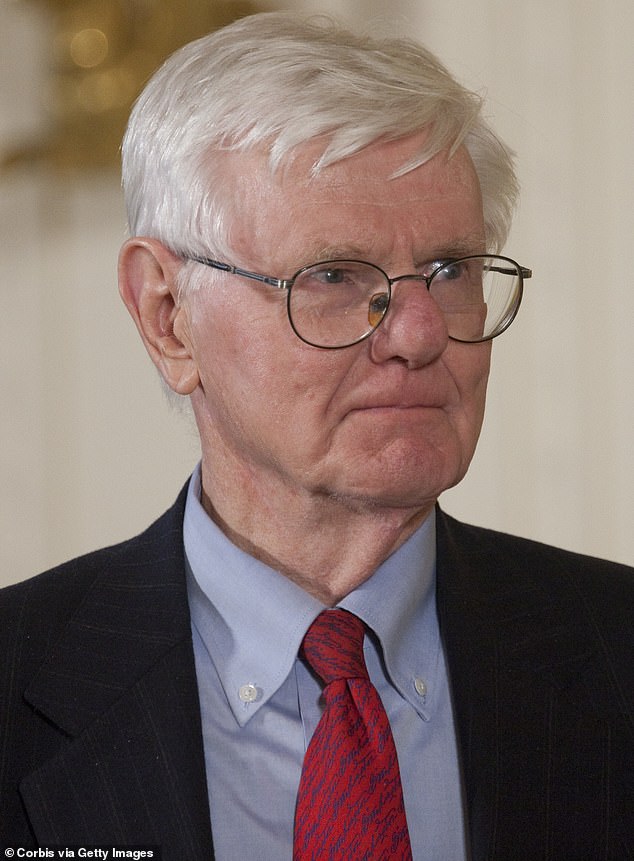
A famed scholar of the American Revolution and the founding of the United States, who was once mentioned in the hit film Good Will Hunting, died in a tragic accident over the weekend.
Gordon S Wood, 92, a professor emeritus at Brown University, was struck by a vehicle while he was walking in a supermarket parking lot in East Providence, Rhode Island on Sunday afternoon.
He suffered serious injuries, and was later pronounced dead at Rhode Island Hospital, Go Local Prov reports.
Meanwhile, the unidentified driver remained on the scene and cooperated with police. He is not currently facing any charges in connection with the fatal collision, but East Providence Police Chief Michael Rapoza said on Monday the crash was still being investigated by a reconstruction team and detectives.
Over the course of his storied career, Wood authored dozens of books and essays that became standard references for discussions about the formation of the US and the legacy of the revolution.
For his work, many of his colleagues saw the white-haired, mild-looking scholar as the embodiment of the learned, traditional historian, guided by facts rather than ideology.
Yet Wood was perhaps better known for being mentioned in the Academy Award-winning film Good Will Hunting, released in 1997.
In the movie, the titular character – a pugnacious, self-taught genius played by Matt Damon – taunts a Harvard undergraduate: ‘You’re gonna be in here regurgitating Gordon Wood, talking about, you know, the pre-revolutionary utopia and the capital-forming effects of military mobilization.’

Gordon S Wood, 92, a professor emeritus at Brown University, was killed in East Providence, Rhode Island on Sunday

He was struck by a vehicle while walking across a supermarket parking lot (pictured)
‘That’s my two seconds of fame. More kids know about that than any of the books I have written,’ Wood told The Los Angeles Review of Books in 2015, noting that he did not actually endorse those ideas.
Wood was born to working-class parents, Herbert G Wood and Marion (Friberg) Wood in Concord, Massachusetts on November 27, 1933.
In high school, the scholar said he found his history education unbearable as he suffered through classes in which the teacher simply read from a textbook.
But he admired his Latin teacher, who encouraged him to attend Tufts University, from which he graduated summa cum laude in 1955 before serving in the US Air Force in Japan.
From there, Wood went on to receive a master’s and a PhD from Harvard University, where he studied under celebrated Revolutionary War historian Bernard Bailyn, whose documentation of the intellectual forces behind independence in his landmark The Ideological Origins of the American Revolution Wood would build upon in his The Creation of the American Republic.
He saw success almost immediately in the field of American history.
His first book, The Creation of the American Republic, won the Bancroft Prize in 1970 and lived on with generations of students who embraced and contended with Wood’s findings that the Constitution was unintentionally subversive, a document devised by elites that led to ‘the destruction of the very social world they had sought to maintain.’
Wood’s The Radicalism of the American Revolution also won the Pulitzer in 1993 and the epic Empire of Liberty was a finalist in 2009.

Wood was mentioned in the 1997 film Good Will Hunting by Matt Damon’s titular character
In 2011, then-President Barack Obama also presented Wood with a National Humanities Medal ‘for scholarship that provides insight into the founding of the nation and the drafting of the US Constitution.’
Wood also received praise from former House Speaker Newt Gingrich, who listed The Radicalism of the American Revolution as an essential work of history.
He called the Georgia Republican’s blessing a ‘kiss of death’ among his many liberal peers and was perceived as an affirmation of conservative policies.
Regarding himself as neither radical nor reactionary, Wood claimed a middle ground between conventional ‘great man’ narratives and the more egalitarian scholarship that emerged in the 1960s.
He acknowledged that historians had overlooked the contributions of women and minority groups, but worried that ‘headline political events’ were being ignored entirely.
He disputed Progressive era historian Charles Beard’s influential portrait of the US Constitution as a cynical triumph for the rich, but didn’t regard the founders as infallible sages above looking after their own interests.
‘I don’t think our history should be seen as a moral tale, either good or bad,’ Wood once wrote. ‘I think historians should try to understand where we came from as honestly as we can, without trying to say this was a great celebration or that this was a disaster. I don’t think either of those extremes is true of our history.’

Wood saw success with the publishing of his first book, The Creation of the American Republic


Over the course of his career, Wood penned dozens of books and essays that became standard references for discussions about the formation of the US and the legacy of the revolution
Wood accepted some scholarly arguments, including Annette Gordon-Reed’s ‘persuasive contextual case’ that the enslaved Sally Hemings bore some of Thomas Jefferson’s children. In Empire of Liberty, which covered the years 1789 to 1815, he included lengthy passages on slavery and called it a cancer ‘eating away at the message of liberty and equality.’
But the professor was also a prominent critic of The New York Times’ controversial 1619 Project and its contention – later amended – that maintaining slavery was a key motivation for the American Revolution.
He argued that the project encouraged a sense ‘victimhood’ and feeling ‘aggrieved,’ even as he acknowledged he hadn’t read most of it. He would counter that the founders, including such plantation owners as Jefferson and James Madison, believed – mistakenly – that slavery would die a natural death and the revolution itself energized the American abolitionist movement.
‘We all want justice, but not at the expense of truth,’ he wrote in 2019, adding, in a widely disputed statement, ‘I don´t know of any colonist who said that they wanted independence in order to preserve their slaves.’

In 2011, then-President Barack Obama also presented Wood with a National Humanities Medal ‘for scholarship that provides insight into the founding of the nation and the drafting of the US Constitution’
Wood also rejected conservative and liberal theories that the American Revolution did not immediately lead to any substantial new freedoms, and that it was essentially a political event – a mere ‘mental shift’ – that otherwise reinforced the status quo.
The new country’s early years, Wood stated, were a time of transformation and democratization in everything from how people dressed to the way they greeted each other in the streets. The shifts were so profound that even the revolution’s leaders didn’t expect or want them.
‘One class did not overthrow another; the poor did not supplant the rich,’ Wood wrote. ‘But social relationships, the way people were connected one to another – were changed and decisively so. By the early years of the 19th century the Revolution had created a society fundamentally different from the colonial society of the 18th century. It was in fact a new society unlike any that had existed anywhere in the world.’
Fellow historian and Pulitzer winner David Hackett Fischer would later write that Wood’s scholarship ‘altered the way historians thought about their field.’
Wood’s other books included Revolutionary Characters and The Americanization of Benjamin Franklin and his essays and reviews appeared frequently in The New York Review of Books, The New Republic and other publications.
Wood also appeared in Ken Burns’ PBS documentary about the American Revolution, consulted on Burns’ film about Jefferson and chaired an advisory panel for the National Constitution Center in Philadelphia.
He even gave a speech just last November at the American Enterprise Institute, in which Wood urged Americans to take the country’s 250th anniversary as an opportunity to reflect on what makes America so unique.
‘To be an American is not to be someone, but to believe in something,’ Wood said. ‘That is why we are at heart a credo nation and that is why the 250th anniversary of the Declaration next year is so important.’
For his work, the historian was set to be honored at a Rhode Island Historical Society gala later this month.
A new collection of Wood’s essays is also scheduled to be published next year.

Filmmaker Ken Burns remembered Wood as ‘a teacher of generations of students and other historians who, like him, help us better understand who we are as a country and a people’
Following the news of his death, Burns wrote on social media that he was ‘devastated’ by his colleague’s passing.
‘Known to many as one of the foremost scholars of the American Revolution, Gordon was also a teacher of generations of students and other historians who, like him, help us better understand who we are as a country and a people.
‘He will be greatly missed,’ Burns posted.
Woody Holton, an author and historian who clashed at times with Wood, also told the Associated Press that he admired his ‘willingness to encourage even a younger scholar like me who viewed the American revolutionary era very differently from him.’
‘The tragic accident that killed him is especially heartbreaking in denying him, by less than a month, the chance to celebrate the country´s 250th birthday,’ added Holton, a history professor at the University of South Carolina.
Karin Wulf, director of Brown’s John Carter Brown Library, echoed that sentiment.
‘Gordon is genuinely the preeminent historian of the American founding period, which makes the timing of his death in this semiquincentennial year all the more tragic.
‘He was deeply publicly engaged and was writing for the public up until his last few months.’
Brown President Christina Paxson also praised the ‘depth, nuance and clarity’ of his knowledge of the events that led up to the country’s founding.
‘He was an inspiring teacher, a generous mentor and a deeply treasured member of the Brown University community for decades,’ she said in a statement.
‘We mourn the loss of a towering historian whose insights will inform both academic scholarship and public understanding for generations to come.’
Wood is survived by his three children; Amy, Christopher and Elizabeth, five grandchildren and one great-granddaughter. He was predeceased by his wife Louise Goss, whom he married in 1956.