
A Utah man whose wife, two daughters, son-in-law, and family dog were crushed to death when their Tesla Model X suddenly crossed a road’s center line and slammed head-on into a tractor-trailer, claims the electric carmaker and CEO Elon Musk negligently lulled him into a “false sense of security” about the vehicle’s purported autonomous capabilities.
In a 33-page lawsuit reviewed by The Independent, Nathan Blaine accuses Tesla and Musk of having “intentionally misrepresented the safety of their vehicles” and the driver-assistance features.
Musk, according to Blaine’s December 23 complaint, oversells the technology in order to, among other things, “generate excitement” about Tesla, to pump up its stock price, and to help “establish Tesla as a dominant player in the electric vehicle market, all at the expense of the public’s safety.”
“Based on representations the Blaines heard made by Musk and Tesla… [they] believed [it] was a safer driver than a human driver of convention[al] vehicles,” the complaint states.
However, it contends, the deadly wreck was brought about by the car’s allegedly inadequate “Autosteer” function, a next-gen form of cruise control the company says “detects lane markings, road edges, and the presence of vehicles and objects to intelligently keep your vehicle in its driving lane.” The complaint also assigns blame to the Model X’s “Lane Departure Warning,” “Lane Keeping Assist,” “Lane Centering Assistance,” and “Emergency Lane Departure Avoidance” systems, contending they “defectively failed” to work as advertised.
“Tesla’s done a lot of good things, in my calculation,” attorney Lynn Shumway told The Independent, “but they did this inadequately. I think the technology is fantastic, but not the way Tesla is implementing it.”
Simulation, according to Shumway, is “a big part of the answer, and apparently Tesla didn’t do enough simulation work on the vehicle, under the conditions this one was in, on the kind of road it was on, and it’s kind of mystifying here because this road was pretty normal and pretty simple.”
“There are about 40,000 deaths a year from car crashes on the highways,” Shumway said. “So many lives could be saved by pushing [manufacturers] to get these systems installed quickly, and to fully use their capabilities.”
An auto-reply from the lead attorney representing Tesla in the case said she was out of the office until January 16. A Tesla spokesperson did not respond on Thursday to a request for comment.
Although Musk continues to confidently tout Teslas as “self-driving,” one lawyer suing the manufacturer described the technology as still “not really ready for primetime.” In early 2025, A Tesla Model 3 in Autopilot mode unexpectedly veered across multiple lanes of highway traffic and slammed into a motorcyclist, demolishing the bike and sending the rider and his passenger to the hospital, according to a $1 million-plus lawsuit pending in Texas. The year before, the family of a 31-year-old California man who was crushed to death behind the wheel of a Tesla Model S in “full self-driving mode,” sued Tesla and Musk over claims the vehicle was truly autonomous. Also in 2024, a Tesla in self-driving mode appeared to steer itself onto an operational train track it mistook for a road.
Whether or not Autopilot was engaged, the systems meant to keep the Blaines’s Model X in its lane should have continued working, according to the complaint. (Shumway said he doesn’t believe Autopilot was turned on at the time of the crash.)
“Disengagement of Autopilot should not reduce the effectiveness of safety features the vehicle is equipped with,” it says.
After 46-year-old Jennifer Blaine, the director of a charter school in Perry, Utah, finished work on September 1, 2023, she drove home in her 2022 Model X to pick up daughters Denali, 11, and Emily, 22, along with Emily’s husband, Zachary Leavitt, 24, according to Nathan Blaine’s complaint, which was first filed in state court before being removed to federal court last week.
“It’s about as sad as you can get,” Shumway said. “The [older] daughter was the valedictorian of her high school class, she graduated with honors from Brigham Young University. Just all kinds of promise.”
The filing, which also lists Blaine’s three surviving sons, Deven, Benjamin, and Bronco, as well as Leavitt’s parents, Douglas and Tracy, as co-plaintiffs, says the four – and the Blaine family dog, Peaches – were planning to meet up with Nathan and Bronco for an overnight in the Tetons, the complaint explains.
They stopped in Idaho Falls to eat dinner and charge the Tesla before continuing on to Driggs, where the group planned to set up camp, the complaint goes on. But, it says, when they got back on the road, tragedy struck.
Shortly before 10 p.m., while traveling east on Idaho State Highway 33, the Model X abruptly veered into the road’s westbound lane as it navigated a “gentle southward curve,” the complaint continues. There, it collided with an oncoming 2007 Kenworth semi-truck hauling a load of grain weighing 90,000 pounds, according to the complaint.
“The Model X… sustained major damage, its front end being crushed rearward crushing all of the occupants… along with the family dog due to the weight [and] the size of the Kenworth truck,” the complaint states.
All four died at the scene.
“When I found out, I immediately fell to the ground just sobbing,” Nathan told local NBC affiliate KSL 5 three days after the fatal wreck.
A GoFundMe campaign, that has $57,000 of its $60,000 goal as on Thursday, said, “To the dear sweet trucker involved[,] we love you. We are praying for you. As we mourn the loss of our loved ones, please know that we ache for you also. You are not forgotten, you are appreciated and loved.”
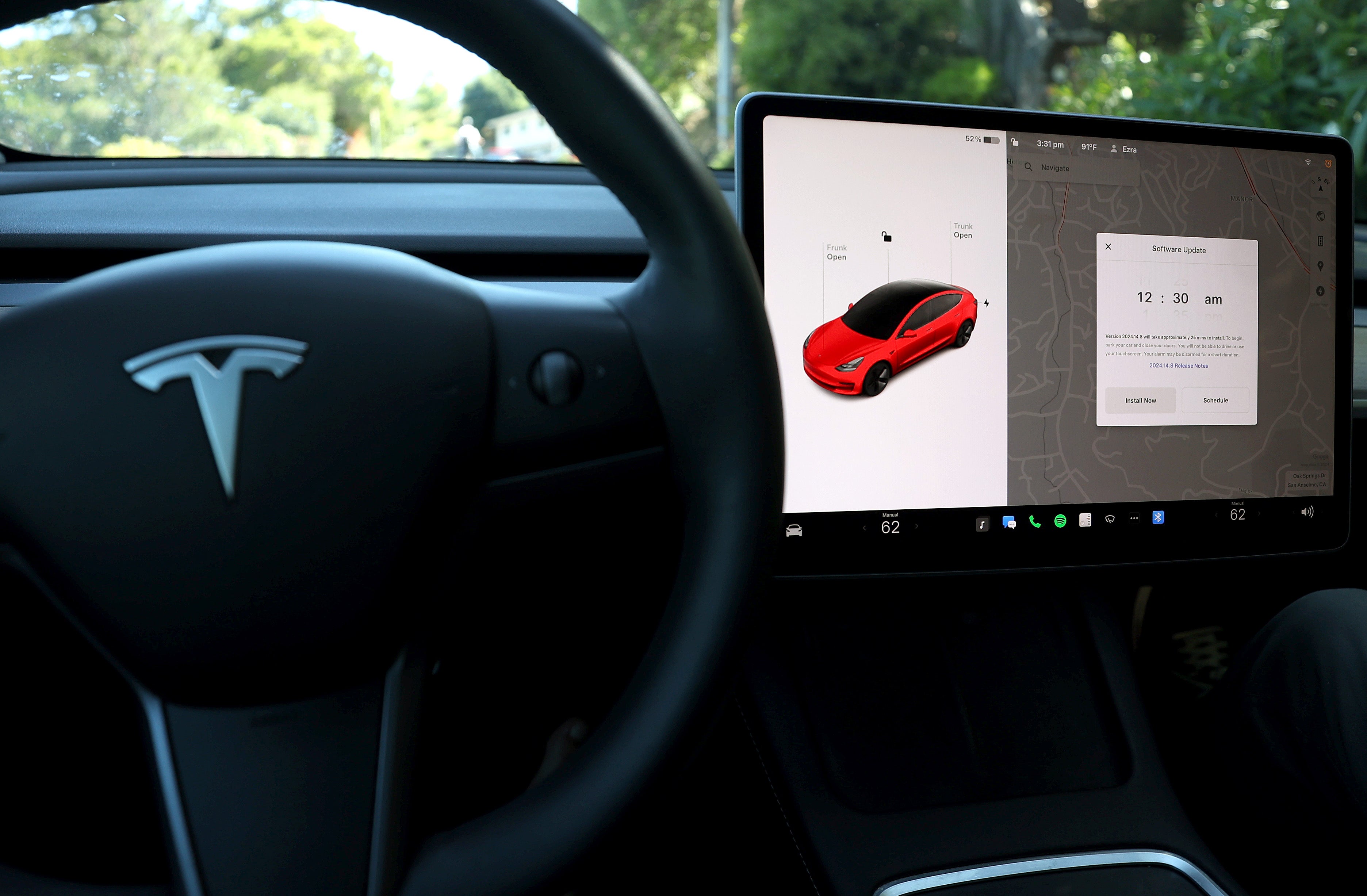
The Blaines ordered the Model X on February 15, 2021, and paid extra for “Full Self Driving,” the complaint states. The two were told that the car was capable of guiding itself from highway on-ramp to off-ramp, could perform lane changes on its own, and could navigate interchanges without driver input, according to the complaint.
At the same time, the vehicle “failed to provide ‘escalating warnings’ to an inattentive driver,” while simultaneously failing to “perceive, react to, and avoid” the oncoming truck by keeping the car “safely in its eastbound lane of travel,” alleges the complaint.
It says the car “is equipped with the capability of showing drivers a series of escalating warnings reminding the drivers to keep their hands on the wheel and pay attention to the road at the very split second that such a warning is needed.”
Further, the complaint argues that other car companies have implemented technology that ensures drivers remain engaged while utilizing automatic-driving features.
“To that end, General Motors and Ford use infrared cameras that closely track the driver’s eyes and sound warning chimes if a driver looks away from the road for more than two or three seconds,” the complaint maintains. “Tesla did not initially include such a driver monitoring system in its vehicles and later added only a standard camera that is much less precise than infrared cameras in eye tracking.”
Jennifer and Nathan Blaine were “just two members of the public exposed to Tesla’s long-term advertising campaign designed to persuade the public that its vehicles were capable of driving themselves,” according to the complaint, which says they “saw, heard, and/or read many of Tesla or Musk’s claims in the news media.”
Blaine’s suit seeks economic damages, non-economic damages, and punitive damages to be determined by a jury.