
Editor’s note: This is the fourth in a series of articles written by former Sen. Jim DeMint. Read the introduction here and the first three articles here, here, and here.
The United States became the world’s leading manufacturer and exporter after World War II. Over the decades that followed, major manufacturing companies in America became top-heavy in their management, costs increased, profits shrank, and the quality of their products declined. By the late 1970’s, Japan, a nation long-known for cheap, low-quality products, began producing low-cost, high-quality automobiles and many other products that were superior to those manufactured in America. Japan’s secret became known as total quality management (TQM). It was the brainchild of American consultants Edward Deming and Joseph Juran — experts who had been ignored by arrogant manufacturing executives in the United States.
I added TQM consulting to my practice in the 1980s and learned a lot about how it could revolutionize any company, including service companies like hospitals and universities. The concept of TQM was relatively simple, but hard for old-style executives to accept, because it required giving up control and pushing decision-making down to the people who were producing the products and providing the services. Giving up control is very difficult for executives — and politicians.
I was a certified quality trainer, and my job was to teach workers how to continuously improve quality and not accept anything less than 100 percent of the desired quality goal. One of the keys to making this work was to identify problems, defects, or inefficiencies, and then keep digging and asking “why” until you discovered the root cause of the problem. Understanding the connection between cause and effect was difficult for many workers, because our lifestyles, education system, and expectations have virtually eliminated critical thinking skills. Most people focus on the problem or the symptom of the problem and don’t naturally seek the root cause. This inability to connect cause and effect is evident with American voters.
You might be asking how this discussion of quality improvement in manufacturing relates to creating better policies in government. Well, after working in the private sector and then in government, I can assure you that the lessons learned from the quality renaissance of American manufacturing are exactly what must happen to fix our government. Remarkably, our Founding Fathers and authors of our Constitution seemed to understand the principles of TQM completely, especially one of the core principles: Power corrupts, and absolute power corrupts absolutely.
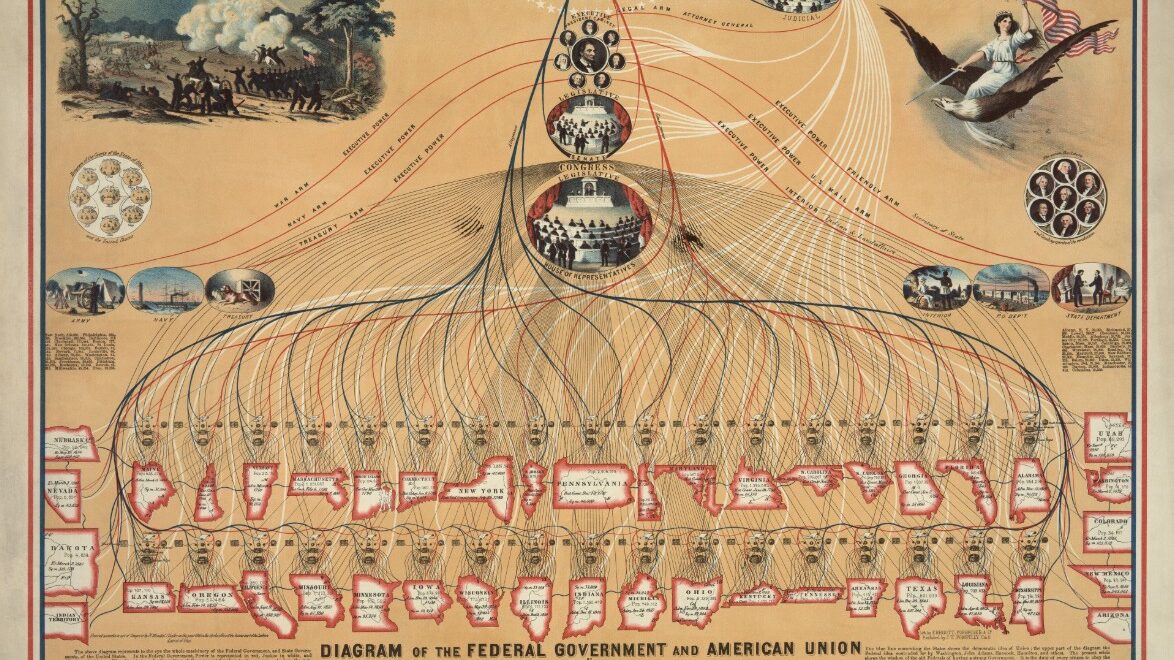
The American Constitution created a flat organizational structure with power and decision-making pushed to the lowest level — the people. The “management hierarchy” at the federal level was divided into three control centers (branches of government) that were intended to balance and limit the power of the other branches — the executive, legislative, and judicial.
In addition to dividing powers at the federal level, the Constitution left most of the decision-making to the states and individual citizens. The writers of our Constitution would be astonished to know that today the federal government controls or regulates education, health care, retirement plans, energy production, workplace safety, environmental issues, and some part of practically every business in America. Our founders intended for the federal government to have limited and divided powers, while most governmental powers would be dispersed among the states and the people. Instead, government power is now concentrated at the federal level.
As predicted, the concentration of power at the federal level has led to waste, fraud, corruption, poor quality and high-cost services, inefficiency, debt, division, and political paralysis. Yet federal politicians, specifically politicians in the Democrat Party, are totally opposed to giving power back to the states and the people. Even though the statistics confirm that the federal government is incapable of providing services efficiently, cost-effectively, and without high levels of waste and fraud, Democrats obstruct efforts to move decision-making to the states and the people. The reason for this obstruction is obvious: Democrats benefit politically by controlling money and services and using this leverage to manipulate voters on a national scale.
Except for national defense, trade, immigration, and border control, there are very few issues that states, private businesses and organizations, or individual Americans could not handle better. The fact that Democrats will not even consider decentralizing power on any issue should tell you everything you need to know. Voters need to wake up and start asking “why.” And Republicans need to be ready with better answers.