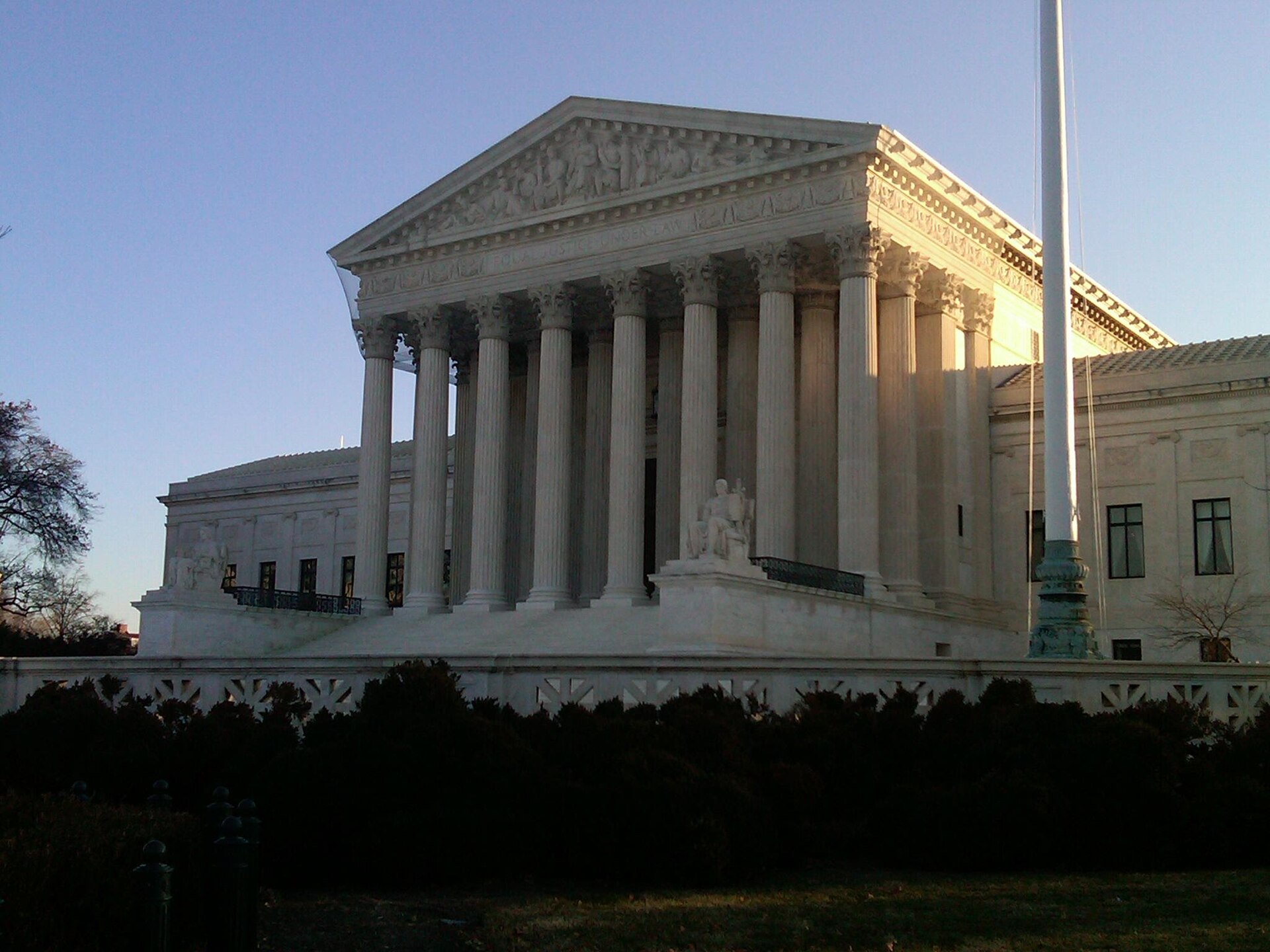

Americans across the country are gearing up to celebrate the country’s 250th birthday. But before that happens, the U.S. Supreme Court will release several high-profile decisions of great constitutional importance.
From presidents’ power over so-called “independent agencies” to the constitutionality of “birthplace citizenship,” here are the biggest remaining cases to keep an eye out for as the high court finishes its 2025 term.
National Republican Senatorial Committee v. Federal Election Commission
This case stems from a 2022 lawsuit brought by the National Republican Senatorial and Congressional Committees and then-Sen. J.D. Vance, R-Ohio, and then-Rep. Steve Chabot, R-Ohio, against the Federal Election Commission (FEC) over a provision of the Federal Election Campaign Act (FECA). They alleged that the provision — which limits coordinated spending campaign between political parties and candidates — violates the First Amendment.
The Supreme Court will determine whether the FECA limits violate the First Amendment “either on their face or as applied to party spending in connection with ‘party coordinated communications,’” according to Oyez.
[READ: Campaign Finance And The First Amendment Take Center Stage At SCOTUS]
Trump v. Slaughter
This case centers around President Trump’s March 2025 firing of Democrat Rebecca Slaughter from the Federal Trade Commission (FTC).
While granting the Trump administration’s request to temporarily pause a lower court blockade on Slaughter’s removal, the high court also agreed to take up and address whether existing statutory restrictions on the president’s ability to remove members of so-called “independent agencies” like the FTC violate existing separation of powers. The justices also notably indicated they will decide whether to overturn the precedent established in Humphrey’s Executor v. United States (1935).
As The Federalist previously reported, Humphrey’s Executor “helped birth what has now become known as the administrative state,” the de-facto “fourth branch of government” comprised of “independent agencies” and other federal departments that has “effectively been allowed to operate outside of the confines of the Constitution for decades.”
[READ: SCOTUS Appears Poised To Recognize That Presidents Run The Executive Branch]
Little v. Hecox and West Virginia v. B.P.J.
These cases deal with the legality of state laws passed by Idaho (Little v. Hecox) and West Virginia (West Virginia v. B.P.J.) that protect women’s sports from trans-identifying males. Attorneys, Republican attorneys general, and female athletes have all highlighted how males’ distinct biological advantage over women puts them at a competitive advantage over female athletes and imposes physical risks to their safety.
The justices will address the question of whether these statutes violate the 14th Amendment’s equal protection clause, or, in the West Virginia case, Title IX.
[READ: SCOTUS Signals Willingness To Uphold State Laws Protecting Women’s Sports]
Trump v. Cook
This case deals with President Trump’s August 2025 removal of Democrat Lisa Cook from the Federal Reserve Board of Governors. The president fired Cook due to allegations that she committed mortgage fraud prior to her time at the agency.
Following a lower court blockade, the administration asked the Supreme Court to pause such actions so that Cook could be removed from her position while litigation on the matter continued. In agreeing to take up the case, the high court deferred on ruling on the government’s request until after it heard oral arguments on the issue, which were held in January.
[READ: SCOTUS Sends Mixed Signals On Trump’s Removal Of Federal Reserve Member]
Wolford v. Lopez
This case came to fruition in 2023, when a coalition of Hawaii residents and a firearms organization challenged the Aloha State’s “vampire rule” restricting citizens with a concealed carry permit from carrying on private property open to the public unless they receive authorization to do so from the property owner, lessee, or manager. The plaintiffs argued that the law infringes on their Second Amendment rights.
The justices will decide whether Hawaii “may presumptively prohibit the carry of handguns by licensed concealed carry permit holders on private property open to the public unless the property owner affirmatively gives express permission to the handgun carrier.”
[READ: SCOTUS Scolds Hawaii For ‘Relegating’ Americans’ Second Amendment Rights To ‘Second-Class Status’]
U.S. v. Hemani
This case came about after FBI agents conducted a search on Texas resident Ali Danial Hemani’s home on suspicions that he held ties to a foreign terrorist group. While carrying out the search, authorities found that Hemani was in possession of a pistol, 60 grams of marijuana, and 4.7 grams of cocaine.
Hemani reportedly admitted to being a regular marijuana user and was subsequently charged under a provision (18 U.S. Code § 922(g)(3)) of the 1968 Gun Control Act that prohibits a person who is “an unlawful user of or addicted to any controlled substance” from possessing a firearm. Hemani challenged the provision’s legality, arguing that it violated his constitutional rights.
Following litigation in the lower courts, the federal government asked the Supreme Court to take up the case and determine whether the statute violates the Second Amendment as applied to Hemani.
[READ: Gun Restriction At The Heart Of Hunter Biden Indictment Takes Center Stage At SCOTUS]
Watson v. Republican National Committee
This case deals with a 2024 lawsuit filed by the Republican National Committee and the Mississippi GOP against a Mississippi election law. The plaintiffs specifically contested that a state law allowing mail-in ballots postmarked by Election Day to be accepted up to five days after Election Day violates existing federal laws establishing an election day for federal contests.
[READ: Supreme Court Voices Skepticism About States Accepting Mail-In Ballots After Election Day]
The justices will decide whether these federal statutes preempt states like Mississippi from enacting such laws.
[RELATED: California’s Latest Election Mess Demands Supreme Court Cleanup]
Mullin v. Alt Otro Lado
This case centers around a previously used border policy called “metering,” which involves U.S. immigration officials turning away asylum seekers before they entered America. The left-wing immigration group Al Otro Lado and more than a dozen asylum seekers challenged the policy, arguing that the 1990 Immigration and Nationality Act, which permits an individual who “arrives in the United States” to apply for asylum status and undergo examination from U.S. border officials.
The 9th Circuit Court of Appeals sided with challengers by ruling that “the phrase ‘arrives in the United States’ encompasses those who encounter officials at the border, whichever side of the border they are standing on.” The Supreme Court will determine whether “an alien who is stopped on the Mexican side of the U.S. Mexico border ‘arrives in the United States’ within the meaning of [the INA’s] provisions.”
[READ: Supreme Court Weighs Asylum Policy Critical To Combatting Border Surges]
Trump v. Barbara
This case deals with President Trump’s January 2025 executive order tackling so-called “birthplace citizenship,” which centers on the idea that the children of illegal aliens born on U.S. soil are automatically granted American citizenship. Legal specialists and court observers have regularly highlighted the doctrine’s legal and practical absurdity.
The president’s directive specified that “It is the policy of the United States that no department or agency of the United States government shall issue documents recognizing United States citizenship, or accept documents issued by State, local, or other governments or authorities purporting to recognize United States citizenship” to individuals who fit these criteria.
[RELATED: A Supreme Court That Doesn’t Stop Birthplace Citizenship Isn’t Originalist]
The justices will determine whether Trump’s order “complies on its face with the [14th Amendment’s] Citizenship Clause and with 8 U.S.C. 1401(a), which codifies that Clause.”
[READ: If SCOTUS Upholds ‘Birthright Citizenship,’ It Will Do So At Its Own Peril]
Mullin v. Doe and Trump v. Miot
These cases center around President Trump’s revocation of Temporary Protected Status (TPS) for various groups of foreign nationals residing in the United States under the TPS program. Under federal law, the executive branch “may be used by the executive branch to offer temporary residency to foreign nationals from countries experiencing natural disasters, violent conflicts, and other “extraordinary and temporary conditions.”
As The Federalist previously reported, the challengers argued that the statutory provisions governing TPS “do not bar courts from reviewing an administration’s actions on the program and that the government is required to undertake certain steps (ex. consultation and assessment of a country’s conditions) before implementing such policies.” The Trump administration argued the opposite — that the provisions bar federal courts from reviewing the executive’s TPS designations.
[READ: SCOTUS Weighs Whether Temporary Status For Foreign Migrants Is Actually Temporary]
Shawn Fleetwood is a staff writer for The Federalist and a graduate of the University of Mary Washington. He is a co-recipient of the 2025 Dao Prize for Excellence in Investigative Journalism. His work has been featured in numerous outlets, including RealClearPolitics and RealClearHealth. Follow him on Twitter @ShawnFleetwood