
Israeli generals lulled Iran into a false sense of security in the hours leading up to Ali Khamenei’s assassination by leaving their headquarters for fake Shabbat celebrations before sneaking back in disguise, the IDF has revealed.
The new information explains how the Ayatollah felt safe enough to emerge from hiding for a meeting at his palace with top officials.
Israeli fighters then launched a barrage of 30 missiles, including state-of-the-art Blue Sparrows which travel to the edge of space before hitting their targets.
The aim of the operation was to take the Iranian despot by surprise, to ensure that he and other top officials had no time to react and escape.
But the entire operation was only made possible by the Israeli leadership’s deception.
Concerned that a buildup of activity around the IDF’s central military complex in Tel Aviv would indicate to Iran that a major operation was imminent, a plan of deception was executed.
The military said: ‘On the Friday of the attack, the IDF deliberately gave the impression that the military was shutting down for the weekend.
‘We released photos and information suggesting that IDF personnel and top leadership were going home for Shabbat dinner.’
It comes as:
- The UAE announced it had been struck by a ballistic missile and six drones in the latest attack on the country
- US and Israeli officials claimed CIA-backed Kurdish forces are preparing for a potential ground offensive against Iran’s regime’ in the country’s northwest
- The Pentagon and at least one Gulf state entered talks to buy Ukrainian-made interceptors to help counter Iran’s Shahed drones
- The Kremlin declared that Iran has not approached Moscow with a request for arms supplies
- Spain is to join France, Italy and the Netherlands in sending its navy to protect Cyprus – including a British military base – in the latest humiliation for the Royal Navy

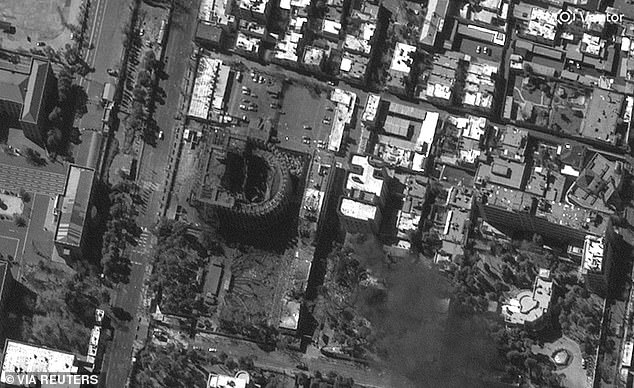
A satellite image shows a view of the damaged Presidential Complex in Tehran, Iran, March 3, 2026. Khamenei was killed here on Saturday in an airstrike

A satellite image shows a closer view of buildings of the Intelligence Ministry in Tehran, Iran, March 3, 2026, after airstrikes amid the Us-Israeli conflict with Iran

Iran’s supreme leader Ali Khamenei (pictured) was killed on Saturday in Tehran
High-ranking generals made sure they were seen leaving the headquarters and back to their families.
But they did not stay home for long, instead discreetly returning later, with many going back to the headquarters in disguise.
On Saturday morning, Israeli jets, including F-15s took off at 7.30am Iran time, arriving in position two hours later.
IDF jets launched the Blue Sparrow missiles at 9.40am, with at least 30 being sent to the Ayatollah’s compound in the heart of Tehran.
Blue Sparrows, which are produced in Israel and have a range of 1,240 miles, weigh around 1.9 tonnes and were originally created to test air defence systems.
But since their creation in 2013, they have been adapted to be used as an air-to-surface missile due to their high speeds.
Their ability to exit and re-enter the Earth’s atmosphere makes them incredibly difficult to intercept.
After being launched from fighter jets, booster rockets take the missile into space. The re-entry vehicle separates from the booster and locks onto a target.
After this, the missile re-enters the atmosphere and hits the target.
The Sparrow series of missiles, which also include Black and Silver variants, take inspiration from USSR Scud missiles, as well as Iranian Shahab-3 missiles.
Join the debate
Has Israel’s covert attack on Iran’s leaders made the world safer?

The IDF said its generals deceived Iran by having high-ranking officials pretend to go home for the Shabbat

An Israeli F-15 fighter jet carrying a Blue Sparrow

Pictured: a satellite image shows smoke rising and heavy damage at the compound after the US-Israeli strike on Saturday
As the missiles were fired, the IDF simultaneously disrupted around a dozen mobile phone towers near Pasteur Street, making phones appear busy when called and preventing Khamenei’s security from receiving possible warnings.
During the strike, senior Iranian national security officials were in another part of the building.
Two high-level military leaders – Rear Admiral Ali Shamkhani, and commander of the IRGC Major General Mohammad Pakpour – and Khamenei’s daughter, grandchild, daughter-in-law and son-in-law were also obliterated in the Tehran strikes.
The wife of Iran’s Supreme Leader, 79-year-old Mansoureh Khojasteh Bagherzadeh, was also killed. As was Iranian President Mahmoud Ahmadinejad.
They had also gained access to almost all of Tehran’s cameras, which are used extensively by Iran to spy on regime opponents and its own population, and tracked the movements of key bodyguards.
Images were said to be transmitted back to Tel Aviv and southern Israel, allowing Mossad to develop intimate knowledge on the guards’ addresses, work schedules and who they were assigned to protect.
One camera angle proved especially helpful and allowed agents to track where bodyguards parked their personal cars when arriving at the Supreme Leader’s compound on Pasteur Street in the heart of Tehran.
The hacks were part of a years-long intelligence campaign which eventually led to the killing of Khamenei.

A plume of smoke rises after an explosion in Tehran on March 2, 2026
‘We knew Tehran like we know Jerusalem,’ an Israeli intelligence official told the Financial Times.
‘And when you know [a place] as well as you know the street you grew up on, you notice a single thing that’s out of place.’
The CIA also had a human source who provided vital intelligence, according to the newspaper.
Combined with Israeli AI tools and algorithms which sifted through a vast mountain of data on Iran’s leadership and their movements, the source allowed them to trace Khamenei to the meeting where he was hit.
Once Israel and the US became aware of where Khamenei was holding his meeting, they decided they had to act.
On the sixth day of the bloody war in the Middle East, the IDF said that its military campaign against Iran had ‘shaken’ the country’s clerical leadership, adding that it was continuing to ‘deepen the damage’.
‘The goal of the operation is to inflict severe damage on the Iranian terror regime until it removes the existential threat… And we continue to deepen the damage to the regime,’ military spokesman Brigadier General Effie Defrin said in a televised briefing.
‘It is important for me to say that it is already shaken. It was shaken by the first strike on Saturday morning, when the leadership was thwarted. And every day we continue to destabilise it more and more, to deepen the damage to it until the existential threat is removed,’ he added.
Alongside strikes on Iran, Israel also continues to attack Hezbollah targets in Lebanon, where its forces pushed into several southern border towns on Wednesday.
Lebanon was drawn into the Middle East war on Monday, when Hezbollah attacked Israel in response to the killing of Iranian supreme leader Ayatollah Ali Khamenei during US-Israeli strikes over the weekend.
‘Hezbollah is an arm of Iran. It serves the terror regime inside Iran,’ Defrin said in the briefing on Thursday, but added that the coordination between the two ‘is not that tight.’
‘So far, we have struck more than 320 Hezbollah terror targets, about 80 of them in the last 24 hours alone,’ Defrin said.
‘There are many commanders and soldiers who are working around the clock to hit Hezbollah and exact a heavy price from it.’

Tehran has been pummelled by US and Israeli air strikes since Saturday, when they killed Ayatollah Khamenei

A man carries an injured woman at the site of US-Israeli airstrikes in Tehran, Iran, on Monday
As Europe continues to dither on whether to take action in the Middle East, a spokesperson for Iran’s foreign ministry warned that the EU would ‘pay the price, sooner or later’ if it continues to remain silent on the US-Israeli strikes.
Iran’s leadership also warned that the US will ‘bitterly regret’ torpedoing an Iranian warship in the Indian Ocean, while a top cleric called for ‘the shedding of Trump’s blood.’
The US navy sank an Iranian warship on Tuesday night in the Indian Ocean, killing at least 87 Iranian sailors, which Iranian foreign minister Abbas Araghchi decried as ‘an atrocity at sea.’
‘Frigate Dena, a guest of India’s navy carrying almost 130 sailors, was struck in international waters without warning,’ he wrote on social media.
‘Mark my words: The US will come to bitterly regret [the] precedent it has set.’
Ayatollah Abdollah Javadi Amoli, in one of the few clerical statements so far from Iran, said the country was ‘on the verge of a great test’ and called on state television for ‘the shedding of Zionist blood, the shedding of Trump’s blood’.
‘Fight the oppressive America, his blood is on my shoulders,’ he said in a rare call for violence from an ayatollah, one of the highest ranks within the clergy of Shiite Islam.
The war has killed more than 1,000 people in Iran, more than 70 in Lebanon and around a dozen in Israel, according to officials in those countries.

A view of Iranian missiles seen in the skies over Gaza after Iran launched retaliatory strikes in response to attacks by the United States and Israel in Gaza City, Gaza on March 01, 2026

Smoke rises from an area of Tehran after it was targeted in attacks as a series of explosions were heard in the Iranian capital on March 1 2026
It has disrupted the supply of the world’s oil and gas, snarled international shipping and stranded hundreds of thousands of travellers in the Middle East.
A drone crashed on Thursday near the airport in Nakhchivan, an Azerbaijan exclave that borders the north of Iran and is separated from the rest of the country by Armenia. Another drone fell near a school and two civilians were injured, Azerbaijan’s foreign ministry said.
Iran has not acknowledged targeting Azerbaijan, but its attacks have spread erratically as the war has gone on involving regional countries and beyond.
Qatar evacuated residents near the US embassy in Doha as a temporary precaution and fighter jets could be heard overhead early in the United Arab Emirates city of Dubai.
Saudi Arabia said it destroyed a drone in its province bordering Jordan, and a new attack off the coast of Kuwait appeared to expand the area where commercial shipping was in danger.
An explosion rocked the area early on Thursday, according to the United Kingdom Maritime Trade Operations Centre run by the British military.
It said a tanker apparently came under attack, but the agency did not offer a cause. Iran has attacked ships by attaching limpet mines to them in the past.
Prior attacks since fighting began on Saturday have happened in the Gulf of Oman and the Strait of Hormuz, which connects it to the Persian Gulf and through which about a fifth of the world’s oil is shipped.
US stocks rebounded on Wednesday after oil prices stopped spiking and reports gave encouraging updates on the American economy.
But oil prices resumed their ascent early on Thursday and Brent crude, the international standard, was up some 15% from the start of the conflict as Iranian attacks have disrupted traffic through the strait.