
There was something utterly depressing about a visit to the emergency water distribution centres dotted around Tunbridge Wells and East Grinstead this week.
The hundreds of palettes of two-litre plastic water bottles stacked high. The frozen teams in hi-vis jackets desperately trying to keep warm. The queues of cars patiently navigating the rain, mud and giant potholes for the fifth day on the trot.
And the miserable stories of nearly a week of flannel baths and closed schools, grinding anxiety and dirty hair. ‘It feels like we’re marinating!’ says Jackie Marsh, a retired hairdresser.
But perhaps worst of all, the sense of defeat and deja vu. And the creeping realisation that, for the 30,000 households affected by South East Water’s newest crisis, queueing for bottled water to brush teeth and boil kettles was fast becoming part of daily life in broken Britain.
Nursery manager Scarlet, 27, is nine weeks pregnant with her first child and suffering from extreme morning sickness. But she can’t flush the loo. Or have a shower or a bath. Or even fill the kettle for a soothing ginger tea. According to her mother-in-law Liza Butler, Scarlet is spiralling into anxiety.
‘She’s terribly distraught, really, really frightened,’ Liza told me as she collected bottled water.
Charlie and Lorna welcomed newborn Pip by Caesarean section last week – a brother for their 20-month-old toddler – only to return home to a sporadic water supply in the Hawkenbury area of Tunbridge Wells.
Nothing came out of the taps after late morning and there was so little water pressure that a shower was impossible.

Jane Fryer visits East Grinstead in West Sussex to see how the water shortage has impacted the town

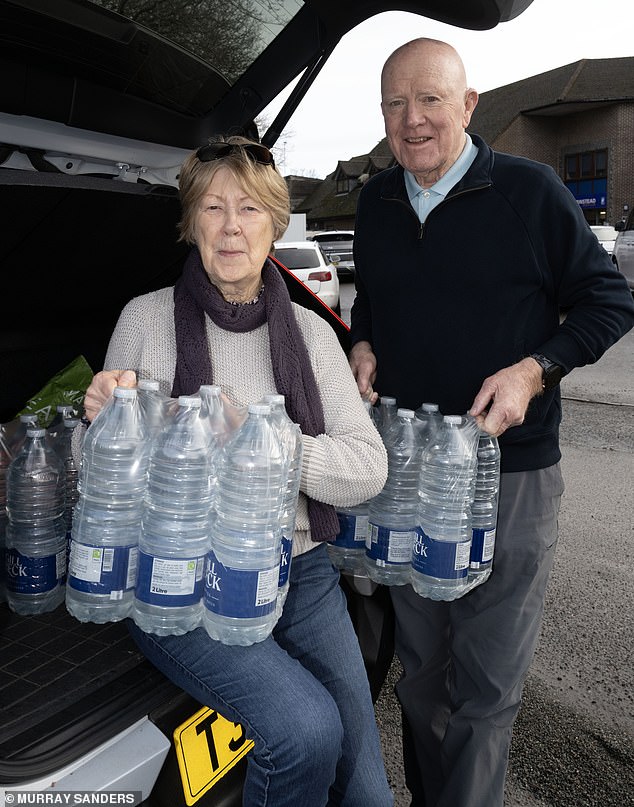
Workers at a bottled water station for those impacted by outages in Tunbridge Wellson Thursday

South East Water boss David Hinton enjoyed a generous 30 per cent pay rise last year, taking his already hefty salary to £400,000. The married father-of-two, 58, also enjoys an annual performance related bonus of up to £115,000 as well a car benefits and a generous pension package
‘She’s supposed to wash the scar, but it’s quite a challenge,’ says Charlie.
Residents have also had to watch, hopeless, as their local businesses – shops, pubs, restaurants, cafes, hairdressers, butchers – stick hastily-printed notices to the door saying ‘So sorry, no water again’ and close up. And not just shops but GP surgeries, dentists, schools, nurseries, leisure centres too. All shut.
‘It’s been like Armageddon,’ says Russ, who runs Mad Dog Coffee Lounge in East Grinstead, which has also been affected. ‘That’s the only way to describe it – a total nightmare. And for some people it’s been going on for months.’
He’s right. This water crisis is just the latest in a sorry slew of water supply shenanigans from South East Water in Kent and Sussex. For several years now, there have been problems with the water pressure in the area – particularly in Tunbridge Wells.
This is alongside occasional 24 to 36-hour outages, which are apparently to do with the pump in a local reservoir not working properly if the water level goes below a certain point, meaning properties up the hill are then not being properly serviced.
In early December just over a month ago, 24,000 households in Tunbridge Wells were without drinking water for two weeks, along with pretty much the entire centre of the historic spa town – closing down schools, shops, cafes and bars. Larratt & Co butchers in the Pantiles area lost more than £12,000 of business in just six days during the outage.
That crisis came after the local water treatment centre was forced to shut down. The Drinking Water Inspectorate later said this outage was foreseeable as the regulator had flagged it as at risk in 2024 due to a lack of maintenance at the site.
Now, South East Water has blamed the current disaster on the freezing weather of Storm Goretti causing leaks in its ageing pipe network.
Which, as at least half a dozen residents point out to me, feels a bit odd given Goretti hit the South-West of the country far harder – yet they don’t seem to have anything like these problems with water supply there.
‘Whereas here, we get quite excited when water comes out of the tap at all,’ says Dave, 72, a retired estate agent.

South East Water has launched its ‘largest ever operation’ this week to deliver bottled water to the most vulnerable

The crisis comes just days after embattled Mr Hinton was hauled in front of MPs for a grilling over his firm’s handling over last month’s failings
You can feel the rage and fury fizzing wherever you go. Aimed at South East Water – ‘incompetent cowboys!’. And at the company CEO David Hinton – ‘He has to go.’ At his enormous £400,000 salary and £115,000 bonus – ‘He should pay it all back.’ At the endless dividends paid out to the company’s shareholders. And at the fact that neither Hinton, nor any senior management, has been spotted in any of the water outage hotspots since the crisis began.
‘They’re very, very good at excuses, just not quite so good at coming up with any running water,’ says decorator Andy Brown, 48.
But before we get completely mired in the who, what and why, let’s have a proper look around to see how people here have been affected by the issues.
At the deserted pub car parks. The shuttered restaurants. The eerily silent leisure centres and empty schools and nurseries. The makeshift water supply stations. And the roads clogged with shiny tankers desperately trying to refill the local reservoirs.
It’s hard to imagine what a _tourist, here to experience the Georgian charm of Royal Tunbridge Wells, would think. Maybe that they’d been transported back to the 1970s.
‘The Third World more like,’ says Dave, the groundsman at a local care home where, yes, you guessed it, residents have no water.
‘It’s total chaos,’ he says. ‘So we’ve come up with a new song: Tunbridge Wells Is Falling Down.’
For most people, the recent crisis began on Saturday morning. ‘I got up to make a cup of tea and . . . nothing,’ says Tony Marsh, a retired salesman.
East Grinstead’s pretty High Street, usually packed with shoppers, was shuttered.
Restaurants, bars, The Crown pub. Book shops, opticians, estate agents. All closed.
But John at Hair & Graces hairdresser stayed open. He tells me how he has operated on strict rules – one kettle per customer and no loos.
Russ at Mad Dog Coffee was open too because as an engineer by trade, he likes to have has his own back-up water supply – but the cafe could only offer takeaway and had a no loo policy.
The owners of F A Anderson, the gun shop at the far end of the High Street, were hit too. They tell me that over the weekend the entire town was gridlocked with traffic because, for some mad reason, South East Water decided to put both their bottled water stations on the town’s congested one-way system. ‘It was nose-to-tail with cars all weekend. All the neighbouring villages had to drive in. They didn’t think to leave them at a village hall or on the edge of town. Madness.’
Then, on Tuesday morning – hurrah! Some residents got their water back – albeit so yellow and cloudy that they couldn’t drink it and with insufficient pressure for a shower. Then it went off again. And on again. And off again.
At Rocca Mediterranean restaurant, staff say they all dashed back in on Tuesday afternoon only to find the water supply was off again. Others have remained closed throughout. Such as The Bull in Frant, which is locked up.
‘They’re pretty new and what with everything else that’s being thrown at hospitality at the moment, we don’t think they’ll make it,’ says Michael Landy, 42, walking his dog outside.
Staff at The Abergavenny Arms on Frant Road had to cancel 80 covers on Sunday and throw most of the food away.
Butchers have also been binning meat all week. ‘We haven’t been able to plan,’ says Richard who works at Fuller’s Butchers in Hawkenbury. ‘It all feels very “Covidy”, and no one wants to go back there.’
Of course, as with any crisis, there are golden nuggets of community spirit. The way everyone pulls together. The resourcefulness of residents. The retirees flushing their loos with water from their garden water butts. One couple in their early 70s tell me they live out of town and have been bathing in their freezing stream – ‘It’s quite bracing!’
But for the elderly, it’s been particularly dreadful.
For days now the 115-odd residents – 12 of them in their 90s – at the Sherborne Close housing complex in Hawkenbury have been without running water.
They can’t wash or shower, but are also being bombarded at 2am by lorries delivering six-packs of two-litre water bottles that they can neither lift nor even get the lids off.
‘They’ve very anxious’, says deputy manager Kate Gayle. ‘For many of them, this feels worse than the pandemic because at least then everything in their homes worked.’
They can’t even shop for groceries because the single local shop within walking distance is closed. ‘Sorry, we’ve got no water’ reads the sign at the store.
For many, the uncertainty and poor communication from the authorities is worse than the lack of water itself.

A bottled water distribution station is seen operating in Tunbridge Wells, Kent

Around 30,000 homes in South East England were left without water, leaving residents and public services struggling to cope
Hannah Knowles, the principal of Skinners’ Kent Academy in Tunbridge Wells, says: ‘We can’t operate like this. We have exams. And more than 1,000 pupils and staff and 52 loos. We can’t be open if there’s no water.’
They were closed for five days before Christmas. Then most of this week too, though they allowed children in to sit exams.
‘I can cope with certainty, but not this on-off nightmare – it’s not fair on the students or the parents and staff.’
By Thursday, she’d had enough of the back-and-forth so she ordered enough Portaloos to serve the entire school community.
‘And I’ll be billing South East Water,’ she says, furious. ‘Who have not been in touch once – which is staggering. No one knows what’s going on.’
Because while there are South East Water employees everywhere – at the water stations desperately topping up the reservoirs and, rather alarmingly, emptying thousands of gallons of water from the mains down Holtye Road in East Grinstead, apparently as part of a bid to get the hospital back on grid – none are allowed to talk.
In fact, the only person I find in two days who has had any contact with the water company is the local Lib Dem MP, Mike Martin.
He raced back from Westminster when the water failed and has been bombarded with terrible stories from constituents hit by the outages – those with young children, elderly people, those who are ill and people who had just come out of hospital.
He tells me he speaks to the water company ‘multiple times a day’, but is not reassured.
‘They don’t seem to understand the situation and are massively over-optimistic. We’re trying to get them to be realistic, but it’s a tough job,’ he says.
‘They say they’re on track for the water to be back on, but I’m not entirely convinced that in a week’s time it will still be on.’
It’s little wonder confidence in the company is at rock bottom. As well as their dim-witted water drop plan in East Grinstead at the weekend, during the previous outage they initially set up a supply station in the wrong town – with a water point in nearby Tonbridge rather than Tunbridge Wells.
Meanwhile, South East Water CEO Hinton recently appeared at the Environment, Food and Rural Affairs parliamentary committee.
He told them that he awarded himself an ‘eight out of ten’ on the operational response to Tunbridge Wells water shortages near the end of 2025.
Hinton added that he didn’t do interviews during that outage because questions would focus on his pay and bonus, which he thought would be a distraction. And Martin confirms suspicions that not one of the senior staff have visited – though perhaps they feared being lynched.
The whole thing is a shambles. On Thursday, hard on the heels of an intervention by the Drinking Water Inspectorate, it was announced that water regulator Ofwat had opened an investigation into South East Water over its servicing of the area to see if it had breached a condition of its operating licence.
Which, presumably, is good news for Kent and Sussex residents in the long term.
But as Kate Gayle at the Sherborne scheme points out, it isn’t much comfort to the thousands of locals still without water.
‘We need help now on the ground. Sort it out here first – bring the Army in if it’ll help. And then deal with the rest of it later. But please, please just get the water going. Or at least, give us some certainty – is it on, or off?’
It’s hard not to feel dreadful for the residents in this lovely, leafy community. They have been brave and resilient and resourceful, but no end of courage or Blitz spirit can halt the catastrophic damage – financial, social, educational and emotional – caused by the water company’s incompetence.
Perhaps Paul, a retired banker stocking up at the emergency water station at East Grinstead Rugby Club, put it best.
‘We’ve had to reset our expectations. Now we just assume there isn’t any water – so we turn on the tap and say: “Ah no, not today” and try and make light of it. Otherwise we’d despair. Not just about the water, but about everything going wrong in this country today.’