
US military officials are growing increasingly concerned about China’s expeditions in the Arctic after the country’s research submarines traversed thousands of feet beneath the ice for the first time over the summer.
Such expeditions could yield valuable data about the natural resources underneath the melting ice caps, significantly reduce travel time for commercial shipping and position nuclear-armed submarines closer to potential targets – including the US, national security officials told the Wall Street Journal.
Chinese vessels on research missions are also often used to give cover to the military, noted US Air Force Gen. Alexus Grynkewich, the top military leader for the North Atlantic Treaty Organization.
‘The Chinese are being more and more aggressive,’ he said, echoing a Department of Homeland Security memo in November that showed that the Chinese military and research have been operating around a section of the Arctic known as the ‘High North’.
China’s Foreign Ministry, though, has insisted that its activities in the Arctic are reasonable and lawful, ‘contributing to the maintenance and promotion of peace, stability and sustainable development in the region.’
But experts are skeptical.
‘China doesn’t field the world’s largest fleet of oceanographic survey ships because they want to save the whales,’ said Hunter Stires, a naval strategist who until this year advised the US Secretary of the Navy.
‘China aims to take the lead in marine and climate science, because understanding the ocean and the climate is a critical enabler to success in naval operations, particularly in anti-submarine warfare.’

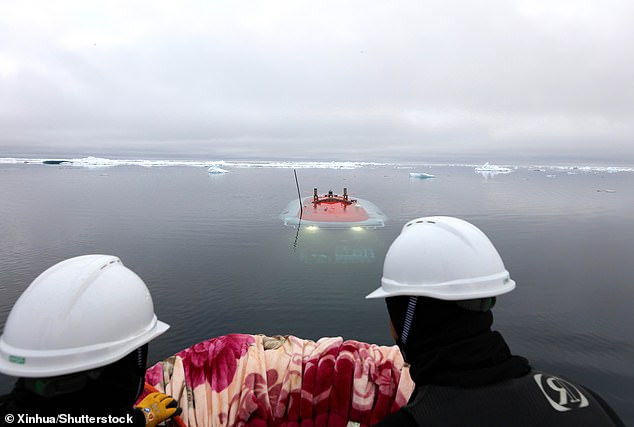
China’s research submarines traversed thousands of feet beneath the ice for the first time over the summer. Its manned deep-sea submersible Jiaolong is pictured returning to the surface from the bottom of the sea in the Arctic Ocean on August 6

Such expeditions could yield valuable data about the natural resources underneath the melting ice caps, significantly reduce travel time for commercial shipping and position nuclear-armed submarines closer to potential targets

The deep-sea submersible Jiaolong is seen diving in the Arctic Ocean on August 6
Stires and other military officials explained that submarine navigation relies on detailed knowledge of ocean floor topography and undersea conditions.
Using the submarines, they said, China is cataloging the world’s oceans to build computer models to guide submarines and help them evade detection.
Conditions in the Arctic also provide stealth for any nuclear submarines.
The thick ice impedes airborne submarine detection that works in other oceans, and the Arctic’s water temperature layers and changing salinity from melting ice interfere with sonar.
The sound of icebergs colliding and the chatter of marine animals also complicate submarine detection.
National security officials now argue that the submarines’ feat is just the latest example of China’s efforts to expand its military capabilities into the High North.
The country views future sea routes through the Arctic as a shortcut for global commerce, sending a cargo ship to the Polish port of Gdansk by skirting the North Pole over the summer.
The route proved to be twice as fast as going through the Suez Canal, the Journal reports.
Chinese officials have since said they plan to expand trans-Arctic cargo traffic with Russia, particularly liquefied natural gas.

China’s Foreign Ministry has insisted that its activities in the Arctic are reasonable and lawful

US Air Force Gen. Alexus Grynkewich, the top military leader for the North Atlantic Treaty Organization, has argued that Chinese vessels on research missions are often used to give cover to the military
The chilly Arctic waters also provide a military advantage due to the North Pole’s proximity to other nations, military officials said, noting that they expect Beijing will be able to send armed subs to the North Pole within the next few years.
The country already has military-grade surface vessels in the Arctic while it expands its fleet of ice-breaking ships.
It is also believed that China has partnered with Russia, which officials say is seeking to repay the Asian nation for the electronics and components for military equipment Moscow needs in its war in Ukraine by sharing advanced technologies in undersea warfare.
That could prove vital for China, as neither it not the United States have a sufficient fleet of vessels capable of navigating the thick Arctic ice when compared to Russia, which has more than 40.
In comparison, China last year commissioned its fifth icebreaker, while the US only has two vessels in operation – though President Donald Trump is seeking to buy more.
Russia has also advocated for greater Chinese involvement in governance of the international waters of the High North and has even invited China to develop infrastructure in Arctic Russia, according to the Journal.


It is now believed that China has partnered with Russia to conduct expeditions in the Arctic, with Russian President Vladimir Putin (right) seeking to repay Chinese President Xi Jinping (left) for the electronics and components for military equipment Moscow needs in its war in Ukraine by sharing advanced technologies in undersea warfare

US President Donald Trump has sought to buy more icebreakers that could traverse the Arctic and has struck a shipbuilding deal with Finland to expand defenses on and around Greenland
In 2023, the two nations created a working group to develop northern sea routes.
They also agreed at the time to coordinate Arctic maritime law enforcement.
By 2024, Chinese and Russian military planes were seen flying patrols near Alaska for the first time, with Chinese long-range bombers operating from a Russian air base – allowing China to strike North America.
Now, China is even sailing coast guard vessels that resemble frigates near Alaska, said Rob Bauer, a retired Dutch admiral who served as one of NATO’s top military officials until this year.
‘They’re basically warships, but they’re painted white,’ he claimed, arguing that the joint patrols with Russian navy ships indicate China’s larger goal is to gain a military advantage.
When more ice melts along the international waterways in the High North, China could use the shortcuts it found to speed its navy into the Atlantic, he noted.

The US and its allies are already training more Arctic troops, increasing sub-hunting patrols out of Iceland. Soldiers are pictured taking part in Joint Viking training exercises in Norway in March 2023
French Adm. Pierre Vandier, who oversees NATO’s efforts to prepare for future warfare, expressed similar concerns.
He said China could use the routes to get its navy to sail from the Pacific Ocean to the Atlantic Ocean without having to go through the more easily-observed and defended routes through the Suez or Panama canals or around South Africa.
‘For all of us, for NATO and the US, it means the threat that is in the Pacific is ubiquitous,’ Vandier said.
‘If we have Asian forces in the Atlantic, it would be a huge game changer. And we need to be prepared for that.’
As a result, the US and its allies are already training more Arctic troops, increasing sub-hunting patrols out of Iceland.
President Trump has also struck a shipbuilding deal with Finland to expand defenses on and around Greenland, and Grynkewich has put NATO members Denmark, Sweden and Finland under the alliance’s Atlantic and Arctic command to bolster the defense of the High North, citing the ‘alignment of our adversaries.’