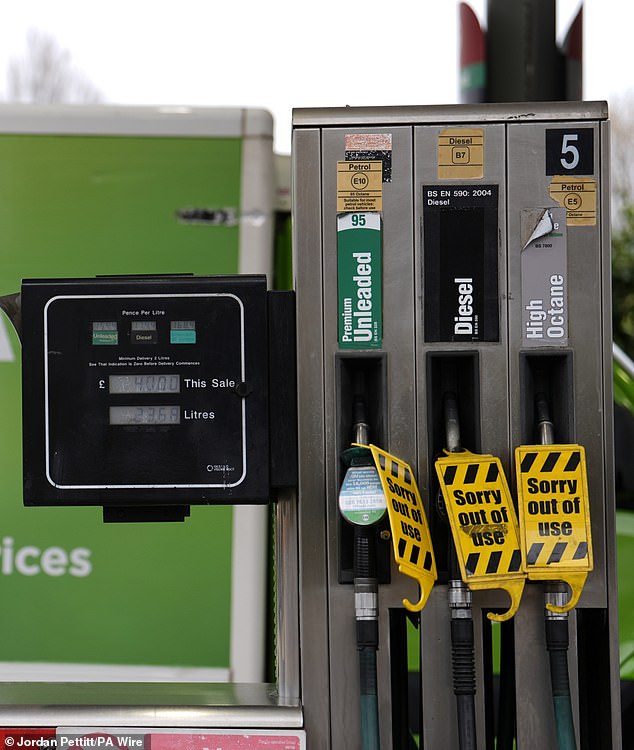

Small petrol stations are being forced to close their pumps rather than charge £2 per litre as supermarkets warn of ‘tight’ supplies amid the war in Iran.
As the conflict between Tehran and the US and Israel entered its second month on Saturday, consumers and businesses are feeling the pinch of spiralling fuel prices.
Queues continue to mass at petrol stations across Britain with short-term supply issues in some areas since Iran closed the Strait of Hormuz, which typically sees 20 per cent of the world’s oil supply pass through it each year.
On Saturday the conflict showed no sign of abating as the Houthi rebels in Yemen entered the war with a ballistic missile strike launched towards Israel.
The latest development raises concerns prices could spike even further if the Houthis resume their previous strikes on shipping in the Red Sea.
This week some small petrol station owners shut up shop rather than be forced to charge customers up to £2 per litre for fuel. And at leading supermarkets, some pumps were closed as supplies simply ran out.
Forecourt bosses say they have been accused of ‘profiteering’ from the crisis – which the industry has firmly denied – by the Government and are facing abuse from angry customers.
Smaller forecourts are typically the first to be hit by rising prices, and many are choosing to close rather than have to pass on the astronomical price rises to customers.

As the conflict between Tehran and the US and Israel entered its second month on Saturday, consumers and businesses are feeling the pinch of spiralling fuel prices

Queues at a branch of CostCo in Gateshead on Friday as customers rushed to take advantage of its cheaper fuel prices

Small petrol station owners such as Mollie Ellis (pictured) have closed their pumps due to the price rise
Today average petrol prices hit 150.11p per litre, while diesel rose again to 177.68p.
Mollie Ellis, who runs her family business Youlgrave Garage in the Derbyshire Dales, told how she shut the pumps two weeks ago after refusing to pass on higher prices to her customers.
Ms Ellis told the Times she was faced with charging customers 180p per litre of petrol and 200p per litre of diesel – something she was not prepared to do.
She stopped selling fuel on March 13, not wanting to face allegations of profiteering from angry customers or buy fuel at a loss that she couldn’t then sell.
‘We can’t afford to take that hit. We’re a one-mechanic garage,’ she said. ‘I don’t want to be at a point where I’m being seen to rip customers off and people think that we’re profiteering, because a lot of colleagues in the industry are getting so much abuse.’
Beth Ballard, who runs a forecourt at H Ballard & Son car showroom in Welshpool, stopped selling petrol on March 19.
The last straw for her was being quoted a wholesale price of more than 150p per litre before any tax or operating costs, while her competitors’ prices were below 140p.
She said: ‘We are normally praised for being the cheapest in Welshpool, so it was just a big fat no. We’re not going to do that.’
Independent fuel stations are more likely to have fuel purchase agreements which see them buy based on the previous week’s, or even day’s, prices, than rivals such as large supermarkets.
This means they are more vulnerable to market volatility and tend be the first to have to pass on large price rises to customers.
Yesterday Allan Leighton, executive chairman at Asda, warned supplies are ‘tight’ due to the ongoing conflict.
He said: ‘Supply is tight and we are all trying hard on that. The issue is a temporary one, and some could see issues when we are waiting for delivery, and we can expect to see that continue.’
The Daily Mail visited several petrol stations in the north of England this week, where motorists hit out at the Government over the rising cost of fuel.

Beth Ballard, who runs a forecourt at H Ballard & Son car showroom and petrol pumps (pictured) in Welshpool, stopped selling petrol on March 19

At CostCo in Gateshead, petrol was being sold for 137.9 while diesel was 160.9 – the cheapest in the area

Michael Hall, a 73-year-old retired electrician from Kingston Park, Newcastle, refills his car’s tank in Gateshead on Friday
At CostCo in Gateshead, petrol was being sold for 137.9 while diesel was 160.9 – the cheapest in the area.
Queues stretched out of the forecourt as desperate drivers scrambled to fill their cars before further hikes.
Joanne Bolam, a 49-year-old support worker from Kingston Park, Newcastle, said: ‘The Government should be bringing the cost down.
‘I fill my tank up about once a month, but the price is absolutely ridiculous. I usually go to Tesco in Kingston Park, but they’ve run out, so I’ve come here.
‘The Government need to act, because there’s going to be a knock on effect.’
David Allen, a 71-year-old retired oil and gas engineer from Lemington, Newcastle, said: ‘The Government need to make their mind up and do something about this.
‘I don’t think reducing fuel duty is the answer. When it comes down to it, I don’t feel like it makes much of a difference. It’s the same when they cut the tax on beer. You never really notice it.
‘The price of fuel varies wildly from petrol station to petrol station. Just joining CostCo to become a member makes more of a difference than bringing down fuel duty by a few pence.
‘We are a two car family. During the week, my wife uses this for work, and at the weekend we always try and go on a trip somewhere.
‘The rising price of petrol will not just affect travel, it will affect everything that travels by road. If you want to get a taxi somewhere, that will be more expensive as well.’
David’s wife, Bev Holmes, a 61-year-old admin worker, of Lemington, Newcastle, added: ‘I do about 28 miles a day, commuting to work.
‘I’ve already said I am going to work from home one day a week, to save money. I’m lucky I have that option, not everyone does.

David Holmes, 71, and his wife Bev, 61, filling up their vehicle – Bev has decided to begin working from home once a week to save on fuel

Joanne Bolam, a 49-year-old support worker from Kingston Park, Newcastle, said the Government ‘needs to act’ to protect families
‘But more people working from home will have a knock on effect on the economy. It’s going to impact so many things.’
Michael Hall is a 73-year-old retired electrician from Kingston Park, Newcastle.
He said: ‘The Government should be helping us out, as far as I am concerned. If they don’t help businesses out, they could be forced to close.
‘When the price of fuel goes up, everything goes up. The Government will be making more money from the VAT. They won’t bring it down, but they should.
‘There should be measures to do this in a crisis.’
Chris Walton, a 34-year-old HGV driver, of Throckley, Newcastle, said: ‘Everything is so expensive as it is.
‘This is just one more thing on top of the pile. It always hits the working people the hardest. It’s never the politicians.
‘The Government should bring fuel duty down. People are struggling in so many ways, because they can’t afford the cost of living.
‘I have to drive a lot of miles for my job, around 40 a day. It’s difficult to estimate just how much it’s going to cost me yet. Luckily I don’t have to pay for the HGV fuel, but this could affect my work.
‘Everything is going to be so much more expensive.’
At nearby Esso Garage PNG Fuel & Foods in Blaydon, petrol was 154.9p and diesel 183.9p per litre.
Rachael Grant is a 40-year-old florist who runs business Jasmine and Pear, in Gateshead.
She said: ‘It’s a massive expense, especially for someone like me, who runs a small business. If there’s anything at all the Government can do, it would be a big help.
‘It’s expensive at this petrol station, and I usually shop around, but I am rushing to pick the kids up from school.
‘I travel to wedding venues all over Northumberland, so I do a lot of miles.
‘If I can’t make money out of wedding flowers, what do I do?
‘The Government will be making more money out of the VAT, and I don’t think they should be.
‘When there are wars going on in the world, there should be interim measures to mitigate the damage in the short term.’
It’s not just fuel that is suffering price rises as a result of the conflict. Fertilizer costs are also climbing due to supply chain disruption, which could push up costs and disrupt food distribution around the world.
Stocks of fertilizer are building up in the Middle East but are unable to be exported efficiently due to the closure of the Strait of Hormuz. Usually, nearly a third of all global fertilizer passes through the strait each year.
Even countries that produce their own stocks outside of the Middle East are struggling as they require natural gas to do so – which is facing similar price hikes to oil as the region is a hub for its production.
And in countries including Slovakia, India and Algeria, fertilizer plants have had to stop or slow production due to the increased price of natural gas.
Experts have warned it is ‘inevitable’ food prices will go up as a result of the crisis.