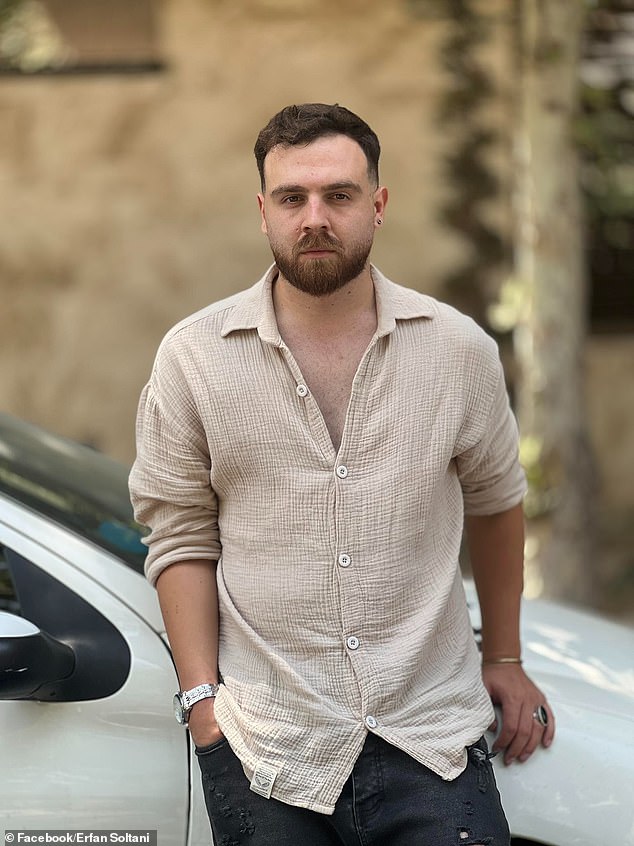

Tehran has confirmed that Iranian protestor Erfan Soltani will not face the death sentence, after US President Donald Trump threatened to take military action if the regime executed anti-government demonstrators.
The judiciary said Soltani, 26, is being charged with ‘colluding against the country’s internal security and propaganda activities against the regime’ but that the death penalty does not apply to such charges if they are confirmed by a court.
It comes as Trump said he had been told by ‘very important sources on the other side’ the killings of protesters in Iran had been halted, and that executions would not go ahead.
He had earlier warned clerics America would take ‘very strong action’ when asked what he would do if the Iranian regime started executing captured protesters, adding: ‘If they hang them you’re going to see something‘.
Soltani, a clothes shop owner, was arrested for taking part in the January 10 protests last week and was being held in the Ghezel Hesar prison in Karaj.
His family was told he would face the death penalty and that his imminent execution was scheduled for January 14.
The Hengaw Organisation for Human Rights told the Daily Mail last night that relatives of Soltani had been informed that the execution order was postponed, however.
Trump had repeatedly talked in recent days about coming to the aid of the Iranian people over the crackdown on protests, which Norway-based Iran Human Rights says has left at least 3,428 people dead.
But in a surprise announcement at the White House, Trump said that Tehran had now stopped the use of lethal force on protesters, adding that he would ‘watch it and see’ about threatened US military action.
He told reporters: ‘They’ve said the killing has stopped and the executions won’t take place – there were supposed to be a lot of executions today and that the executions won’t take place – and we’re going to find out.’

Tehran has confirmed that Iranian protestor Erfan Soltani will not face the death sentence

US President Donald Trump said Wednesday he had been told the killings of protesters in Iran had been halted, but added that he would ‘watch it and see’ about threatened military action

Protesters set fire to makeshift barricades near a religious centre on January 10, 2026
Asked by an AFP reporter in the Oval Office if US military action was now off the table, Trump replied: ‘We’re going to watch it and see what the process is.’
His comments sent oil prices plunging on Thursday morning, as concerns eased of a looming supply shock in energy markets.
Iran makes up around three percent of global oil production.
Iranian Foreign Minister Abbas Araghchi later said there would be ‘no hanging today or tomorrow,’ in an interview with US network Fox News, while accusing Israel of orchestrating violence, without providing evidence.
Araghchi contends the peaceful protests about economic hardship that began December 28 devolved into widespread violence between January 7 and 10 because the protests were infiltrated by external ‘elements who had a plan to create a big number of killings in order to provoke President Trump to enter into this conflict and start a new war against Iran’.
Iran’s Minister of Justice Amin Hossein Rahimi echoed that allegation, telling state news agencies that after January 7, ‘those weren’t protests any longer’ and anyone who was arrested on the streets then ‘was definitely a criminal’.
Late Wednesday, UN leadership announced a meeting of the Security Council Thursday for ‘a briefing on the situation in Iran,’ as requested by the United States.
Araghchi said the Iranian government was ‘in full control’ and reported an atmosphere of ‘calm’ after what he called three days of ‘terrorist operation’.
Iran also struck a defiant tone about responding to any US attack, as Washington appeared to draw down staff at a base in Qatar that Tehran targeted in a strike last year.
Iran targeted the Al Udeid base in June in retaliation for US strikes on three of its nuclear facilities. Ali Shamkhani, a senior advisor to Supreme Leader Ayatollah Ali Khamenei, warned Trump the strike showed ‘Iran’s will and capability to respond to any attack’.
Al-Udeid is the largest US military base in the Middle East, with about 10,000 personnel and around 100 UK staff.
Speaking to Fox News, Araghchi warned the US president to ‘not repeat the same mistake that you did in June,’ adding: ‘If you try a failed experience, you will get the same result.’
Fears of possible US military action continued to rile the region.
The British government said its embassy in Tehran had been ‘temporarily closed,’ while the US embassy in Saudi Arabia urged staff to exercise caution and avoid military installations and India’s government urged its citizens to leave the country.
Germany’s Lufthansa on Wednesday said its flights would avoid Iranian and Iraqi airspace ‘until further notice’ after the US threats against Iran.
The country had earlier issued a notice to air operators recommending that flights do not enter Iranian airspace, citing potential danger from ‘escalating conflict and anti-aviation weaponry’.
Trump has threatened to intervene militarily in Iran several times since the protest movement that has shaken the country began in late December.
The protests are the largest since the Islamic Republic was proclaimed in 1979.

Clashes between protesters and security forces in Urmia, in Iran’s West Azerbaijan province, on January 14, 2026

Iranian demonstrators gather in a street during a protest over the collapse of the currency’s value, in Tehran on January 8, 2026

Protesters dancing and cheering around a bonfire in Tehran on January 9, 2026
Rights monitors say that under cover of a five-day internet blackout, Iranian authorities are carrying out their harshest repression in years against demonstrations openly challenging the theocratic system.
Iran’s judiciary chief vowed fast-track trials for those arrested, stoking fears authorities will use capital punishment as a tool of repression.
In Tehran, authorities held a funeral for more than 100 security personnel and other ‘martyrs’ killed in the unrest, which officials have branded ‘acts of terror’.
G7 nations said Wednesday they were ‘deeply alarmed at the high level of reported deaths and injuries’ and warned of further sanctions if the crackdown continued.
Monitor NetBlocks said Iran’s internet blackout had lasted 144 hours.
Despite the shutdown, new videos, with locations verified by AFP, showed bodies lined up in the Kahrizak morgue south of Tehran, wrapped in black bags as distraught relatives searched for loved ones.
The US-based Institute for the Study of War said authorities were using ‘an unprecedented level of brutality to suppress protests,’ noting reports of protest activity had sharply declined.
A senior Iranian official told journalists there had been no new ‘riots’ since Monday, distinguishing them from earlier cost-of-living protests. ‘Every society can expect protests, but we will not tolerate violence,’ he said.
Prosecutors have said some detainees will face capital charges of ‘waging war against God.’ State media reported hundreds of arrests and the detention of a foreign national for espionage, without giving details.

Empty airspace over Iran amid concerns about possible military action from the United States

The courtyard of the Forensic Diagnostic and Laboratory Centre of Tehran Province in Kahrizak on January 12, with dozens of bodies in bodybags laid out for family members
Erfan Soltani was arrested on Thursday evening last week near his home in Fardis, a working-class district of Karaj, west of Tehran.
Some 18,470 people have been detained since protests began in late December, according to Norway-based Iran Human Rights.
For three days, his family didn’t receive any news about the 26-year-old, and weren’t told about where he was detained or what charge he was accused of committing.
On Sunday, a phone call from a regime official arrived, telling them he was sentenced to death and that his execution would take place on Wednesday.
That would make Soltani the first known protester in the latest Iranian uprising to be condemned to the death sentence.
His relatives didn’t receive any explanation about the charges, and Soltani was denied access to a lawyer as well as a court hearing.
On Tuesday night, the family travelled to Ghezel Hesar prison to protest for his release.
The Islamic Republic typically carries out hangings at dawn, during the morning call to prayer, when the faithful are called to worship and the condemned are summoned to experience their last moments.
In a desperate plea for Soltani, one of his cousin’s, Somayeh, called on Trump to urgently intervene to save him.
‘I beg you, please do not let Erfan be executed, please,’ she told CNN.
‘We need Trump’s help by the second.’
On Wednesday night, the family were informed that the scheduled execution had been postponed, according to the human rights group Hengaw.

Rubina Aminian, 23, was shot in the back of the head by Iranian security services after joining the street protests after a day of classes in her textiles programme at Shariati College on Thursday

Rebin Moradi, 17, was shot dead during protests in Tehran

Erfan Faraji died a week after 18th birthday
It comes after Rubina Aminian, a 23-year-old fashion student, was shot in the head ‘from close range’ during last Thursday’s protests.
Erfan Faraji, a resident of Rey, outside Tehran, was shot dead by Iranian government forces during the protests a day earlier, Hengaw said. He had turned 18 just a week earlier.
A source close to Faraji’s family told Hengaw his body was identified among those transferred on Saturday to the Kahrizak morgue, from where images of dozens of body bags sparked international alarm.
His family collected his body on Saturday and he was buried without any public announcement.
Rebin Moradi, a 17-year-old Kurdish student, originally from Salas-e Babajani in Kermanshah province but a resident of Tehran, was a member of the capital’s youth premier football league and a youth player with Saipa Club at the time of his death.
He was seen as ‘as one of the promising young talents in Tehran’s youth football scene,’ Hengaw said.
Moradi was killed by Iranian government forces who shot him last Thursday, Hengaw said.
A source familiar with the case told the organisation that Moradi’s family received confirmation of his death but that they had not yet been allowed to take possession of his body.
Mehdi Zatparvar, 39, from Rasht in the Caspian Sea province of Gilan was a former bodybuilding champion who became a coach and held a master’s degree in sports physiology.
‘Zatparvar began weightlifting at the age of 13 and earned national and international titles in powerlifting and weightlifting between 2011 and 2014,’ Hengaw added.
He was shot and killed on Friday.
The protests broke out in two major markets in downtown Tehran after the Iranian rial plunged to 1.42million to the US dollar, a new record low, compounding inflationary pressure and pushing up the prices of food and other daily necessities.
This was after the Iranian government had raised prices for nationally subsidised gasoline in early December, with Central Bank head Mohammad Reza Farzin resigning a day later as the protests spread to cities outside of Tehran, where police fired tear gas to disperse demonstrations.
The UN human rights chief said on Tuesday that he was ‘horrified’ by mounting violence by Iran’s security forces against peaceful protesters.
‘This cycle of horrific violence cannot continue. The Iranian people and their demands for fairness, equality and justice must be heard,’ Volker Turk said.
UN Secretary-General Antonio Guterres said on Sunday that he was ‘shocked by reports of violence and excessive use of force by the Iranian authorities against protesters resulting in deaths and injuries in recent days’.
The US State Department on Tuesday urged American citizens to leave Iran now including by land through Turkey or Armenia.