
Defense Secretary Pete Hegseth has claimed that an Iranian leader who plotted to assassinate Donald Trump had been killed as he announced the US has taken total control of the skies and will now start dropping massive gravity bombs.
Hegseth said ‘the leader of the unit that attempted to assassinate President Trump has been hunted down and killed,’ at a press conference at the Pentagon on Wednesday.
Though this was ‘not the focus’ of the mission and ‘never raised by the president,’ Hegseth said he and others ensured the leader was added to the ‘target list.’ He did not identify the individual or specify the nature of the plot against Trump.
Trump has claimed that he authorized the US-Israeli strikes that killed Ayatollah Ali Khamenei on Saturday because intelligence showed that Iran was targeting him.
‘Four days in we have only just begun,’ Hegseth said. ‘Now with complete control of the skies, we will be using 500-pound, 1,000-pound and 2,000-pound GPS and laser-guided precision gravity bombs of which we have a nearly unlimited stockpile.’
Hegseth said the US had opened the campaign with ‘exquisite standoff munitions,’ sophisticated long-range weapons designed to strike from beyond the reach of enemy air defenses.
He said those munitions were no longer needed, pushing back at reports of stretched supplies with the assurance that ‘our stockpile of those remains extremely strong.’
Tomahawk missiles cost upwards of $2 million apiece; gravity bombs deliver a comparable punch for roughly $25,000 per unit, though they require total air superiority to be deployed within range.

Secretary of War Pete Hegseth arrives ahead of Congressional briefings on Iran at the U.S. Capitol on Wednesday

A Dept. of Defense map entitled, Operation EPIC FURY Timeline – First 100 Hours, is displayed during a news conference with Defense Secretary Pete Hegseth and Chairman of the Joint Chiefs of Staff Gen. Dan Caine, at the Pentagon, Wednesday

A view of a destroyed police facility on Wednesday, struck days earlierduring the US-Israeli strikes

Smoke rises from the site of an Israeli airstrike that targeted the Al Lailaki neighborhood in Beirut’s southern suburbs, with the city’s international airport visible in the background, on March 4

People walk by a damaged building, struck days earlier, during the US and Israeli military campaign on March 4
Hegseth asserted that Iran is running low on missiles, saying the volume now in enemy hands was ‘not even close’ to the outset of the conflict on Saturday.
The Pentagon chief said that a torpedo from a US submarine sank an Iranian warship on Tuesday night, the first such attack on an enemy since World War II.
‘An American submarine sunk an Iranian warship that thought it was safe in international waters,’ Hegseth said. ‘Instead, it was sunk by a torpedo.’
Explosions sounded in Tehran and Jerusalem Wednesday as the war entered a fifth day following earlier strikes on an Iranian nuclear site and retaliatory strikes by the Islamic Republic across the Gulf region.
The explosions around Tehran came at dawn, Iran state television reported, while Israel’s military said its air defenses had been activated to intercept incoming missiles and blasts were heard around Jerusalem.
The war has killed more than 1,000 people in Iran and dozens in Lebanon, while disrupting the supply of the world´s oil and gas, snarling international shipping, and stranding hundreds of thousands of travelers in the Middle East.
NATO member Turkey was targeted by Iranian missile fire overnight as the conflict inside the Middle East lurched towards Europe. British RAF bases on the Mediterranean island Cyprus have already come under fire.
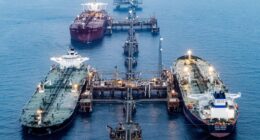
A container ship was attacked off the coast of Oman while transiting the Strait of Hormuz, through which a fifth of the world’s oil flows. Iran has closed the narrow passage in a bid to cripple the economies of America’s Arab neighbors.
In addition to oil, these countries, including Saudi Arabia, Bahrain, and the UAE, are dependent on the strait as they import up to 80 percent of their food.
The tempo of the strikes on Iran was so intense that state television announced the mourning ceremony for Ayatollah Khamenei would be postponed. Millions attended the funeral of his predecessor Ayatollah Ruhollah Khomeini in 1989.

An Israeli Air Force AH-64 Apache attack helicopter fires rockets while flying at a position along the border between northern Israel and southern Lebanon on March 4

Smoke rises from Israeli bombardment on the southern Lebanese village of Khiam on March 4

Foreign workers look at a tall plume of black smoke ascends following an explosion in the Fujairah industrial zone on March 3

Residents stand amid the debris of a building near a damaged car following airstrikes in central Tehran on March 4
Israel struck Tehran for a fifth consecutive day and hit Iranian-backed Hezbollah in Lebanon, while Iran fired on Bahrain, Kuwait and Israel.
Israel said it hit buildings associated with Iran’s Basij, the all-volunteer force of the paramilitary Revolutionary Guard that conducted a bloody crackdown on protesters in January that killed thousands and saw tens of thousands detained in the country.
The Israeli military also said it hit buildings associated with Iran’s internal security command, which also has suppressed demonstrations in the past. It also pounded towns near Beirut.
Israel and the US have said they want to see the Iranian public overthrow the country’s theocracy, and strikes against counterprotest forces are likely part of that effort.
Iranian state television showed the ruins of buildings in the center of the capital of Tehran, with interviewees saying the attacks damaged their homes.
Strikes have also been reported in Qom, the holy Shiite seminary city, hitting a building associated with the clerical panel set to pick Iran’s next supreme leader, Iranian media reported. It was said to be empty at the time.
State TV has begun calling the conflict the ‘Ramadan war,’ a nod to the holy Muslim fasting month now underway, but the framing also signals that leaders are bracing the public for a long fight.
Adm. Brad Cooper, the top US military commander in the Middle East, said American forces have damaged Iran’s air defenses and taken out ballistic missiles, launchers and drones.

This US Navy handout photo released by US Central Command public affairs shows an F/A-18E Super Hornet, attached to Strike Fighter Squadron (VFA) 151, preparing to launch from the flight deck of Nimitz-class aircraft carrier USS Abraham Lincoln (CVN 72) in support of Operation Epic Fury on March 2

Smoke rises after a strike on a building which the U.S. Central Command reported as a strike on the Islamic Revolutionary Guard Corps (IRGC) headquarters, amid the U.S.-Israel conflict with Iran, in Tehran, Iran in this screengrab obtained from a social media video released on March 2

This image provided by U.S. Central Command shows a EA-18G Growler preparing to launch on the flight deck of the USS Abraham Lincoln (CVN 72) in support of Operation Epic Fury on Monday, March 2

This US Navy handout photo released by US Central Command public affairs shows an F-35C Lightning II, attached to Marine Fighter Attack Squadron (VMFA) 314, chained down on the flight deck of Nimitz-class aircraft carrier USS Abraham Lincoln (CVN 72) in support of Operation Epic Fury on March 2
Israeli military spokesman Brig. Gen. Effie Defrin said such damage has led to a decline in launches from Iran.
Still, explosions echoed in the skies over Jerusalem on Wednesday. Israel’s military said Iran launched missiles toward the country, and Hezbollah sent rockets.
Iran has also struck around the region, and air sirens sounded Wednesday across Bahrain, home to the US Navy’s 5th Fleet.
A resident of Tehran, who runs a clothing shop, said he didn´t know how to protect himself from the bombing.
‘It’s very difficult to decide what to do. If I leave the city, how am I supposed to earn money and survive?’ said the man, who spoke on condition of anonymity for the fear of reprisals.
Iran’s Revolutionary Guard issued its most intense threat yet, warning the strikes would result in ‘the complete destruction of the region’s military and economic infrastructure.’
Iran’s leaders are scrambling to replace Khamenei, who ruled the country for 37 years. It’s only the second time since the 1979 Islamic Revolution that a new supreme leader is being chosen.
Candidates range from hardliners committed to confrontation with the West to reformists seeking diplomatic engagement. Khamenei’s son Mojtaba has long been considered a contender, despite never having held an elected or appointed government post.
In a sign that Iran’s leadership will only seek to consolidate its power as it faces its biggest crisis in decades, the head of the judiciary warned Wednesday that ‘those who cooperate with the enemy in any way will be considered an enemy.’
How Washington would respond to a successor cast in Khamenei’s mould remains unclear. Trump said the ‘worst case would be do this, and then somebody takes over who’s as bad as the previous person.’
Iraq, which borders Iran, was taking steps to prevent Iranian opposition groups from breaching the border.
There are a significant minority of Shiite Muslims in Iraq, the dominant sect in Iran, and any instability in the region can spark sectarian violence.
The moves come amid reports that the CIA is seeking to arm Kurdish militia groups inside Iraq to foment an uprising in Iran.
Iran’s borders are made up of diverse ethnic groups and any loss of central power by the dominant Persians, who control the government, could spark a civil war.
An Iraqi official warned that ‘mischief and deception by the United States in the region will come at the cost of the complete destruction of the region’s military and economic infrastructure.’
Canadian Prime Minister Mark Carney has described the war as an extreme symptom of a rupturing world order in which nations act with mounting disregard for international norms and law, speaking at the Lowy Institute, a Sydney-based international policy think tank.
‘Geo-strategically, hegemons are increasingly acting without constraint or respect for international norms or laws while others bear the consequences. Now the extremes of this disruption are being played out in real time in the Middle East,’ Carney said.
But whether the US and Israeli airstrikes on Iran broke international law was ‘a judgment for others to make,’ he added.