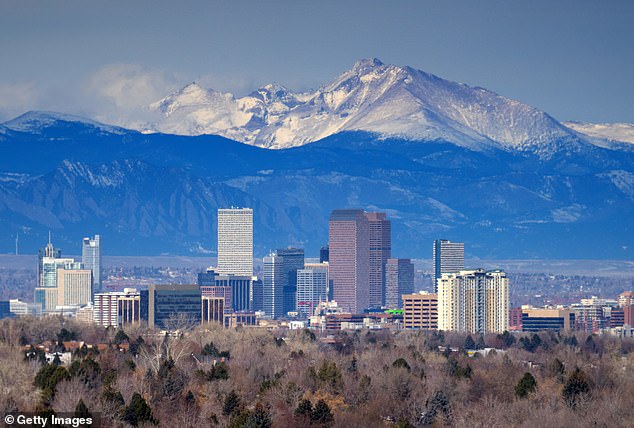

For years, Denver was one of America’s great success stories.
Drawn by its snow-capped mountain backdrop, thriving economy and coveted outdoor lifestyle, thousands of Americans flocked to Colorado’s capital during and after the pandemic. Home prices surged, cranes filled the skyline and developers raced to keep up with demand.
Today, the picture looks dramatically different.
Downtown office towers sit eerily empty. Storefronts remain vacant. Housing prices are under pressure after years of rapid construction. Denver now holds an alarming title: the highest downtown office vacancy rate among the nation’s 50 largest cities.
The city’s struggles have become a cautionary tale for urban centers across America grappling with the long-term consequences of remote work.
‘We had our real heyday, and now we’re paying for it,’ veteran Denver real estate executive Bill Mosher recently told The Wall Street Journal.
According to CBRE data cited by the Journal, nearly 40 percent of office space in Denver’s central business district now stands vacant, creating concerns that the city could become trapped in the same urban ‘death spiral’ facing other struggling downtowns.
Yet, amid the gloom, city officials, developers and architects insist Denver’s story is far from over.

A view of the downtown Denver skyline, which has snow-capped mountains as a backdrop

An aerial view of a neighborhood in Denver, where home prices once surged and developers raced to keep up with demand

Otis Odell, housing sector leader at architecture and engineering firm HED
One of those voices is Otis Odell, housing sector leader at architecture and engineering firm HED, who said Denver’s current troubles are largely the result of its own extraordinary success.
‘Denver definitely experienced a solid uptick as people moved from more expensive markets during the pandemic,’ Odell told the Daily Mail.
The city’s combination of outdoor recreation, quality of life and relative openness during COVID restrictions made it particularly attractive to newcomers fleeing coastal markets.
As migration accelerated, builders responded.
‘Building continued as population grew, and housing costs increased accordingly,’ Odell explained.
But eventually the market tipped too far.
‘Housing costs were rising with increases in rent outpacing increases in wages. Eventually, the housing market was oversupplied’ Odell said.
Andrew Fortune, who owns and operates a real estate brokerage in Colorado Springs and regularly works in the Denver market, said the city’s troubles did not emerge overnight.
‘Denver benefited from lifestyle migration, remote workers, low mortgage rates and a strong “move west” narrative during the pandemic,’ Fortune said. ‘That pushed prices ahead of what many local buyers could afford.’

A view of Denver’s downtown cityscape, where office towers now sit eerily empty and storefronts remain vacant

Andrew Fortune, who owns and operates a real estate brokerage in Colorado Springs and regularly works in the Denver market
According to Fortune, the market has now shifted from what he describes as ’emotional buying’ to ‘payment-sensitive buying,’ with prospective homeowners paying far closer attention to monthly costs, insurance premiums, HOA fees, taxes and commuting expenses than they did during the frenzy of the pandemic boom.
The result has been a cooling market.
Many multifamily developments are still offering incentives and concessions to attract renters, while population growth has flattened considerably.
Together, those factors have put downward pressure on both rents and home values.
The housing slowdown is occurring alongside downtown’s office crisis.
On a recent afternoon, developer Asher Luzzatto stood atop one of the city’s office towers admiring panoramic Rocky Mountain views. Below him, though, existed a world of darkened office floors, empty buildings and quiet streets.
Luzzatto recently acquired the massive Energy Center office complex for just over $5 million – an astonishing 97 percent discount from what a previous owner paid roughly a decade ago.

Denver now holds the title of highest downtown office vacancy rate among the nation’s 50 largest cities

A view of the Denver skyline. Some fear the city has become a cautionary tale for urban centers across America grappling with the long-term consequences of remote work
The collapse in value reflects a fundamental shift in how Americans work.
Denver’s economy historically benefited from growth in technology, telecommunications, finance, energy and professional services. Those sectors, Odell said, have also proven among the most receptive to hybrid and remote work arrangements.
As workers stopped commuting into the city center five days a week, demand for traditional downtown office space evaporated.
But that’s not necessarily the devastating sign some believe it to be.
‘Weak office occupancy does not always mean the job market is collapsing,’ Fortune argued. ‘It often means the job market has changed where the work happens.’
Many of Denver’s professional, technology, finance and energy jobs still exist and continue supporting the regional economy, he said, but they no longer generate the same weekday foot traffic that downtown businesses once relied on.
In many ways, Denver became a victim of changing work habits.

Denver’s Lower Downtown district, where commuter railways cut through the landscaping. The city’s combination of outdoor recreation, quality of life and relative openness during COVID made it particularly attractive to newcomers fleeing coastal markets

Homes in Denver’s Central Park neighborhood
The city’s culture has long revolved around outdoor pursuits, from skiing and mountain biking to hiking and climbing. For many workers, flexible schedules proved difficult to give up.
While downtown foot traffic has fallen significantly since 2020, Odell argued reports of Denver’s demise may be overstated.
‘Many city organizations and government agencies are actively working to address the issue and find ways to invest in downtown Denver,’ he said.
Major sports venues, entertainment districts and general tourism continue to draw large crowds into the city center, even as traditional office occupancy remains weak.
Fortune also cautioned against portraying downtown as completely deserted.
‘It’s definitely not empty,’ he said. ‘The problem is uneven activity.’
He noted that restaurants may be packed before a sporting event, concert or convention while nearby streets remain quiet on weekday mornings, creating the perception that the area has lost the predictable rhythm of office workers.
Still, few dispute that downtown requires reinvention. That is where Luzzatto’s ambitious vision enters the picture.

A home in Denver, where pandemic migration accelerated, and builders responded to meet the demand

Nearly 40 percent of office space in Denver’s central business district now stands vacant
Rather than waiting for office workers to return, the 38-year-old developer believes cities must fundamentally rethink their downtowns.
His plan is to convert large portions of several nearly empty office towers into roughly 1,100 apartments. Beyond housing, he envisions bookstores, art galleries, daycare centers, community spaces and family-oriented attractions.
The strategy represents a dramatic reversal of the formula that shaped American downtowns throughout much of the 20th century.
Instead of building city centers around office workers who leave every evening, the goal is to create neighborhoods where people actually live.
‘Office-to-residential conversions can help to revive downtown, and it is only part of the solution,’ Odell said.
Fortune does believe conversions could play an important role, but warned against viewing them as a silver bullet.
Many older office towers present significant challenges because of their layouts, plumbing systems, window placement, elevator configurations and financing requirements, he said.

Denver is currently facing a downtown office crisis, but some are plotting ways to fix it

Homes in Centennial, a suburb of Denver

Denver’s baseball stadium, Coors Field – one of several major sports venues continuing to draw large crowds into the city center
He also warned that filling former office buildings exclusively with luxury apartments may not solve broader affordability concerns.
‘The better outcome is a mix of uses,’ Fortune said. ‘Downtown needs housing, yes, but it also needs safe streets, useful public spaces, small business support, events and reasons for people to come in even when they don’t work there.’
Odell said the broader answer lies in what planners call ‘integrated placemaking.’
That means combining housing with public gathering spaces, entertainment venues, outdoor recreation opportunities, restaurants, ‘multi-generational playgrounds’ and mixed-use developments.
Denver officials are increasingly embracing that approach. The Downtown Denver Development Authority recently approved a $63 million loan to support Luzzatto’s plans – the largest loan in the agency’s history. City leaders have also explored converting underused office buildings into housing as a way to address both vacancy and affordability concerns.
Still, challenges remain significant as construction costs are high and financing is difficult.
But supporters argue the alternative – allowing downtowns to continue hollowing out – is far more costly.
For Odell, Denver’s future ultimately depends on its ability to adapt. ‘It is not too late,’ he said.

A view of neighborhoods in Centennial

The Denver area is known for offering many year-round outdoor activities

The Denver city skyline, where some propose turning office towers into housing
He believes the city retains the very qualities that made it attractive in the first place.
The question now is whether Denver can transform itself quickly enough to avoid becoming a permanent symbol of urban decline.
If the experiment succeeds, the city may become a blueprint for how downtowns across the country reinvent themselves in the age of remote work.
But if it fails, Denver could become a warning.
The challenges facing Colorado’s capital are hardly unique. Across the country, office towers built for a five-day-a-week workforce are struggling to find tenants, while city leaders grapple with how to keep these districts vibrant.
From Portland and St Louis to Chicago and Washington, DC, officials are wrestling with the same question: How do they replace the economic engine that once powered restaurants, retailers and office landlords?
It remains to be seen whether Denver can provide the answer.