
Joe Tracini fought back tears as he emotionally discussed the sexual abuse he suffered as a child, admitting he ‘suppressed’ the ordeal for many years.
The former Hollyoaks star, 37, who is the son of comedian Joe Pasquale, first spoke about his abuse in the documentary Me and the Voice in My Head in 2024, where he also opened up about being diagnosed with Borderline Personality Disorder (BPD).
In a new interview, Joe shared the reason why he failed to speak about being abused until he reached his 20s, adding he still ‘gaslights himself’ due to his diagnosis.
Joe was diagnosed with BPD 12 years ago – a condition that leads to intense, unstable emotions, chronic insecurity and intrusive thoughts.
He previously shared that he was sexually abused at the age of eight, saying at the time he was ‘sick’ of being the only person who knew about it.
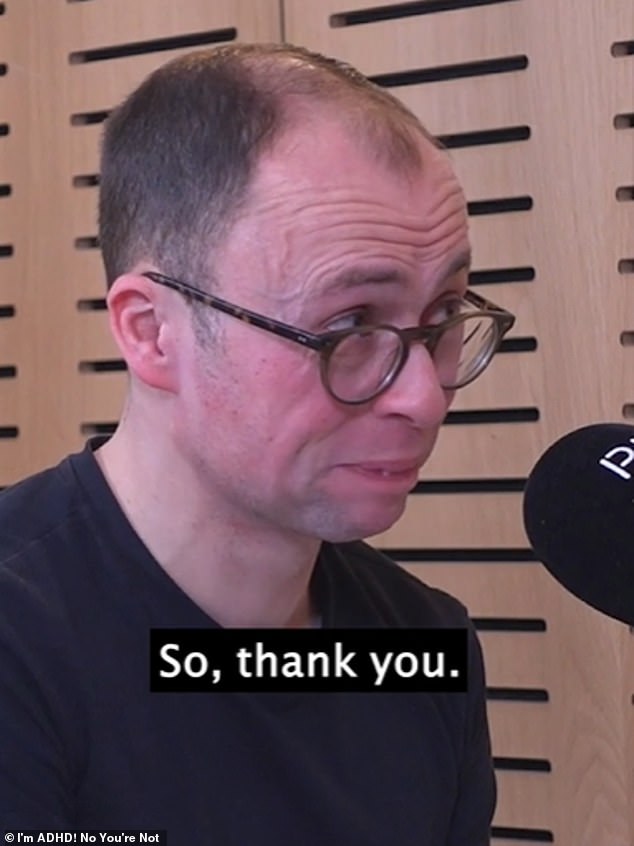
Speaking on the I’m ADHD! No You’re Not podcast, Joe spoke to hosts Paul Whitehouse and his wife Dr Mine Conkbayir, a neuroscientist, about his decision to omit the abuse from his 2022 memoir.

Joe Tracini fought back tears as he emotionally discussed the sexual abuse he suffered as a child, admitting he ‘suppressed’ the ordeal for many years

The former Hollyoaks star, who is the son of comedian Joe Pasquale, first spoke about his abuse in the documentary Me and the Voice in My Head
Mine said: ‘ I just wanted to understand how mindful you are… do you allow yourself the space in your mind and your body to go, ”This did happen, I’m f***ed up over it, it hurt me, it really did. It still has an impact on me.”
I read about it [sexual abuse] on page 140 or something when you’re in your early twenties, but obviously at that point you don’t mention the eight year old being abused.
‘To me, I trace everything back pretty much to that.’
Joe then said: ‘Yeah, same. And I think I knew, I’ve always known that happened. I didn’t put it in the book and I…’
‘The one when I was in my twenties became the story that I told people maybe as some sort of outlet to kind of… Not that it was a good thing that happened to me.
‘But it was… I always knew there was something. I always knew it was that, not that I ever thought about it explicitly or the details of it or anything like that, but I’ve always known as I’ve gotten older and wanted to kill myself that it’s probably related to the thing in the loft.
‘I think I wanted talking about what happened to me in my twenties… to be enough. To process that by talking about that. I wanted that, it’s not a nice thing to talk about in itself, but…’ with Mine noting it was ‘easier than when he was eight.’
The actor continued: ‘There’s a lot that I hate about that one, but I think that… I don’t remember it in… I remember feelings.
‘There were certain specific things that I remember, but I don’t remember it like I remember other things that have happened in my life.’
Agreeing he ‘suppressed’ his abuse, Joe said: ‘And I think because with my brain, how it is, I question reality and with the paranoia and things like that.
‘So in my head, you’re like, ”Are you making it up?” ”Did you make that up?” I’m gaslighting myself. So it’s that constant, you know, it’s not a nice state to be in.
‘It’s not a nice place to go. Again, if I’m coping with the day-to-day reality of not killing myself, it’s not an alley that I want to pop down.

Speaking on the I’m ADHD! No You’re Not podcast, Joe spoke about his decision to omit the abuse from his 2022 memoir
‘Because I just never have. But again, I now understand all of those, you know, ‘Why isn’t this being the thing that fixes me?’ I’ve stopped the drugs, I’ve done all the things. It’s because I would’ve never spoken about that.’
Joe continued: ‘Directly related to your question, in the documentary what you see is me saying it out loud for the first time.
‘Because I told them, ”There is something I’ve not spoken about, keep asking me”. And they did. That was the fourth time they asked me in the time they were with me. I’m proud that I spoke about it.
‘I also like the fact that I left in that I think about it and I can see past me sitting on a bench going, ”Okay. You know, just say it”.
‘I know that of course that’s the cause of it. Of course that is. It’s very obvious to me and always has been, even if I’ve not admitted it. Because part of admitting that means you’ve got to talk about it. You’ve got to deal with it.’
‘And I know that there is nothing I can do on my own when it comes to that. If I could sit here, if I could go through it and sort it out or think about it, I would. But I can’t – I don’t know how to. I don’t know what to do with what feels like limited information I have in regards to that.
‘That’s not a nice place for me to be. I don’t feel comfortable knowing that about myself because I’m quite good… I’m not good at loads of stuff, but one of the things is talking about s**t and nowadays dealing with it. And I can’t seem to talk or deal with that.’
Joe admitted he’s never discussed his abuse with a psychiatrist, telling Mine and Paul: ‘What’s insane is this is the most I have ever sat and spoken about it with people that give a s**t.
‘Not that I’ve sat and spoken about it with people that don’t care – I’ve not spoken about it at all. Given that four minutes ago we were talking about Tom Jones’ chest hair, I love that I feel safe enough to do this with you both.
‘Because I do know that you care and it’s lovely. And again, I’m glad that you are affirming how I feel. Because I do feel like it’s because of that. Definitely not my fault.’
Mine shared: ‘You’ve gotta separate the threads, and that bit’s the A DHD and that’s the BPD (Borderline Personality Disorder). And I’m like, no. You know, you speak about erectile dysfunction, you speak about the intimacy issues, all of this. I’m like, it’s a sexual abuse.
‘He hasn’t resolved it. And it’s just, I was so desperate to get it out and share it with you in a way that is safe.
‘And hopefully, you know, maybe one day you are able to sit with someone and unpack it. ’cause you say you’ve got limited information that’s clearly because you’ve pushed it all right down, which I understand.
‘Again, you were alone. You’ve developed coping mechanisms that have kept you alive, you know, and that’s outstanding, that’s to be commended.
‘But I just hope that one day you feel able to just explore it a little bit more, just to give it the words to process the emotions and it will help you to move forward a little bit more. ’cause I just see the way you are, you experience physical flashbacks. You know, the emotional flashbacks.
‘I see it in you. I’ve watched you a lot. I’ve read this, you know, back to all of it. And you are still triggered deeply. So when, when people say BP D I’m like, it’s unprocessed childhood trauma and it’s probably the worst violation. But like you said, your foundation is good.
‘My, you know, similar upbringing. Very chaotic, but unconditional love in my mother. You know, you went through something no child should have gone through and you’re probably feeling that anger, the resentment, the dirt, the guilt, the shame.
‘None of that’s yours, you know? And so that’s why I just wanted to chat about this BPD bollocks and say it’s unprocessed trauma. It’s tough to survive and want to live.’
Joe then fought back tears as he said: ‘Yeah. I didn’t know why you asked me to come here today. I thought I was coming just to do a podcast.
‘I did not know you were coming… I was coming for you to tell me that, so thank you, because it does mean a lot. It does mean a lot.
‘Normally you just come in to talk about the tour. Thanks for getting that out the way at the beginning.’
‘I know, you told me about it! I, it’s good to know it’s there! Any questions that I had as they came up then, you answered.
‘So I haven’t really got anything more to say apart from the fact that I’m really glad that you think that it would help me to do that, to talk about that, because there is no part of me, even though I sort of do understand that, I don’t understand how that would possibly happen.
‘I don’t know, because I don’t feel like I’ve got the tools to access it, to talk about it and do the things that you need to do.’
Joe’s father previously said he feels ‘to blame’ for his son’s mental health struggles, which saw him attempt suicide six times.
As a teenager, Joe’s struggles with BPD resulted in him battling a heavy drug addiction, leaving home for weeks at a time.
Speaking in his son’s Channel 4 documentary, Pasquale admitted that he in part felt ‘to blame’ for Joe’s struggles – but still saw BPD only as a matter of ‘looking at things differently’.
He told his son: ‘You didn’t come home for weeks and weeks and weeks and you made some not good decisions for yourself.
‘I was in denial of it for a long time but it shouldn’t have got to that point. I should have stopped it earlier and I didn’t. I was too busy working if I’m honest.
‘It feels horrendous. Every time the phone rings, I still think oh s***. There’s a part of you that’s very dark inside and wants to end it. I don’t have that in me and I wish you didn’t have it in you.
‘For me, I’m going what did I do wrong to adopt that lifestyle of not wanting to be here.’
In the documentary, Joe hinted that he himself experienced a traumatic event akin to sexual abuse, which has affected him to the extent he ‘doesn’t talk about it’.
As he looked deeper into his childhood, Joe recalled that when he was around seven or eight, a man had told him to take his clothes off.
As he broke down in tears, he remembered that the harrowing incident had involved ‘dice’ and the different numbers rolled had meant he was made to do different things.
‘I was broken, not just by me, by people and stuff,’ he reflected.
I’m ADHD! No You’re Not is available on all podcast platforms now.
If you have been affected by this story, you can call the Samaritans on 116 123 or visit www.samaritans.org.