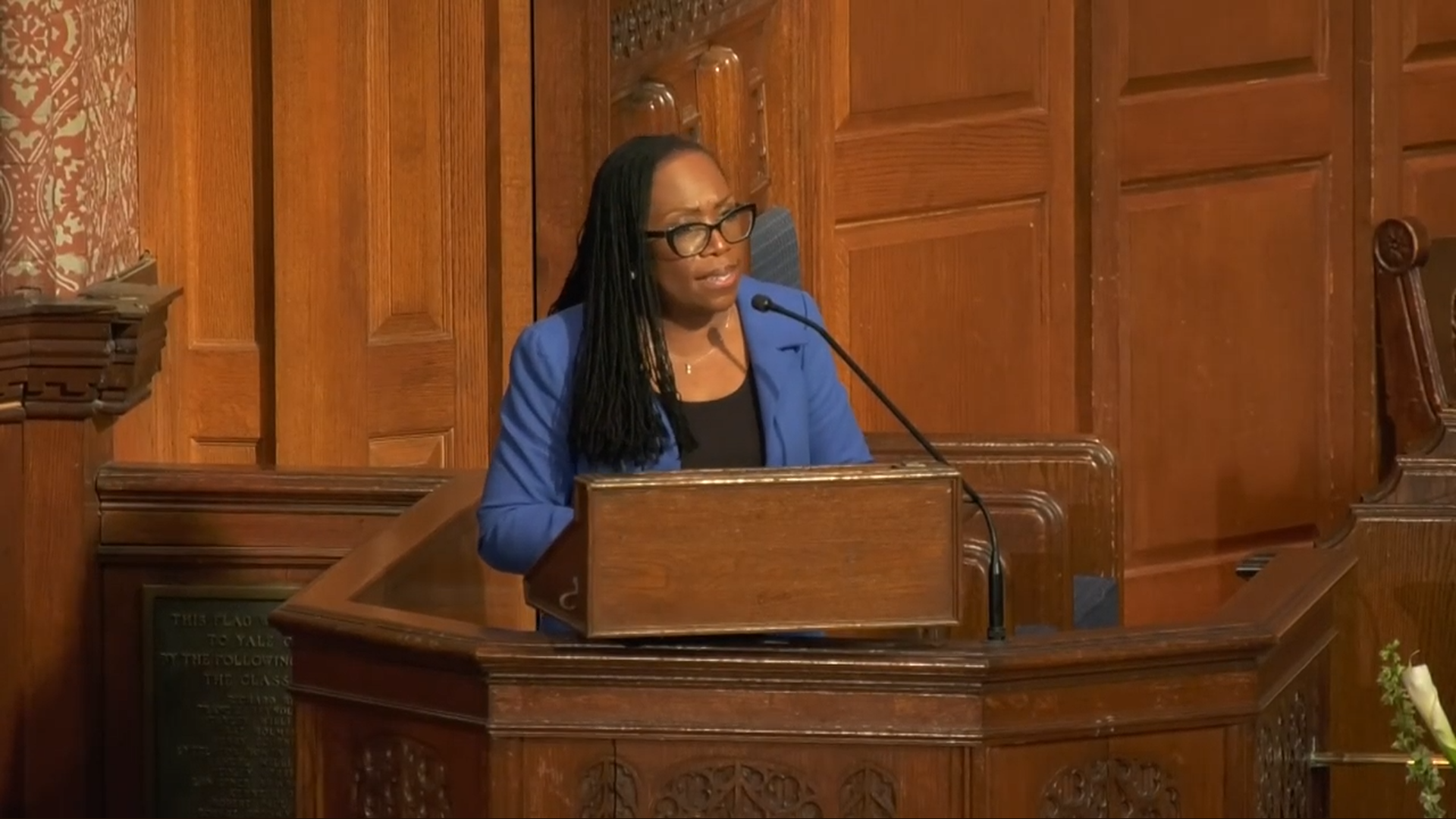

Supreme Court Justice Ketanji Brown Jackson ran a not-so-subtle defense of leftists’ judicial coup against President Trump on Tuesday by downplaying the harms it poses to presidents’ executive power. The moment came during a lecture the junior justice gave at Yale Law School about the Supreme Court’s emergency (or “interim”) docket.
In her speech to attendees, Jackson openly criticized her colleagues for their handling of cases that come before the court’s emergency docket. She more specifically chastised SCOTUS for its granting of emergency applications that request a stay (“pause”) of lower court injunctions and for the lack of legal explanation that comes with such decisions.
Unlike the traditional merits docket, in which fully litigated cases are heard and decided by the justices on the merits of the issue(s), the emergency docket deals with cases that are still undergoing consideration in the lower judiciary. These interim decisions — which often come with little legal explanation to avoid a “lock-in effect” — are not final verdicts on the merits of the cases but are preliminary judgments that target specific lower court actions until these matters can be fully litigated.
Jackson’s criticism was clearly a jab at the court’s conservative majority, which has often approved applications filed by the Trump administration to stop overreaching injunctions by rogue lower court judges. And yet, such critiques were not even the most notable part of Jackson’s remarks.
During her post-speech interview, the Biden appointee was asked by Yale Law School Dean Cristina Rodríguez about the Trump administration’s arguments that there is a “concept of harm that the inability of the president to be able to utilize his power is itself a harm.” Put another way, the president will suffer irreparable harm to his constitutional authority if a given lower court injunction on one of his policies or orders is permitted to remain in place.
“What relevance does that [argument] have in the calculus of harm?” Rodriguez asked.
Citing her past experience as a district court judge, Jackson argued that “harm has to be evaluated relative to what is happening in a concrete way with respect to facts on the ground.” She then brazenly brushed aside any serious concerns about a lower court’s infringement upon the executive’s constitutional authority by saying, “Something like constitutional harm is too abstract to drive this kind of analysis.”
“Constitutional harm is little more than a legal concept, and we have an underlying legal process that is supposed to be determining whether or not the president or whomever has violated the law,” Jackson said. “The President of the United States, although he may be — in this hypothetical that you’ve [Rodríguez] posed — harmed in an abstract way by not doing what he wants to do, he certainly isn’t harmed if what he wants to do is illegal, right? He doesn’t have the ability to do something unlawful.”
The Biden appointee went on to contend that the “point of the merits proceeding” is for courts to “determine” whether the challenged policy or action a president undertakes is lawful. She further claimed that, under this argument, “the interim relief proceeding really has to be about something else.”
“And the something else is: Are we going to allow him to do this thing … that is being challenged in the interim, while we are evaluating whether or not that thing is lawful? And the only way to make that determination without having it just completely collapse into forecasting the merits is to focus on what is going to happen if he does this thing — concretely — in the real world, versus not,” Jackson said. “What I would be looking for as a district court judge is the government explaining to me the need for them to implement this policy right now — in concrete ways — and therefore the harms that would befall the government or the public if they don’t do it now.”
So much for that “judicial restraint” she mentioned in her speech.
If such argumentation sounds familiar, it should. It’s the same “imperial judiciary” Jackson advocated for in her unhinged solo dissent in the Supreme Court’s 2025 decision (Trump v. CASA) limiting lower courts’ use of nationwide injunctions.
Under Jackson’s worldview, the executive branch is not autonomous at all. Rather, it’s wholly subservient to the whims of unelected lawyers in black robes, who get to decide whether to “allow” an independent branch of government to carry out its constitutional authority.
This Jackson-esque line of thinking completely flips the Constitution’s establishment of separation of powers on its head. It advances the judicial supremacist philosophy that courts have unlimited power to micromanage the other two branches of government with virtually no check on their own authority.
The judiciary plays an important role in America’s system of government. But that role is not one that is supreme to the legislative and executive branches.
Jackson’s dismissive attitude to the “real world” harms that lower courts’ overreaching actions have on the executive’s constitutional authority raises alarm bells. Given her track record on the bench thus far, however, it’s not the least bit surprising.
Shawn Fleetwood is a staff writer for The Federalist and a graduate of the University of Mary Washington. He is a co-recipient of the 2025 Dao Prize for Excellence in Investigative Journalism. His work has been featured in numerous outlets, including RealClearPolitics and RealClearHealth. Follow him on Twitter @ShawnFleetwood